
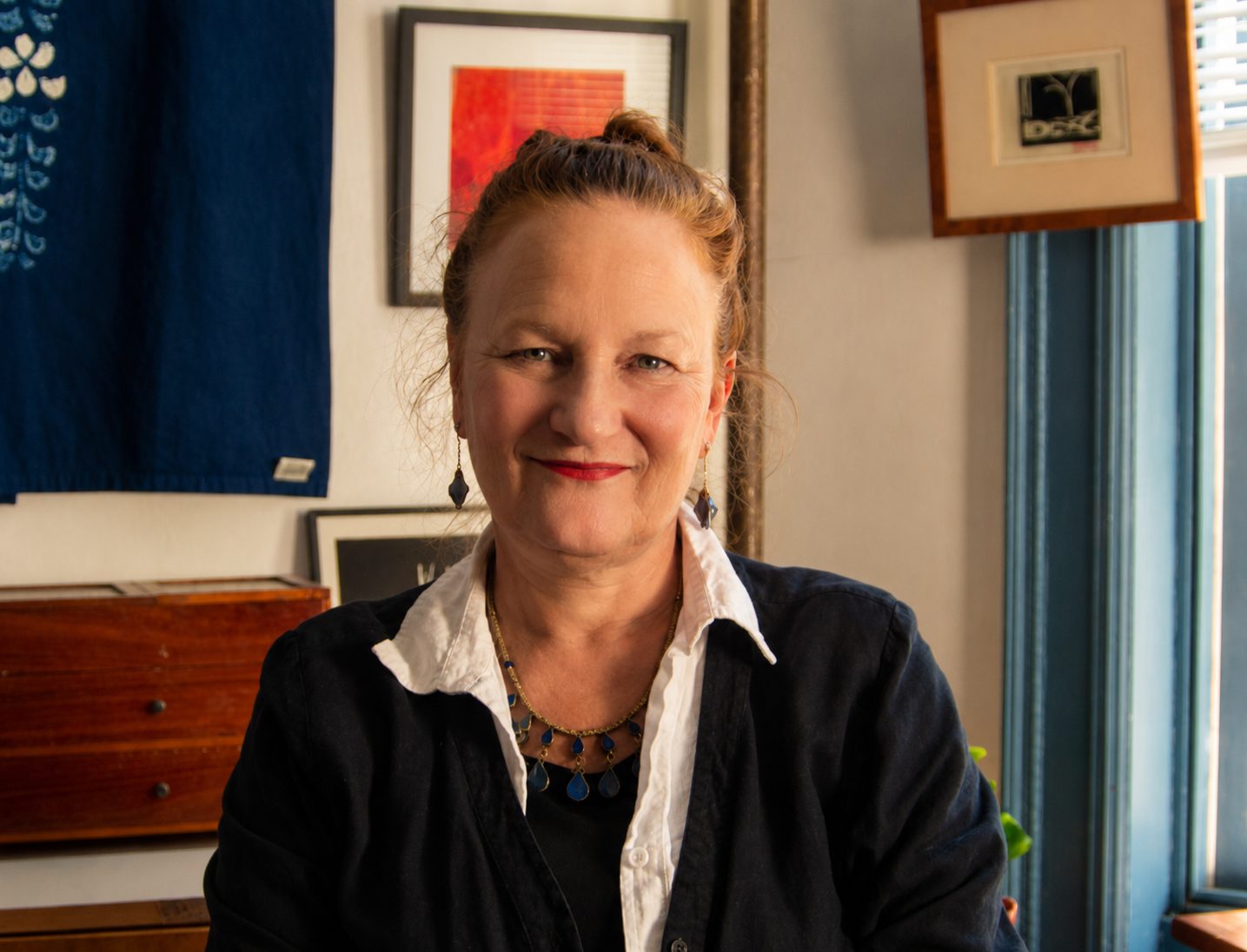
INTERVIEW SERIES: Beyond the Frame — A Journey into Cinema, Storytelling, and the Depths of Human Experience INTERVIEWER: Gökhan Çolak | INTERVIEWEE: Amy Guggenheim

Many of your films explore the relationship people have with themselves and the world around them. Do you believe self-knowledge is ever fully attainable, or is it an endless pursuit?
I believe there is something constant in us, but the way it gets lived out is always changing. We are shaped first by family, childhood, early wounds, love, fear, and the stories we inherit about who we are and what is possible. Those early imprints matter deeply, but they are not the whole story. We keep changing, growing, resisting, repeating, and transforming.
My feature film Blindsight, which I’m currently putting together, is very much about this: how we internalize stories that shape how we see ourselves, the world, and our place in it. A crucial part of becoming free is recognizing that some of those stories may not truly belong to us. We may even be living from someone else’s point of view. For me, self-knowledge begins when we can see those inherited narratives clearly enough to question them. Then we can begin to claim our own perspective and create our own story. But that story keeps evolving as we live. The self is not something we arrive at once and for
all; it is something we are continually discovering, revising, and becoming. In that sense, self-knowledge is an endless pursuit—and we are endlessly changing with it.
Blindsight challenges conventional ideas of seeing and knowing. Were you more interested in exploring blindness itself, or in questioning how sighted people construct reality?
Blindsight is actually different from blindness. Blindsight describes a condition in which a person sees something but does not consciously know that they have seen it. This can result from a lesion in the brain, but it can also describe a psychological process in which something is kept from conscious awareness because it is too painful, threatening, or difficult to face. In either case, what is seen remains outside conscious knowledge.
For that reason, I was interested less in blindness itself than in the relationship
between perception, attention, and awareness. What does it mean to see? Is
sight simply the registration of visual information, or does it require attention,
interpretation, and meaning? We often assume that seeing and knowing are the same thing, but they are not. It was important to me that the main character begins as someone who is sighted. Through her encounter with vision loss, she becomes more aware of the act of seeing itself and of how meaning is created from what we perceive. The film asks not only what we see, but what we fail to see, what we refuse to see, and what remains hidden in plain sight.
At the same time, other characters in the film who are living with vision loss help guide her toward a deeper understanding of sight, blindness, adaptation, and ultimately her own perspective. Their experiences challenge many of her
assumptions about seeing and not seeing. In that sense, the film explores
awareness as an essential dimension of vision itself. Seeing is not only a matter of what reaches our eyes, but also of what we are able to recognize, attend to, and make meaning from. The film is ultimately about learning to become aware of what has always been there and, through that awareness, finding one’s own way of seeing the world.

As a storyteller, what aspects of human nature continue to fascinate you the most? Is there a question you find yourself returning to throughout your work?
I think the aspect of human nature that fascinates me most is ‘irrationality’.
I’m drawn to the parts of ourselves—myself included—that seem beyond
conscious control: the irrational, the intuitive, the contradictory, the absurd. We
often like to imagine that we are guided by reason, but so much of our lives is
shaped by desires, longings, fears, habits, and impulses that we only partially
understand. I never cease to be surprised by the things people do, or by the
things I do, in pursuit of what we need, fear, or love.
This connects directly to the question of awareness that runs through much of my work. I keep returning to the gap between what we think we know about
ourselves and what is actually driving us. At its core, my work is often about how reality is shaped by our hidden needs, unspoken hopes, and private terrors—and how those inner forces become someone else’s external world. The stories we tell ourselves, and the stories we cannot tell ourselves, have an extraordinary power to shape how we live and how we see.
Having lived and worked across different cultures, particularly in Japan, how has your understanding of belonging evolved over time?
I think that traveling from a very young age with parents who were genuinely curious about the world, other cultures, and other people gave me a sense that we belong to one another—that we share one world.
My first memory of travel is from when I was five years old, visiting Mexico City. I remember walking through an open-air market. There was meat, herbs, live animals. The smell was overwhelming—strange, pungent, and at first a little frightening. Then I became fascinated by it.
A little later, I saw a young girl selling walnuts that opened on tiny hinges. Inside each one was an intricate miniature scene—a wedding, complete with tiny figures and sparkling walls. I was mesmerized. That image has stayed with me my entire life.
As I grew older, I came to understand that we don’t encounter one another outside of history. Each of us inherits different stories, losses, privileges, and ways of seeing, shaped by larger cultural and geopolitical forces. Belonging is not about erasing those differences, but learning to listen across them and allowing them to deepen our understanding of one another.
When I think about belonging, I think about moments like that—moments when something unfamiliar moves from fear to curiosity to wonder. Those moments of shared wonder, and the openness they invite, are where belonging lies: in the encounter itself.
When Night Turns to Day is deeply connected to kendo and the idea of a lifelong path of practice. What drew you to that world as a filmmaker?
As I return to this project, its title has become Holding the Center, and that change gets to the heart of what draws me to kendo as a filmmaker.
At its core, kendo is a practice of entering the unknown and remaining present there until it becomes clear how to respond. It is a martial art, but for me it is also a model for art-making and for life. You step into a situation that cannot be fully controlled or predicted, and you learn to meet it with attention, discipline, and responsiveness.
Kendo is also practiced between two people. In Japanese aesthetics there is the concept of ma—the space between. That space is not empty; it is alive with timing, distance, tension, possibility, and relationship. It is something both people are responsible for creating and maintaining.
That idea lies at the center of the film. Holding the Center asks how we can find a better way of being together. How do we hold our aggression, fear, desire, grief, and longing without allowing them to overwhelm the space between us? How do we remain responsive rather than reactive? Kendo offers a beautiful metaphor for that question—not only as a way of fighting, but as a way of relating, creating, and living.

Some filmmakers see cinema as a form of expression, while others see it as a process of discovery. When you begin a new project, do you start with answers or with questions?
For me, art-making is both expression and discovery—for the filmmaker and for the audience. When a project begins, it often starts with a powerful but unnamed response to something—a situation, an encounter, an image. Usually it is an image of a person doing something. For reasons I don’t fully understand, it carries emotional and metaphorical weight for me, and I find that I can’t let it go.
The work then becomes a process of asking questions. Not questions I already know the answers to, but questions that emerge from living with that image over time. In many ways, my challenge is giving myself permission to follow those questions wherever they lead, especially when they take me into uncertainty. That’s the part I am both terrified of and excited by. The more unexpected the question, the more likely it is that I am getting closer to something alive.
At the same time, I do a tremendous amount of research. I try to immerse myself in the world I am exploring—not to become an expert, but to orient my own point of view. For Holding the Center, that meant practicing kendo in New York and Japan, filming it, speaking with senseis and students, and learning about Japanese culture, philosophy, tea practice, and performance traditions.
In the end, the film is neither the research nor the original image. It is the trace of a long encounter between them and my own life. The project may begin with a question, but the process of creation usually reveals many more. My hope is that the finished film does the same for the audience—that they leave not with answers, but with questions of their own to carry home with them.
There is a strong sense of intuition in your creative process. How do you know when to trust intuition and when to challenge it?
I think it is most important to trust intuition at the beginning of the process—so that something can exist at all. The initial impulse, image, or feeling often arrives before I understand it. If I question it too soon, I can talk myself out of discovering the unexpected. Later, I try to step back and look at the material more critically. What is connected? What is missing? What structure is emerging? That part of the process requires a different kind of attention. The challenge is knowing when a new idea—especially feedback from others—is
revealing something essential, and when the original intuition was actually the wiser artist.
For that reason, I do many drafts. Over time, I find that elimination reveals what matters. By removing what is unnecessary, the work gradually tells me what it wants to be. Directing requires a similar balance. Preparation is essential—the visual design, the work with actors, the understanding of the material. But once you’re on set, intuition becomes just as important. No amount of planning can replace the ability to respond to what is
happening live in front of you and with you. It’s a constant play between intuition and discovery, preparation and abandon.

Looking back at your body of work, is there a film that changed you more than it changed your audience?
Blindsight has definitely changed me in the making—particularly through its own subject matter. The film is, in many ways, about confronting what we see but do not yet know we see. In the process of making it, I found myself having to confront things in myself and in others that I hadn’t fully recognized or understood. It forced me to deepen my own point of view, both as a person and as an artist.
At the same time, I’ve learned an enormous amount about sight, blindness, and the ways we think about disability and ability. As these worlds have become more familiar to me, they’ve also become less abstract. What once felt unknown now feels much more human, nuanced, and present.
As for the audience, we’ll have to wait and see. The film is still being made, and we hope to release it within the next year and a half. But I can say with certainty that it has already changed me.
In an era increasingly shaped by artificial intelligence, what remains uniquely human about storytelling?
At least for now, I also think imagination remains uniquely human—not just the ability to recombine what already exists, but to venture into the unknown, the irrational, the mysterious, and what has not yet been imagined. AI has already proven itself extraordinarily powerful at solving problems. But many of the stories that matter most to me begin in absence—in longing, uncertainty, love, loss, and the knowledge that we will die.

Leave a Reply