
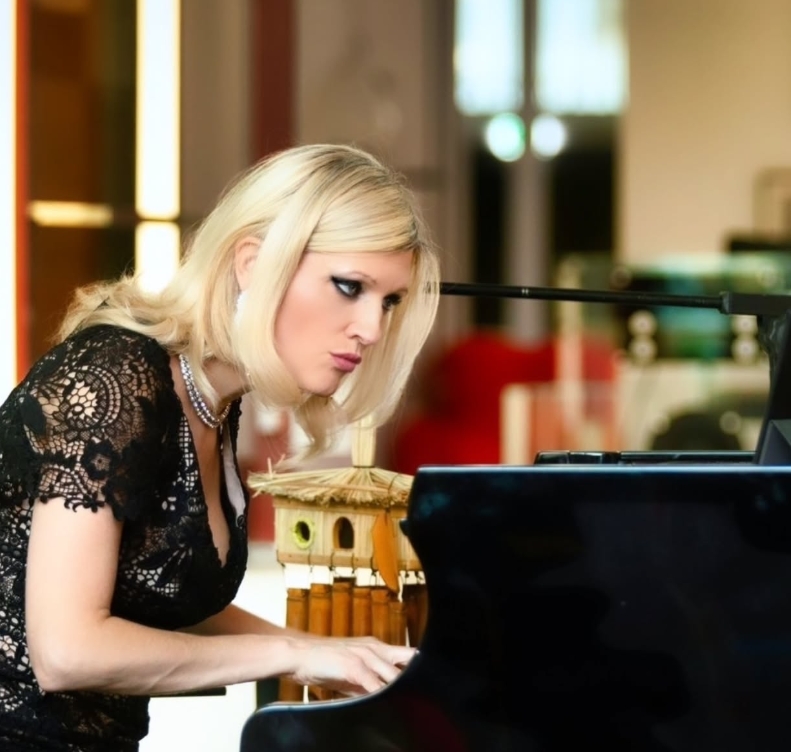
INTERVIEW SERIES: Creative Resistances and Interdisciplinary Music INTERVIEWER: Gökhan Çolak | INTERVIEWEE: Veronique Vanhoucke

Artistic Context & Identity
On stage, you define yourself as a “piano rebel.” How and when did you embrace this definition?
I started calling myself a “piano rebel” when I realized I didn’t want to fit into a single box. I love the richness of the classical tradition, but I also want to challenge and expand it by bringing in contemporary music, performance, and visual art. For me, being a “rebel” is not about destroying, but about opening new perspectives and surprising the listener.
A resistance rising from the piano refers, for me, to the choice of bringing classical music closer to people. I want to show that piano music is not only refined and traditional, but also surprising, energetic, and accessible to new generations. In doing so, I bring my identity with me: my programs, my style, my presence are consciously personal and distinctive. For me, this is not rebellion out of anger, but an act of freedom and self-awareness.
In a way, I feel connected to a tradition of rebels in music history. Think of Beethoven, who broke conventions and gave the piano unprecedented dramatic power, or later John Cage and George Crumb, who opened up the instrument and reinvented it. They all showed that true innovation comes from curiosity, courage, and honesty. For me, being a “piano rebel” is not a role or an image, but an extension of who I am.
It reflects my character: searching, free, and always slightly against the current. My rebellion is also an invitation to the audience: dare to step outside the beaten path, let yourself be surprised by a new experience. In this way, the rebel is not distant, but becomes a bridge to connection and discovery.
How do you think your appearance and presence on stage influence the distance or connection between performer and audience?
For me, stage presence is not only about how I play, but also how I exist as a person. My appearance, my femininity, and my personal style are all part of the story I want to tell. Music is never abstract to me: it always passes through a body, a glance, a gesture. Sometimes I deliberately play with distance, to create tension or to give the audience space to dive into the music. But most of the time I want to break the walls between stage and hall. When I show myself in both vulnerability and strength, an encounter arises that feels honest and direct.
I believe authenticity is the key: the more genuinely present you are, the more strongly the music can resonate. My presence is not something I “perform,” but an extension of who I am. It is that combination of playing, personality, and aura that makes the audience feel addressed, and that creates real connection.

Contemporary Music & Repertoire Choices
What does it mean to you to work with contemporary composers? How have figures like John Cage or George Crumb shaped your musical approach?
Working with contemporary composers means participating in a creative process that is still very much alive and in motion. There is a direct, intense bond between creator and performer: the music is not only transmitted, but actually shaped together. That immediacy is what attracts me.
Not only Cage and Crumb changed my thinking. Since childhood I have played contemporary composers: at first mainly atonal music and works with polyrhythms—not yet extended techniques or prepared piano. But even then, I was already making the link with visual arts. In the visual arts you have narrative works that tell a story, but also abstract movements, like Russian geometry, that break with convention. Cage and Crumb break musical patterns in a similar way. Cage explores the perception of time and sound, while Crumb opens the piano into a universe of colors and stories.
This is essential for me: contemporary music is not an ivory tower, but a living process. From my youth I learned that art—whether musical or visual—can always create space for new perspectives. It is an invitation to step off the pre-digested paths and to seek freedom, imagination, and authenticity again and again at the piano.
Your repertoire is rich and diverse. What guides your choices when selecting works to perform?
My repertoire often moves between two extremes. On one side, I feel deeply drawn to intimate, slow works that ask for silence and concentration. Like the work of artists such as Bill Viola or Mark Rothko, it is not about understanding everything immediately, but about taking the time to look, to listen, and to feel until the essence reveals itself. In such music, a single resonance or a single silence can open up an entire world.
On the other side, I seek the explosive, the overwhelming energy that hits you physically. A piece like The Blue Rider by George Crumb has, for me, the same power as a painting by Jackson Pollock or the raw expressivity of Basquiat: art that bursts with rhythm, color, and intensity, and that leaves you shaken.
These two extremes—the hushed intimacy and the eruptive energy—together form my identity as a pianist. They balance each other, and make every program into a field of tension where vulnerability and strength are constantly in dialogue.

Technology & Visual Art
How did the idea of combining piano with technology and visual art emerge, and how do you bring this integration to life on stage?
The idea came from my desire to approach the piano not only as an instrument of sound, but as a total artwork. For me, music is never just sound: it is emotion, movement, space, and image. I wanted the audience not only to listen, but also to see, feel, and almost “touch” what was happening.
Through projections, live video, and electronic processing, sound gains a new dimension. The images on stage are not illustrations of the music, but a second layer that deepens the interpretation. Sometimes they dialogue with the piano sound, sometimes they contrast it, creating tensions and new meanings.
This idea connects with a long tradition in art. Think of Kandinsky, who linked colors and shapes with music, or Oskar Schlemmer from the Bauhaus, who fused disciplines into total performances. Contemporary artists like Marina Abramović also show how art can touch both body and mind, while the collaboration between Philip Glass and Robert Wilson in Einstein on the Beach proved how image, music, and theater can form a unique ritual together.
On stage, I do not see myself only as a pianist, but as a performer in a larger visual landscape. The piano is literally made visible: playing on the strings, the movements of the hands, even the resonance of the sound receives a visual translation. For the audience, this opens an extra dimension of experience. It is like stepping into a painting that constantly transforms with the music—an experience that can be both intimate and vast. My goal is that music and image not only reinforce each other, but together create a new form of poetry, where the boundaries between disciplines dissolve.

Could you tell us more about your project “Metamorphoses”? How is the dialogue between the visual and musical elements structured in this performance?
“Metamorphoses” is a project centered on the music of George Crumb, in collaboration with Italian filmmaker and video artist Francesco Leprino. Each piece in Crumb’s cycle is inspired by a painting—from Whistler to Dalí to Kandinsky—so from the outset there is already a strong link between sound and image.
On stage, this creates a double dialogue. On one hand, there is the relationship between the music and the original artwork: the colors, forms, and emotions of the painting become audible in Crumb’s music. On the other hand, there is the encounter between my piano playing and Francesco’s live-manipulated visuals, which do not literally reproduce the paintings but transform, distort, and let them breathe anew in dialogue with the sound.
This ongoing interplay makes the concert a total experience. The audience steps into a universe where painting, sound, and video challenge and complement one another. For me, this connects to a longer tradition of the arts, where one has always searched for a Gesamtkunstwerk—a synthesis of disciplines where music, image, and imagination converge. Metamorphoses gives this a contemporary form: showing how music can transform into image, and how image can give music a new dimension.
Multidisciplinary Approach
In your collaboration with Tolga Baklacıoğlu and in your series “Seduced by Sound,” what kinds of stories do you aim to explore?
Together with Tolga Baklacıoğlu, I form a duo that deliberately seeks out and crosses the boundaries of genres. My classical piano playing and his experimental electronic soundscapes merge into a new universe, where acoustic finesse and electronic textures both challenge and embrace one another. Our inspiration comes from diverse sources—from Jean-Luc Godard to contemporary visual art—and through our Berlin-based label Noise à Noise we bring this cross-pollination to life. In a way, we connect to the legacy of Pierre Schaeffer, who with his idea of musique concrète showed how sound itself can become narrative and cinematic. Our live performances and recordings create evocative soundscapes that resonate beyond traditional divisions, where the listener can lose themselves as in a film or a dream.
With Seduced by Sound I address a different audience, but from the same idea of seduction and surprise. The series is twofold. On one hand, I want listeners to encounter a wide spectrum of music, from Bach to Crumb, and to experience how rich and versatile piano music can be. On the other, it is also about my identity and presence as an artist. I show that music is not separate from who I am on stage—my image, my femininity, my physical presence—and that this adds an extra layer to the experience. Each concert becomes a meeting: not only with the music, but with the person behind it.

You also use Instagram to visually express your artistic approach. How do you view these digital spaces as part of your artistic expression?
For me, Instagram is an extension of my artistic world. There I show the images surrounding my music: my photos, my style, my aesthetic. It is not a detached medium, but a window into my universe—a way of fully sharing my identity as an artist, where music, image, and personality flow together.
On Instagram, I often collaborate with photographers and present art photography that closely connects to my artistic language. I am a great admirer of Helmut Newton: his sensual yet classy black-and-white photography speaks to me deeply. That visual language parallels how I experience and perform music. The sensual toucher of the keys, the caress of the hands to draw out a certain sound, the breathing, the tension and release of muscles—my music arises from the body. The photographs are therefore not isolated images, but visual translations of the same emotions I put into my music. A continuum arises between my physical presence, my sound world, and the artistic images I share. For me, Instagram is not a separate world, but a stage where the same intensity and imagination are present as in a concert hall.
Personal Inspirations & Sources
Beyond what you express on stage, what are your personal sources of inspiration? How do, for example, travel or bodily practices (like Pilates) resonate in your art?
Travel opens my mind and gives me images, sounds, and stories that I bring back to the stage. When artists leave the familiar boundaries of their studio or home and immerse themselves in new environments, their creative canvas inevitably expands. Each destination carries its own influence on the artistic process: it offers a new palette of experiences and perspectives. For me, it is not only about landscapes or architecture, but above all about encounters. Conversations with people from other cultures shift my perception and open me to new sensitivities.
But inspiration is not only found far away: I also find it in people on the street or in a café. Their lives, their worries, their small joys—all of this is rich and inspiring. Sometimes a single gesture or a brief exchange can leave a greater impression than a long journey.
Bodily practices like Pilates also play an important role. What inspires me in the philosophy of Joseph Pilates, but also in the sculptures of Anish Kapoor, is that both work with the tension between inside and outside. Kapoor does this in his monumental forms, which draw you inward and confront you with emptiness and presence. Pilates does this through the body: not by foregrounding muscular strength, but by cultivating attention, breathing, and concentration. That is exactly how I experience Pilates in my own practice: as a way to awaken my body, to use it as a living instrument. Breath, tension, release, pressure, caress—these are also the pathways I use at the piano to create sound.

In your daily life outside the stage, do you have rituals or rhythms that nourish your creativity and artistic process?
Yes, I love silence in the morning, walks with my dog, simple rituals that ground me. They are small habits that help me be present and make space in my mind and heart. I often write down thoughts in notebooks, read poetry or books that nourish me, or lose myself in images of art. And I also listen a lot to music myself—sometimes simply in the bath, where I let myself be fully immersed in sound and find new energy.
I also cherish the pleasures of daily life: good food, a fine pastry, a fragrant cheese or a glass of wine. I love to cook; for me it is equally a creative practice, a way to experiment with flavors and to find beauty in something simple. These moments of rest and enjoyment are essential: they form the soil for the intensity I bring on stage. Without silence and slowness, but also without joy and delight, the eruptive energy of a concert would be far less layered. It is precisely the alternation between everyday rhythms and the extreme concentration of a performance that keeps my creativity alive.
And perhaps that is the essence of my artistry: whether I am playing, reading, cooking, or listening, it always comes down to the same thing—tasting life, in all its silence, intensity, and beauty.
Leave a Reply