
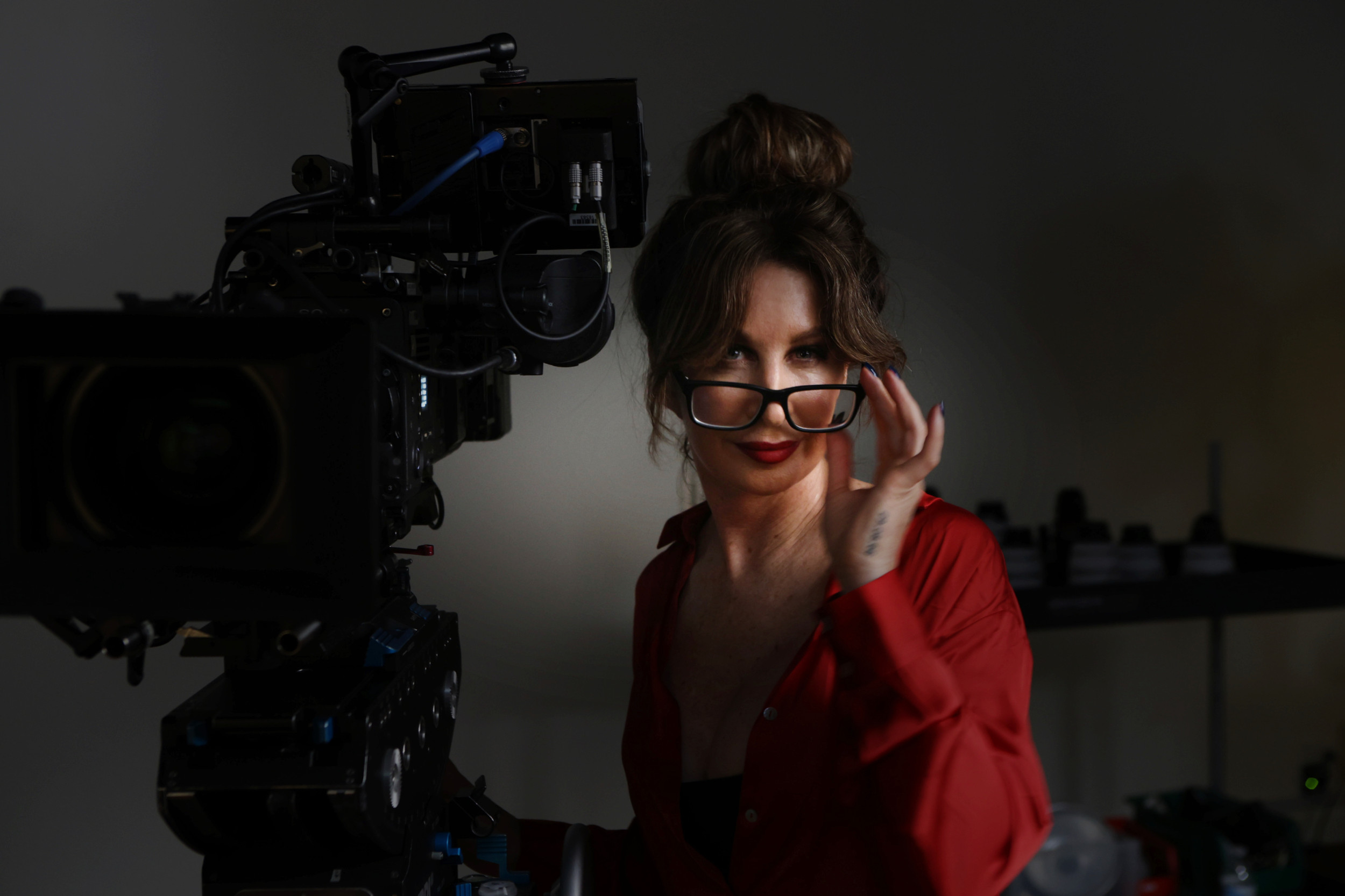
INTERVIEW SERIES: Beyond the Frame A Journey into Cinema, Storytelling, and the depths of Human Experience INTERVIEWER: Gökhan Çolak | INTERVIEWEE: Kelly Mason

Kelly Mason, when you look back at your career, what has been the most defining turning point that shaped the work you do today?
I realized I was filming the same story repeatedly, and it truly wasn’t helping humanity. It was the same Hollywood formula, and my soul felt like it was dying. So I pivoted into the most difficult role of my life, motherhood. From there, I realized I had a lot of healing to do, and humanity has a massive awareness to wake up to. At the same time, my father was dying. When I asked him, if he had more time here, what would he do? He said community service work. It didn’t really hit home until I found a box of files of all the people he helped put through college, or enroll in hockey, or camps, and he did this silently. He didn’t look for any accolades; he simply gave from what he thought was right if he was in the position to do so. From there, I set out to do as much as I can while I am still walking this earth to bring awareness to the KULA Method: Know who you are, Understand why you are here, Live with intention, Activate your potential.
You started your career in cinematography and later transitioned into telling your own stories. How did that creative shift happen?
I realized I had a lot of stories to tell! After four decades in film, two decades as a human behavior specialist (healer), and two decades as a mom, the stories add up. But seriously, as I lived my life, I became aware of who I really am and what I am here for. For the first forty years of my life, I was “one of the guys” on big-budget film sets, but I was lost because I conformed to how I thought I was supposed to behave. I lost myself. It wasn’t until I had children that I realized the impact storytelling can have, especially when combining activism work with the story itself, as we did with “Pave the Road.”

“Pave the Road” stands out both artistically and in terms of its social impact. What was your core motivation behind creating this film?
In the beginning, I didn’t have making a film in mind. I was simply using the camera as a tool, or you could say, a weapon, to find my way into the highest corridors of public and private power. The camera tends to hold people accountable, almost as if they are under oath. There is a truth- telling that usually results. And when people are lying on camera, it becomes obvious through their body language and expressions. So, my core motivation was to inspire the government to pave roads where thousands of children and citizens were becoming ill from toxic road dust.
However, I didn’t just want to pave roads, I wanted to address the plastic waste crisis, and road construction presented an opportunity to test waste materials in the process. We did this in partnership with the University of Costa Rica and LANAMME (National Laboratory of Materials and Structural Models), which happens to have one of the best facilities in the world for testing waste materials.
The Divine works in funny ways. In fact, the director of LANAMME wrote about using waste materials in road construction in his thesis, which provided us with perfect alignment to complete this task. In the end, we created four certified modifiers made from waste materials, and those are now being used in road construction there. The funny thing is, our movement prompted an investigation into the spending of the infrastructure budget, and they found 72 government officials guilty of stealing $125 million. The entire sector has been dismantled and is being rebuilt ever since. You just never know how a ripple for change can turn into a tsunami.

How do you experience the differences between working on large-scale productions and creating independent projects, particularly in terms of creative control and expression?
When you step onto a large-scale production, it’s almost like entering an intricate ecosystem. There are industry protocols, union rules, studio ambitions, and financial stakes, layers upon layers, all tightly woven together. The stakes are high, and you’re surrounded by some of the brightest technical and creative minds, each person playing their part in a machine that demands precision and discipline. Creative expression is absolutely present, but it’s channelled through a series of approvals and must align with the director’s vision, the studio’s objectives, and the overall strategy. It’s collaborative, yes, and you learn what it means to operate within a larger framework, one where individual contributions build toward something greater, but where you must also surrender a degree of control.
Independent projects, by contrast, are more like wandering through wild terrain. There’s space to experiment, to trust your intuition, and even to fall flat, which is often where the most profound breakthroughs happen. The smaller scale and budget force you to be inventive, and that constraint can actually spark unexpected creativity. You’re free to take risks, follow ideas that don’t fit the conventional mold, and let the work unfold in its own way. Today, with film festivals, streaming, and direct releases, independent voices can find their audience without needing to navigate the same gatekeeping structures.
For me, both worlds are vital. Big productions push you to master your craft in a system that demands excellence. Independent work brings you back to your authentic creative pulse. It’s in the interplay between the two that genuine artistry finds room to grow.

When telling real-life stories, how do you balance ethical responsibility with the need to create a compelling narrative?
When you’re working with someone’s real life, you’re not just spinning a narrative, you’re holding their lived experience in your hands. That carries a weight. I always pause and ask myself: Am I honouring what truly happened? Not every detail needs to be literal, but the emotional and psychological truth needs to stay intact, or else the story loses all meaning.
But storytelling is also about structure. Real life is tangled, unpredictable, and rarely fits neatly into a film’s arc. So yes, there’s shaping: timelines get compressed, moments merge, character journeys are clarified. I see this as refining, not manipulating. The aim is to make the truth clearer, not easier.
Consent and perspective matter deeply. Whenever possible, I want the person at the heart of the story to feel acknowledged, not exploited. Even when direct involvement isn’t possible, I approach the process with empathy and restraint, especially when trauma is involved. You don’t need to amplify suffering to make an impact; often, it’s the quieter approach that resonates most. In the end, it’s about integrity. If a creative decision makes the story dramatic but betrays its heart, I let it go. A powerful narrative should pull people closer to the truth, not steer them away from it.

In your opinion, what does it take for a story to truly move people into action?
For me, it’s not only raw facts or information that spark change, it’s when people recognize themselves in the story. A story ignites action if someone can see their own life, or the life of someone they care about, reflected in it. It’s about bypassing the intellect and landing right in the heart, in the gut. You can give all the stats and warnings in the world, but unless the audience actually feels something, nothing shifts.
For a story to truly set something in motion, it has to be built from three things:
1. Emotional honesty: the story has to ring true on a deeper level, not just in the details, but in the feeling of it.
2. Personal stakes: it matters when it’s about real people. When you focus in on one face, one family, one turning point, the audience can’t help but internalize: “That’s me. That’s someone I love.”
3. A clear path to act: the story doesn’t just stir feeling, it invites a response. It might be as simple as a conversation, a moment of reflection, or as concrete as a donation or a change in daily life. But there needs to be a door the audience can walk through.
And beneath it all, the story needs coherence, an alignment between what it says, what it feels, and what it’s asking. When all of that is in sync, there’s a resonance. People can’t look away. The stories that shift us don’t shove, they move us. And along with that movement, they show us where to go next.

How does your background in cinematography influence your decisions as a director?
As a cinematographer, you develop a keen understanding of how camera angles, lens choices, and color palettes can best shape a scene. You carefully observe the monitors to ensure that the emotion of each shot is coming through clearly and authentically. These skills are fundamental to becoming a strong director. It’s essential to grasp movement, momentum, and the flow of a story. The deeper your connection to the narrative, the more seamlessly the camera work, pacing, and performances become intertwined with the story itself. In this way, every technical and creative decision serves to reinforce the emotional journey, drawing the audience in and making the experience truly immersive. By blending visual artistry with storytelling, you transform each moment on screen into something memorable and meaningful.
Filmmaking and your work in parenting may seem like very different fields. From your perspective, where do these two worlds intersect?
I love this question because, to me, they’re actually the same work, just expressed in different arenas. Both filmmaking and parenting are about shaping perception. In filmmaking, we guide an audience’s attention, what they see, how they feel, what meaning they take from a moment. In parenting, we’re doing the same thing in real time with a developing human. We’re helping a child interpret the world, understand themselves, and build an internal narrative about who they are and what’s possible.
Both require presence, emotional intelligence, and a deep awareness of impact. On set, if the energy is chaotic, it shows up in the work. In a home, if the emotional field is dysregulated, children absorb that instantly. So in both spaces, I’m constantly aware that what I’m being matters just as much as what I’m doing. You can’t fake coherence, whether it’s in a frame or in a family.
There’s also a storytelling component in both. The stories we tell in film can shift culture. The stories we reinforce at home shape identity. A child who grows up feeling seen, safe, and understood carries a completely different internal story than one who doesn’t, and that story influences every relationship, decision, and expression of their life.
And then there’s leadership. Filmmaking is collaborative leadership under pressure. Parenting is leadership over time. Both ask: can you hold vision, stay grounded in uncertainty, and respond rather than react? So while they may look different on the surface, they intersect at the level of influence. Both are about guiding human experience, and ultimately, both are about creating environments where people can feel, grow, and become more fully themselves.

When working with parents, what is the most common challenge you encounter, and what underlying patterns do you see behind it?
The most common challenge I see is reactivity. Parents aren’t struggling because they don’t care, they’re struggling because, in the moments that matter most, they get pulled into emotional reactions they don’t fully understand or feel in control of. A situation with their child escalates, and suddenly they’re not responding as the grounded adult, they’re reacting from something much younger.
And underneath that, there’s a very consistent pattern: Most parents are unconsciously parenting from their own childhood experiences, the way they were spoken to, disciplined, ignored, or expected to perform. Those patterns don’t disappear just because we become adults; they live in the nervous system. So when a child pushes a boundary, expresses big emotion, or doesn’t listen, it can activate old feelings of disrespect, powerlessness, or not being seen.
Nervous system dysregulation. Modern life is fast, demanding, and overstimulating. Many parents are operating in a low-grade stress state all the time. From that place, patience shortens, tone sharpens, and connection weakens. It’s not a lack of love, it’s a lack of internal capacity in the moment.
Identity attachment. There’s often an unconscious belief that “my child’s behavior reflects me.” So when a child struggles, acts out, or doesn’t meet expectations, it can feel personal, like a failure or loss of control. That tightens the dynamic instead of opening it.
What I help parents see is that the child is rarely the root of the issue, they’re the trigger that reveals what’s already there. When a parent begins to regulate themselves, understand their own patterns, and separate their identity from their child’s behavior, everything shifts. Communication softens. Trust builds. The home becomes less about control and more about connection. So the real work isn’t “fixing the child,” it’s strengthening the adult so they can lead with awareness instead of reaction.

If you could go back with the experience you have today, what advice would you give to your younger self at the beginning of your career?
I would tell my younger self: don’t be afraid of authority. In the beginning, it’s easy to walk onto a set and feel like everyone above you holds something you don’t, that they’re more powerful, more certain, more entitled to be there. But the truth is, we are all equal in our humanity. Everyone is doing their best to solve problems, manage pressure, and bring something meaningful to life. The moment you stop placing others above you, you start showing up more fully as yourself, and that’s where your real value is.
I would also say: watch your ego. Not in the sense of shrinking yourself but in noticing where you feel the need to prove, to be right, or to be seen as “the best.” That energy can quietly disconnect you from collaboration. Film is not a solo art form. The magic happens when you’re open, when you’re listening, when you’re willing to be changed by the process. Your strength isn’t in dominating a space, it’s in contributing to it with clarity and presence.
And most importantly: you don’t have to be the best. That pressure is exhausting, and it’s not even where great work comes from. Focus instead on being truthful. Be curious. Be devoted to the craft. The people who last in this industry aren’t the ones chasing perfection, they’re the ones who keep showing up, learning, adapting, and staying connected to why they started.
I would remind myself to trust my instincts sooner. There were moments I second-guessed what I felt or saw, especially in rooms where I was one of the only women. But that intuition, that sensitivity is not a weakness. It’s a creative advantage.
And I would say: take more risks, earlier. Don’t wait for permission. Don’t wait until you feel “ready.” Some of the most important growth comes from stepping into things before you fully know how to do them. You’ll figure it out. You always do.

Through your work—whether it’s a film or a talk—how would you define the core impact you hope to leave on people?
At the core, I want people to leave with a deeper sense of themselves. Whether it’s through a film or a talk, the goal isn’t just to inform or entertain, it’s to create a moment of recognition. A pause where something inside them shifts… where they see their life, their patterns, or their possibilities in a new way. I want people to feel more aware, more grounded, and more empowered in how they meet their own lives.
A lot of what I create is designed to move someone from reaction into reflection, from feeling overwhelmed or disconnected into a sense of clarity and agency. Because when that shift happens, even subtly, it changes how they show up in their relationships, their work, and their decisions.
There’s also a deeper layer of impact for me, which is reconnection. Reconnection to truth, to self, to what actually matters. We live in a world that constantly pulls people outward into comparison, pressure, performance. If my work can bring someone back inward, even for a moment, and help them feel more aligned, more honest, more steady, that’s meaningful. And ultimately, I hope it ripples. Because when one person becomes more aware and regulated, it doesn’t just affect them, it affects their family, their community, and the way they move through the world. So the impact I’m after isn’t just a reaction. It’s a shift in how someone lives.
Leave a Reply