
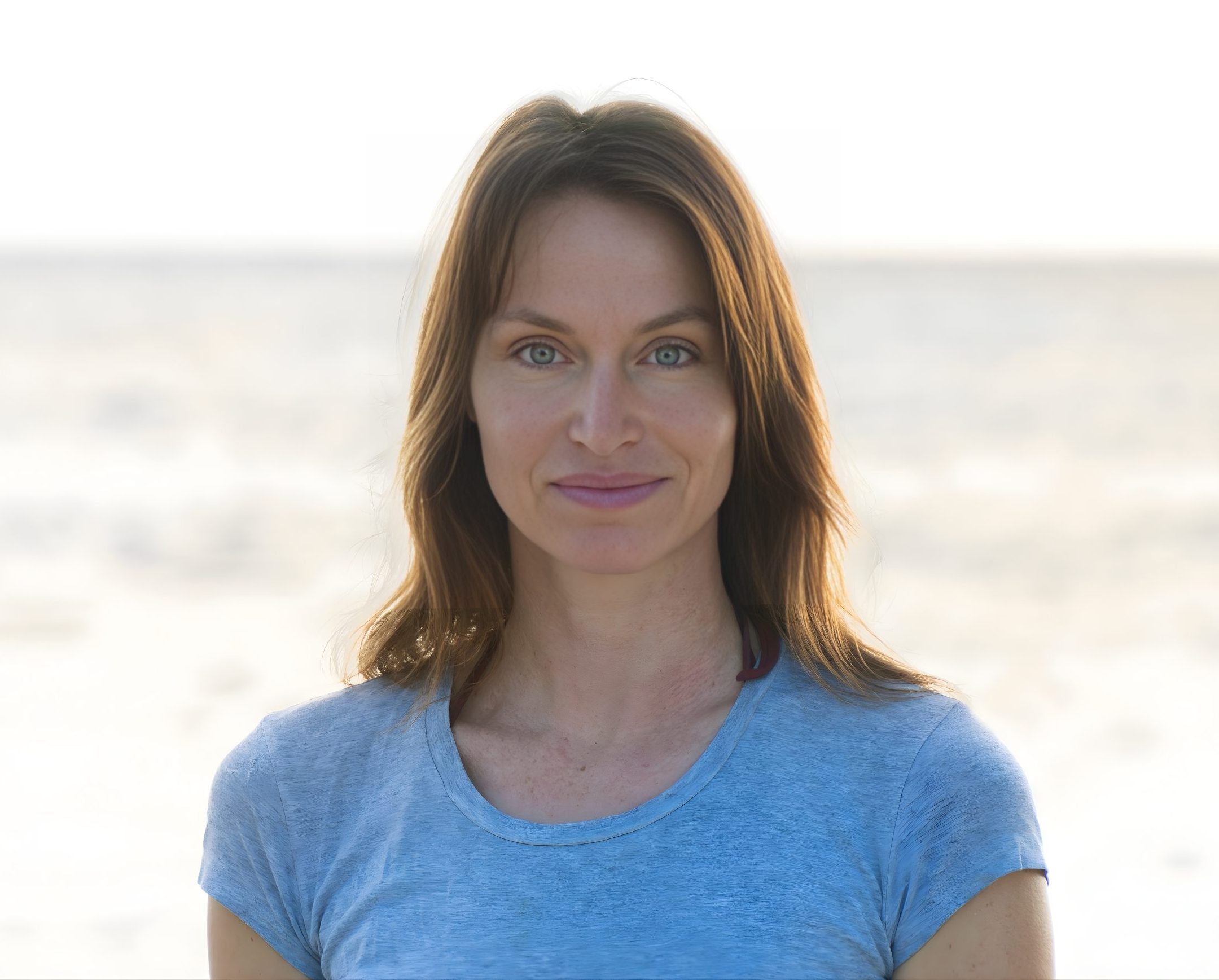
INTERVIEWER: Gökhan Çolak INTERVIEWEE: Anne De Carbuccia
Art and the Anthropocene
How do you define the Anthropocene in your art, and how do you represent this concept in your works?
The Anthropocene is our mirror. It is the first era in which humankind has become a geological force. We are shaping the planet more than any natural phenomenon. Through my art, I try to visualize this paradox: our capacity to destroy, but also our potential to protect.
My work is a form of witness. It’s about presence, not accusation — to show what we have, what we may lose, and what we have already lost. I’m not interested in illustrating catastrophe, but in revealing how beauty and fragility coexist. I want people to see the Anthropocene — to recognize that we are part of it, and that we can still choose to make it a positive force rather than a destructive one.
TimeShrines Installations
What symbolic meanings lie behind your TimeShrines installations, and what considerations guide your choice of locations and materials?
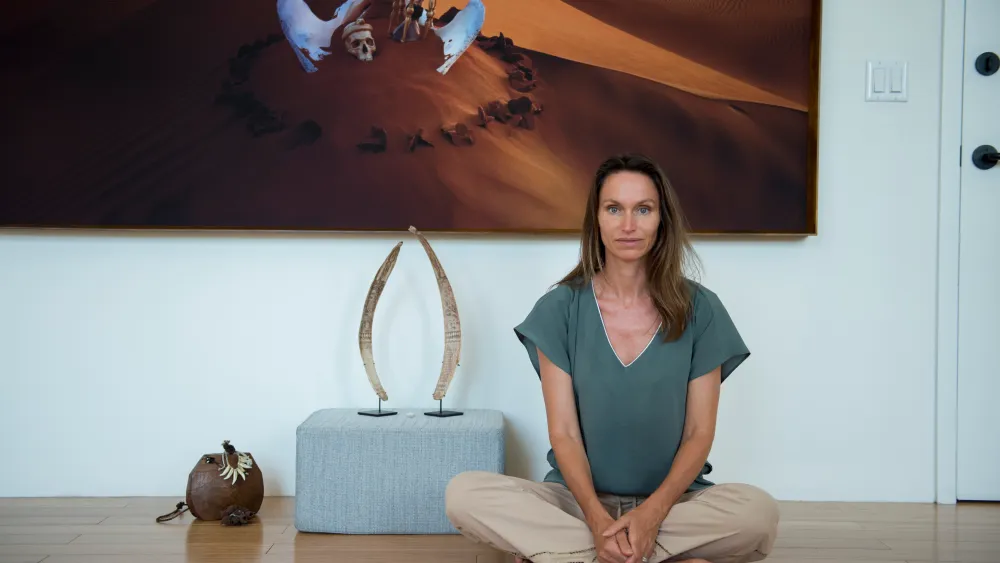
Each TimeShrine is a symbolic installation: a small altar to time, life, love and choice. I began creating them in 2013 as a way to honor and capture the beauty that is disappearing from our planet.
Two objects always travel with me: an hourglass and a skull. The hourglass is one of humanity’s oldest measures of time, a reminder of our fleeting existence and of the sacred value of time itself. The skull, or vanitas as it was once called, comes from 16th- and 17th- century art. It is not a symbol of death, but of awareness. It tells us that as mortals, we are free to choose how to live: to build, protect, and love, or to waste our time in vanity and denial. In the vanitas, there is no death, only the power of choice.
Each shrine is created on site, in direct dialogue with its environment. I never transport materials; I work only with what I find, natural or human traces that carry memory: driftwood, coral, bones, plastic, glass, remnants of life. The setting determines the shrine’s form, light, and emotion. It could be a glacier, a coral reef, a desert, or a refugee camp. Once completed, the shrine disappears, only the photograph remains as its witness. The TimeShrines speak to our origins, our beliefs, and what we cherish. They connect the past to the present, and what was to what may still come. Through them, I hope to move the viewer, to spark reflection, empathy, and ultimately, a renewed sense of belonging to our planet. Make people feel that everything is connected.
Film and Documentary Work
What kind of impact do you hope your documentaries and short films have on audiences regarding environmental awareness?
Film allows me to tell stories that move beyond a single image. It connects emotion, sound, and time, the three dimensions of empathy.
In Earth Protectors (2023), I followed seven young protecotrs from Siberia to the Amazon. Their courage gave me hope. They are proof that humanity is adapting, that we can evolve with awareness and action.
With Choose Earth (2025), I spent a decade (2014-2024) documenting voices that have been ignored: Indigenous leaders, scientists, and youth who are reimagining what our relationship with the planet could be. My goal is not to convince, but to connect, to awaken a sense of belonging, of shared responsibility and of global community. Art can open the heart where facts alone cannot. Film, for me, is a bridge between the two.
Educational Programs
How do the educational programs organized by your foundation aim to increase environmental awareness among younger generations?
The One Planet One Future Foundation was born in 2016 from the belief that education is the most powerful form of active resistance. We are convinced that the next generation needs to start now to play a key role in devising solutions to portect and save our planet. Our program Lessons from Our Planet offers free digital lessons for students of all ages, from primary schools to universities, in English and Italian.
We focus on key themes of the Anthropocene: water, drought, refugees, trash, endangered species and cultures but we also speak about the possibilities of a positive Anthropocene: wonder, protection, love, and action. The goal is to inspire young people to think critically, to connect emotionally, and to act consciously. The next generation must not inherit despair; they must inherit the tools to create change.

Personal Experiences
Could you share a memorable experience or moment from your journey as an environmental artist that has had a significant influence on you?
A memorable axperience happened to me underwater, in Raja Ampat in the Coral Triangle, one of the last places on Earth where corals still grow. I was there to create a TimeShrine among living reefs. As I descended with my hourglass and skull, thousands of small blue fish surrounded me.
Their energy and light surrounded me and made me feel a strong form of tenderness. As if they were whispering to me “we are with you, we are on your side”. For a moment, I felt both infinite and small, a visitor in a world where nature still reigns, where everything is connected. That same evening, I walked on a pristine beach only to find it covered with plastic carried by the tides. That contrast, beauty and destruction, wonder and denial defines our time. It’s what drives me to continue: to remind us all that we are still capable of changing things, that we must not loose the connection.

Future Projects
What themes do you plan to explore in your future projects, and how do you envision their impact on society?
I am currently completing Children of the Anthropocene, the final episode of my decade-long series Choose Earth. It follows young leaders across continents as they rise against climate failures. Engaging in law suits, protest, creativity and resilience, they strive for a future still within reach.
I say at the beginning of each episode that the series is dedicated to the viewers who will watch it in 2050 and I wish it to be a historical document of this era. I think this is an important moment to reflect on what we have achieved until now, what our rootsa are as a Humanity and at the same to project ourselves forward, try and undertand where we want to be in 10, 20, 30 years. Not pay too much attention to the noise of the “old trees that are falling” and listen to the “forest that is gorwing”.
At the same time, I am developing a new body of work titled Sergeant S.N.A.F.U. a series of sculptures. They speaks about the “war on truth,” about how words have become weapons in an age where disinformation is spreading. If Choose Earth is about listening to our planet and reflect on this epoch that is the Anthropocene, Sergeant S.N.A.F.U. is about listening to each other again. Both are connected by the same conviction — that awareness can become action, and that art can restore some meaning where noise seems to have taken over.
Leave a Reply