
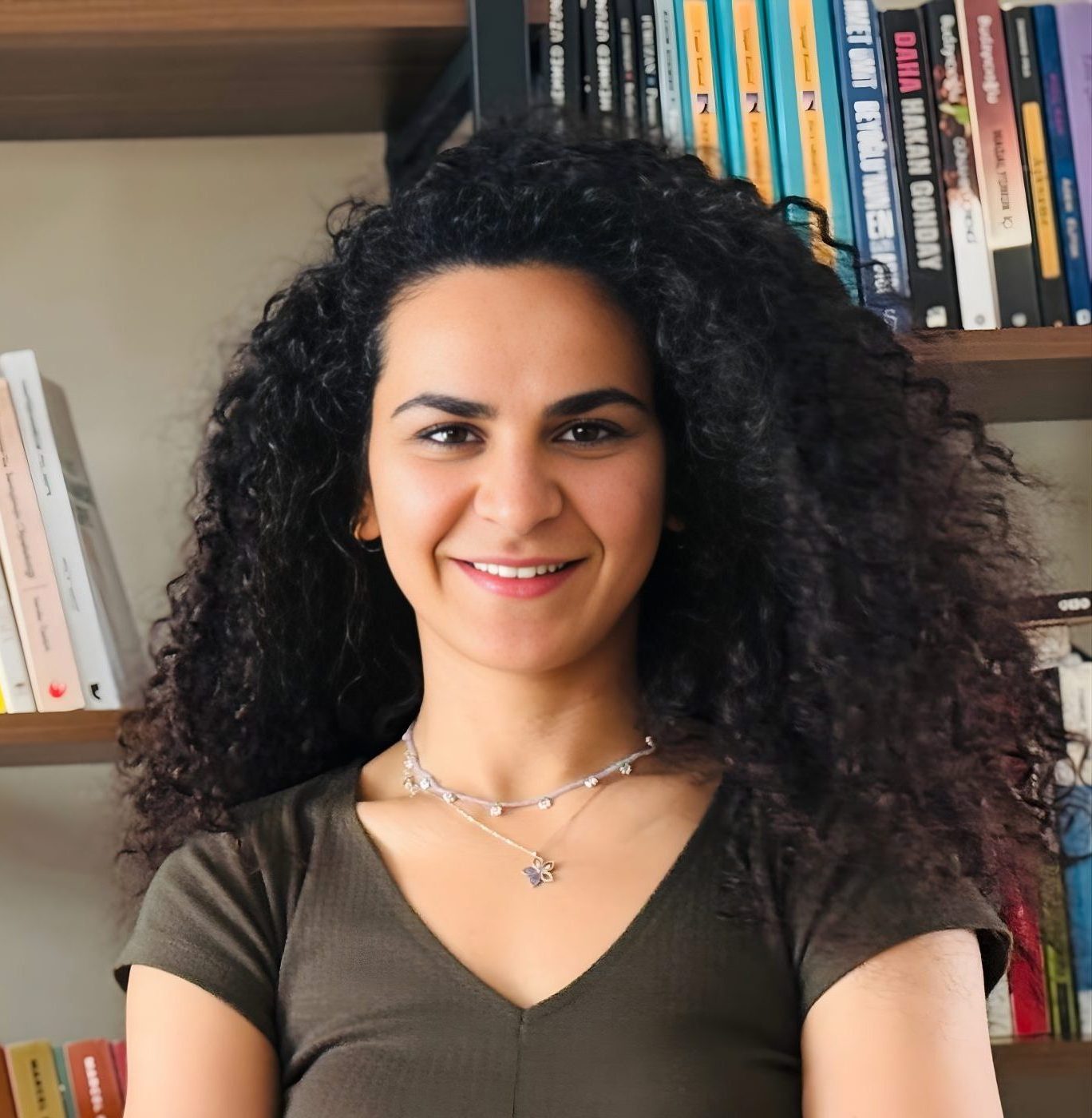
INTERVIEWER: Gökhan Çolak | INTERVIEWEE: Şirvan Önce Çolak

Academic Orientation and Theoretical Interest
What was the main issue that influenced you to focus on the discipline of communication in your academic studies?
To tell the truth, I set out with ideal “naivety” to do active journalism, and when I tasted the reality halfway through, I started academy and communication studies with the vision of my FATHER, who made me who I am. The act of questioning everything he instilled in me, was so compatible with communication and especially journalism that I couldn’t help questioning… My interest in communication studies in particular is that this field is the core point of interdisciplinary fields in my opinion. And reading and writing are the two basic methods of existence that heal me. In other words, I couldn’t help writing…
What was the first question that sparked your interest in public sphere theories? Which thinkers guided you?
Politics has been an area of interest for as long as I can remember. In fact, if we were to approach it with a deterministic attitude, I would say it was the influence of family and especially my father. The aspect of the concept of the public sphere that is not separated from politics is also, in my opinion, a side worth examining. The thinkers who interested me most about this concept, especially during my academic readings, were Nancy Fraser and Richard Sennett.
While Fraser’s criticism of Habermas’ “hegemony” regarding the conceptual definition of public space in the West and all over the world excites me, on the other hand, Sennett’s concept of destructive communalization, which he actually puts forward regarding the collapse of the public space, can lead to a pessimistic path regarding society. I can describe the concept of public space, which I address within the framework of non-Westernization, through Western thinkers and give my self-criticism on this subject, and I can personally describe the thoughts of Nilüfer Göle and Besim F. Dellaloğlu from Turkey as enlightening.

On Theories of the Public Sphere
How do you think the meaning of public space differs in Eastern and Western societies?
In my opinion, the public sphere in its ideal form can be described as a pluralistic, rational and most importantly critical communication and interaction-creating area. As far as I have read and observed, it continues to exist as an area that authorities try to control in some way all over the world. If we make a distinction between the East and the West, I can say at this point, starting from our own society; If the cultural, political and sociological lifestyles of Eastern societies are taken into account, the public is understood as a structure shaped around the state and a rational tradition of criticism remains limited.
In our society, where public understanding is seen as equal to the state and the state’s mind, it has not become a tradition to criticize the state and authority because the state is in a transcendent position. Therefore, the public sphere remains far from an effective criticism and potential for change. If we look at Western societies within the framework of my readings rather than observations, a structure prevails where the interests of the individual and society are considered rather than the transcendent meaning of the state. Therefore, the public sphere retains its potential for change and even revolution.
How do you relate Habermas’s theory of the public sphere to today’s social media structures?
Habermas’s public sphere represents an area where a certain group comes together, independent of authority, and engages in critical and rational communication. These areas were usually the cafes of the period. Although social media has the ability to bring together large audiences and potentially create participatory criticism due to its structure, it is obvious that it is not completely independent of authority. It can be said that social media platforms, where access to information is problematic, democratic potential is limited, commercialization is at its peak, and algorithmic manipulation is very possible, have aspects that are similar to Habermas’s theory of the public sphere in terms of ideas. And even in terms of being problematic and incomplete like his theory, they may have similar aspects. Although, unlike Habermas’ theory, there is a possibility that a potential public space could be created by more diverse communities coming together rather than a specific mass, the possibilities remain limited due to the economic and political concerns I mentioned above.

Social Media and Political Polarization
In your article “Political Poisoning” you analyze the role of social media in political polarization. How has this process evolved today?
With the political poisoning theory, he talks about the paralysis of basic functions of social media platforms such as communication and socialization due to excessive politicization. He shows with examples from Twitter that the extreme political polarization in our country has become widespread and toxic through social media. I believe that this situation continues to increase today. It is possible to encounter symptoms of political poisoning in the YouTube street interviews I am currently working on.
What do you think about the power of algorithms to direct everyday political discourse?
A day is a very long time for the political agenda in Turkey. We can see many different political discussions within hours. If we put aside the joke that algorithms may not be able to keep up with this speed, our society, which is quite prone to manipulation, can of course be made to focus on the desired issues with algorithms. This gives political authority great power to run a society, and they have no hesitation in using it.

Critical Academy and Practices of Resistance
What kind of a struggle does it require to maintaın critical thinking in academic production today?
The social, cultural and political differences that develop among academics and the fact that these differences take precedence over scientific knowledge sets a bad example for future academics. I observe that within this hegemonic structure of the academy, those who stand out with their criticism are not given much space. At this point, it may be useful to think through Plato.
We can also adapt his discourse on who should govern the state and how to the academy. It is necessary to move forward with a perspective and new practices that are free from personal ambitions and do not alienate differences; It is necessary to critically break the structures that push science into the background and turn differences into enemies, especially in the field of social sciences.

How do you evaluate the current situation and transformation of communication academia in Turkish?
I must say that there are very valuable scientists and enlightening perspectives in the field of communication in academia. I am trying to benefit from this enlightenment from my own perspective. As I mentioned by giving an example from Plato, I believe that we should get rid of the tendency to look at the intellectual and political differences that come with being human.
Leave a Reply