
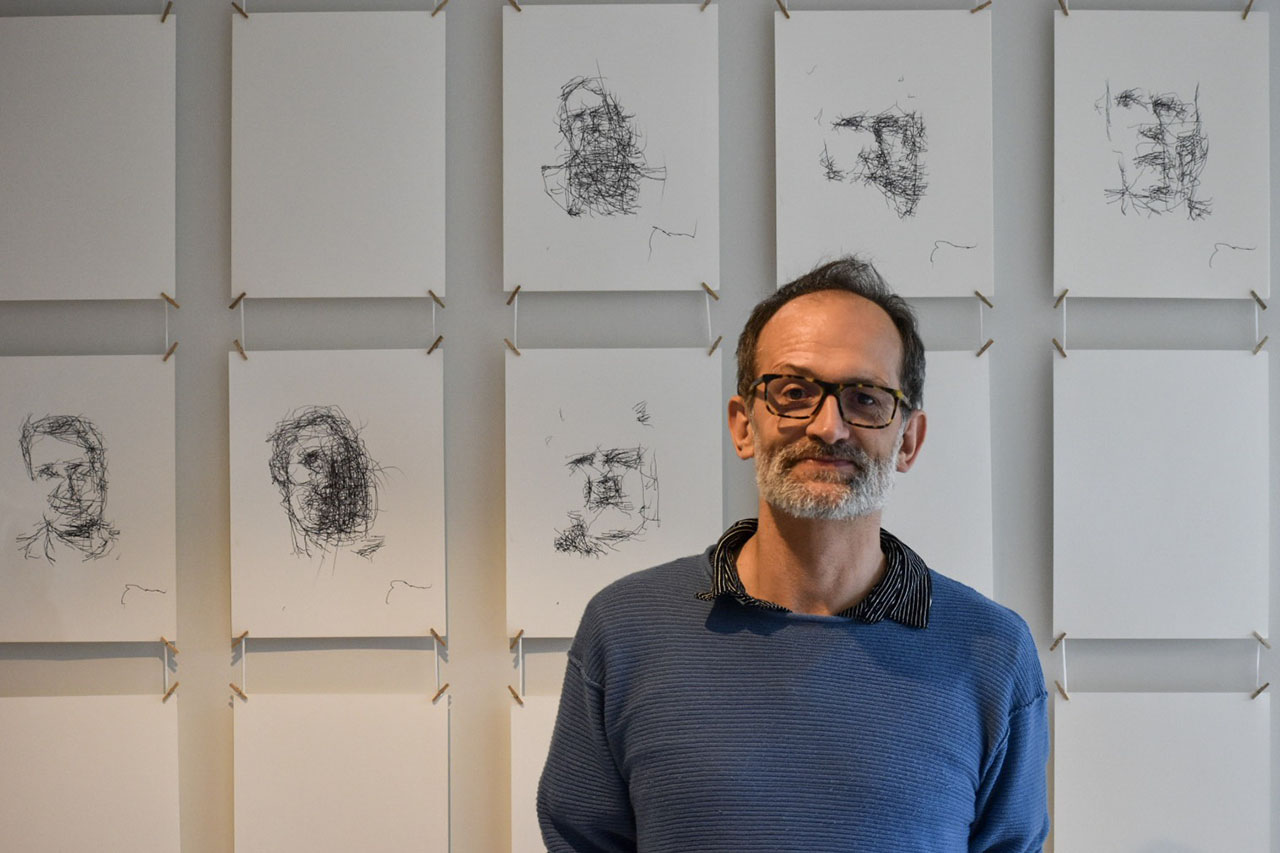
INTERVIEW SERIES: The Creative Machine INTERVIEWER: Gökhan Çolak | INTERVIEWEE: Patrick Tresset

Before I answer these questions, I must first clarify the nature of my practice and my process. My work unfolds in distinct stages. First, I work as an artist, conceiving a concept and a direction for a new medium. Next, I act as a researcher in robotics and AI, exploring the technological possibilities to establish that medium, which sometimes includes writing academic papers. Then, I take on the role of a developer to build the actual computational framework. Finally, I return to my position as an artist, using this framework to produce artworks; installations, digital animations, paintings and drawings.
The following questions and answers are mostly concerned wıth that second stage of research and development, mainly about the medium. However, it is important to remember that my artistic practice is using thıs medium to tell stories about certain aspects of humanness and the human experience, rather than on technology.

In your artistic practice, how do you understand the distribution of agency? Which aspects of creativity belong to the algorithm, the robot, yourself, and ultimately the viewer?
It is often assumed my work explores computational creativity, the question of whether a machine is truly “creative” has never actually been a focus of my practice. Because I develop autonomous systems, embodied or otherwise, that produce drawings, paintings, or digital animations, I am frequently asked about this.
However, my aim is to build autonomous systems capable of producing artistically valuable, interesting artworks with a surprising but coherent aesthetic that are not mere pastiches. By this, I mean I do not programme them to mimic existing human art; Instead, I always design the system so that the artwork’s aesthetic emerges as a direct consequence of the system’s own characteristics, whether physical or computational.
When discussing agency and creativity, I usually emphasise two points. First, creativity is neither the sole nor the main capacity required to produce art. Mastery, expertise, and the capacity to evaluate your ideas and production are equally, and perhaps more, important. In the context of art, I prefer the term “authorship,” as it encapsulates everything at play in an artistic practice. Second, in my view, authorship cannot happen without intent, and intent cannot happen without consciousness. Consequently, until we achieve artificial consciousness, we will not have computational systems that are authors. The agency of true intent remains with me as the artist.
A computational system appearing to be an author is a different matter entirely, and this is where the viewer’s agency comes in. If we think in terms of the Turing test, a system that can fool humans passes. I am often fooled into feeling that my most recent LLM-based agents are the authors. Audiences experiencing my installations naturally project intention and agency onto the robots, but this is a constructed experience; I specifically design certain behaviours to provoke this impression. I develop and direct these systems as stylised actors. The viewer’s role is to complete the performance by attributing meaning to it.
To understand the agency of the algorithm and the robot, it helps to look at how my systems have evolved through three main stages:
From 2009: My first systems, which I developed as part of my doctoral studies, were based on theories of enactive cognition. The system, being biologically inspired, has what you could describe as a nervous, immediate reaction to reality, operating without learning or memory. It relies on its physical embodiment and sensory input in the moment. This is still the foundational system I use most often to drive my robots’ behaviours.
From 2017: I began integrating custom deep-learning models trained on personal datasets. This introduced a form of memory that brought a distinct stylisation to the work. Here, the model’s influence was on perception: the robot no longer reacted to raw data straight from the camera; its vision was influenced by what it had learned.
From 2024: My recent work and research in the context of the EACVA [https://eacva.org/] project incorporates LLM-based agents. This introduces an element of culture, along with rudimentary reasoning and planning, to the agents. I have difficulty qualifying their exact level of autonomy. The underlying framework is described in our 2026 paper titled “An Embodied Companion for Visual Storytelling” [https://arxiv.org/pdf/2603.05511].
I realised recently that I am still following the core ideas I described in a research paper from 2014 titled “Artistically Skilled Embodied Agents” [https://doc.gold.ac.uk/aisb50/AISB50-S04/AISB50-S4-Tresset-paper.pdf].
The distribution of agency is entirely theatrical: I am the artist and director with the initial intent; the algorithm and robot are the stylised actors performing their roles within the constraints of their physical and computational implementations; and the viewer is the audience whose perception grants the system its illusion of life and authorship.

Your drawing robots continuously perceive, act, and adapt while sketching a subject. To what extent does this process reflect the principles of embodied or enactive cognition, where intelligence emerges through interaction with the environment?
In reality, they do not continuously perceive and act in an uninterrupted loop. A portion of their behaviour is theatrical. However, at certain stages of the drawing process, they do operate this way, and the framework of the system is built on these principles.
When I began working with robotics in 2009, applying principles of embodied or enactive cognition was already an established approach in AI and robotics. My initial motivation for developing these drawing robots was to explore the drawing practice.
Because of this, I avoided programming the system to produce pastiches or imitations of my own hand-drawn work. I wanted the drawing process to be true to the robot. This is where the concept of embodiment becomes central to the work: the final drawing is a direct consequence of the machine’s characteristics, both physical and computational. In that sense, whatever “intelligence” or aesthetic quality appears on the paper emerges from the robot’s physical, enactive interaction with its environment and its subject, rather than being imposed from the top down.

In human artistic practice, mistakes often become sources of originality. When your robots deviate from expected behavior, do you regard these deviations as technical noise, or as moments of genuine aesthetic emergence?
To call it “genuine aesthetic emergence” seems a bit grand. In reality, when my pre- LLM systems deviate from their expected or intended behaviour, it is usually due to an occasional bug. This has happened a few times over the years. In these cases, if the resulting output happens to be aesthetically interesting, I choose not to fix the bug; instead, I might even preserve and refine it.
With the LLM-based works, the agents’ behaviour is not strictly predetermined. It is an exploration of a very complex system, and as such, there is a high level of unpredictability; perhaps here we can name it “genuine aesthetic emergence”:.
Because we are dealing with computational systems, this unpredictable behaviour usually occurs under specific conditions. This translates onto the paper as a distinct visual logic.
I find these deviations desirable. After all, departing from the norm is precisely what constitutes an individual style. Rather than dismissing it as technical noise, I embrace it, because the bug is just another part of the system’s computational characteristics. It goes back to allowing the machine’s nature to shape the artwork.

Your installations create a feedback loop in which the observer watches the robot while simultaneously being observed by it. Do you see your work as engaging with the ideas of second-order cybernetics, where the observer inevitably becomes part of the system?
While second-order cybernetics provides a valid theoretical lens for analysing the work, my interest in this feedback loop is much more pragmatic and theatrical. I am interested in the psychological and performative situations that arise when a human enters the space of a machine that seems to possess its own gaze and intentions. In these installations, the observer becomes part of the system, but how they are integrated depends entirely on the specific staging of the piece.
In Human Study #1, my best-known work, the loop is very direct. The human is placed in the traditional role of a “sitter.” When the robot’s arm pauses, turns its camera to “look”at the human, and returns to the paper, it forces a physical and emotional reaction. The human sits still, feels scrutinised, and inevitably projects agency and judgment onto the machine. Furthermore, for the wider audience, the sitter becomes part of the installation itself. Other elements, such as the vintage desks, allow the audience to imagine their own stories.

Your robots do more than draw, they appear to look, hesitate, and contemplate. How do you think this robotic gaze transforms the phenomenological experience of being observed?
All these behaviours reinforce the illusion of intention. If you have visible attention and physical actions directly linked to that attention, the human brain automatically projects a mind at work, especially when the action is drawing, a distinctively human activity.
The robot doesn’t actually “contemplate” ın a human sense. However, by stagıng the physıcal markers of contemplatıon, such as the hesıtatıon, the shıftıng of the camera, and the pause before the pen touches the paper, the machıne acquıres what feels lıke a subjectıve gaze. As I mentıoned earlıer, these are carefully desıgned performatıve elements; the robots are stylısed actors playıng the role of the artıst.
Because of the hesitation and deliberate pacing, the robot appears to be making decisions. It appears to be evaluating the sitter’s face. Even though the person consciously knows they are just looking at a computational system made of motors and cameras, their physical and emotional reaction is very real. Depending on the sitter and the context, they might feel vulnerable, self-conscious, or judged. They might even feel a connection with the machine, as there is something akin to eye contact at play.

Many computational creativity researchers argue that novelty alone is insufficient for creativity. In your view, does creativity also require intention, self-reflection, or contextual understanding?
I agree that novelty alone is insufficient. A computational system can generate infinite random variations, but without an underlying framework or visual logic, that novelty is just noise, not art.
As I mentioned earlier, my stance is quite firm on this: authorship requires intention, and intention requires consciousness. Because machines currently lack consciousness, they do not possess genuine self-reflection or true intent. The intention behind the artwork always remains with me, the artist who conceived and directed the system. That being said, we can build systems that simulate these qualities to serve an artistic purpose. For example, my earlier enactive systems had no contextual understanding or self-reflection; they operated purely on a nervous, immediate physical reaction to their environment.
But this need for context is exactly what my recent work with LLM-based agents explores. By integrating LLMs, I am introducing a layer of “culture” to the agents. These models bring rudimentary reasoning, planning, and a vast dataset of human context. They allow the agent to simulate a contextual understanding of what it is doing, which makes its behaviour as a “stylised actor” much more complex, convincing, and unpredictable. I used one of these systems to produce a book “Skediama and Us” published with RRose editions where I dialogue with the machine to explore my cultural memories. [https://rrose-editions.com/portfolio/patrick-tresset-skediama-nous-us/]
I use the same system for a participatory installation I premiered recently where a participant imagines a visual story in conversation with a drawing machine [https://patricktresset.com/new/skediama/].
However, we must not confuse the simulation with reality. The machine does not self- reflect. The self-reflection happens within me during the development process, and within the viewer when they interpret the final drawing or the performance. The robot is executing a sophisticated role; the authorship belongs to the human minds on either side of it.

Today’s generative AI systems are remarkably powerful, yet largely disembodied. Having worked with physical drawing robots for decades, what role do you believe embodiment plays in genuine creative intelligence?
To start, I must once again set aside the notion of machines possessing “genuine creative intelligence.”As I have noted, I believe that capacity belongs to the human. However, if we look at embodiment in terms of how the final output is perceived, it plays a critical role. It is what allows the output to be perceived as a genuine work of art, rather than just a generated image.
Today’s disembodied, generative diffusion-based models produce imagery almost instantaneously and without physical constraints. In contrast, my robots operate in real time and in physical space. The drawing is a slow accumulation. The friction of the pen, the limitations of the motors, the slight vibrations, and the occasional bugs all leave tangible, physical traces on the paper over time. Even with my LLM-based agents, I provide them with tools they use to produce drawings sequentially over time, incorporating feedback loops. It is apparent that the images were not simply generated, but constructed.
This is where the theories of the cognitive scientist and anthropologist Alessandro Pignocchi are relevant. Pignocchi argues that our aesthetic appreciation of an artwork is tied to our mind’s instinctive attempt to reverse-engineer it, to reconstruct the intentions, decisions, and sequence of physical actions that were used to produce it.
[https://hal.science/ijn_00750952v1/preview/History_and_Intentions_in_the_Experience_of_Artworks_Pignocchi.pdf]
When a viewer looks at a purely digital, disembodied AI image produced with a diffusion model, this cognitive process hits a dead end; there is no action to reconstruct. But when a viewer looks at a drawing made by one of my systems, they can visibly trace the “history” of its making.
Because the robot is embodied, it leaves physical marks that trigger the exact same cognitive mechanisms we use to appreciate human art. Even if the human brain is projecting an illusion of intention onto the machine, the physical traces of the process are real. This embodiment allows the viewer to engage with the drawing as an authentic artwork with its own physical history. With the LLM-based agents, even if they are not all physically embodied, the fact that they are using tools sequentially and using feedback to contract drawings or animations means these exact same mechanisms are at play.

In your installations, the artwork is not merely the finished drawing but the unfolding performance itself. How do you conceptualise the relationship between computation, time, and artistic performance?
I view the finished drawing as a memory, a physical trace of the performance. There is a meta-artwork, the performance itself, which consists of multiple elements: the computation that drives the robots as autonomous actors, the physical installation, and both the individual drawings and the collective group of drawings produced not only during a single performance, but throughout the entire exhibition. All these elements are conceived and designed to work together to constitute the overall artwork.

Do your works challenge the human-centered conception of artistic authorship? Could robotic creativity contribute to a genuinely posthuman aesthetics rather than simply extending human artistic practice?
To an extent, yes, but we have to be careful with terms like “posthuman aesthetics” and “robotic creativity.” As I have maintained throughout my practice, true authorship and intention still fundamentally reside with the human artist.
My most recent work incorporating LLM-based agents might seem to point toward a posthuman direction. For example, in one of my current systems, I use a framework involving two interacting agents: one acts as a storyteller that expresses itself through words, and the other acts as an artist-illustrator that expresses itself through drawings. They dialogue with each other to autonomously imagine and construct visual stories about us. I presented some of these works during the Automata Anima exhibition at the Artverse [https://www.artverse.fr/] gallery in Paris.
Observing these two agents converse, interpret, and draw together might look like a display of genuine computational authorship. However, there is a paradox here. Because LLMs are trained on vast datasets of human text and imagery, they are entirely dependent on “humanness.” They possess a compressed knowledge of human culture. When these two agents interact, they are not generating a posthuman aesthetic; rather, they are exploring our own cultural memories and offering insights about us from the perspective of an outsider. I cast them not as independent agents or collaborators, but as stylised actors and narrative devices that reflect human aesthetics and logic back at us.
That said, the concept of a genuinely posthuman aesthetic is something I have had in the back of my mind since before the advent of LLMs, but this recent development has provided an interesting new space to explore.
I actually have some specific ideas on how to push this further and achieve a more radical departure from human-centric aesthetics, where a system’s output is purely a consequence of its own non-human, mechanical, and computational ontology. However, developing these systems takes time, and I simply have not yet had the opportunity to fully explore this possibility in the studio. It remains a compelling direction for future work.

As creative systems increasingly combine humans, robots, large language models, sensors, and autonomous agents, do you think the concept of the “artist” is evolving from an individual author into a distributed creative ecology?
I am old-fashioned: I still enjoy my position and my responsibilities as an artist. It is how I found my place in society. While it could be interesting to describe these complex networks of LLMs, sensors, and robots as a “distributed creative ecology,” I do not view them as co-authors. I view them as a highly sophisticated medium.
As I have maintained throughout this discussion, art requires intent, and intent requires consciousness. A large language model, an autonomous agent, or a robotic arm does not possess intent, nor does it take responsibility for what it produces. I am the one who designs the framework, sets the parameters, and writes the underlying logic for these stylised actors. I am the one who evaluates the aesthetic output and takes responsibility for presenting it to the public as a work of art.
If we use the term “ecology,” it implies a sort of natural, undirected emergence. But my installations are highly directed. Even when I have two LLM agents autonomously conversing to draw visual stories, or a drawing robot physically adapting to a human sitter in real time, they are still operating within a constructed, theatrical space that I conceived, using actors that I developed.
In a way, my role is closer to that of a theatre or film director. An author-driector works with a network of actors, scriptwriters, cameras, and physical environments, but the conceptual authorship remains singular. While the tools of productoin have evolved into a complex, distributed network, my concept of the artist has not. The intent, the consciousness, and the final responsibility remain fırmly with me. That said, I will admit I might be contradicting myself. While I insist on maintaining control and taking full responsibility as the director, I also fundamentally need that loss of control, as I cannot accept seeing myself directly in the work.


Leave a Reply