
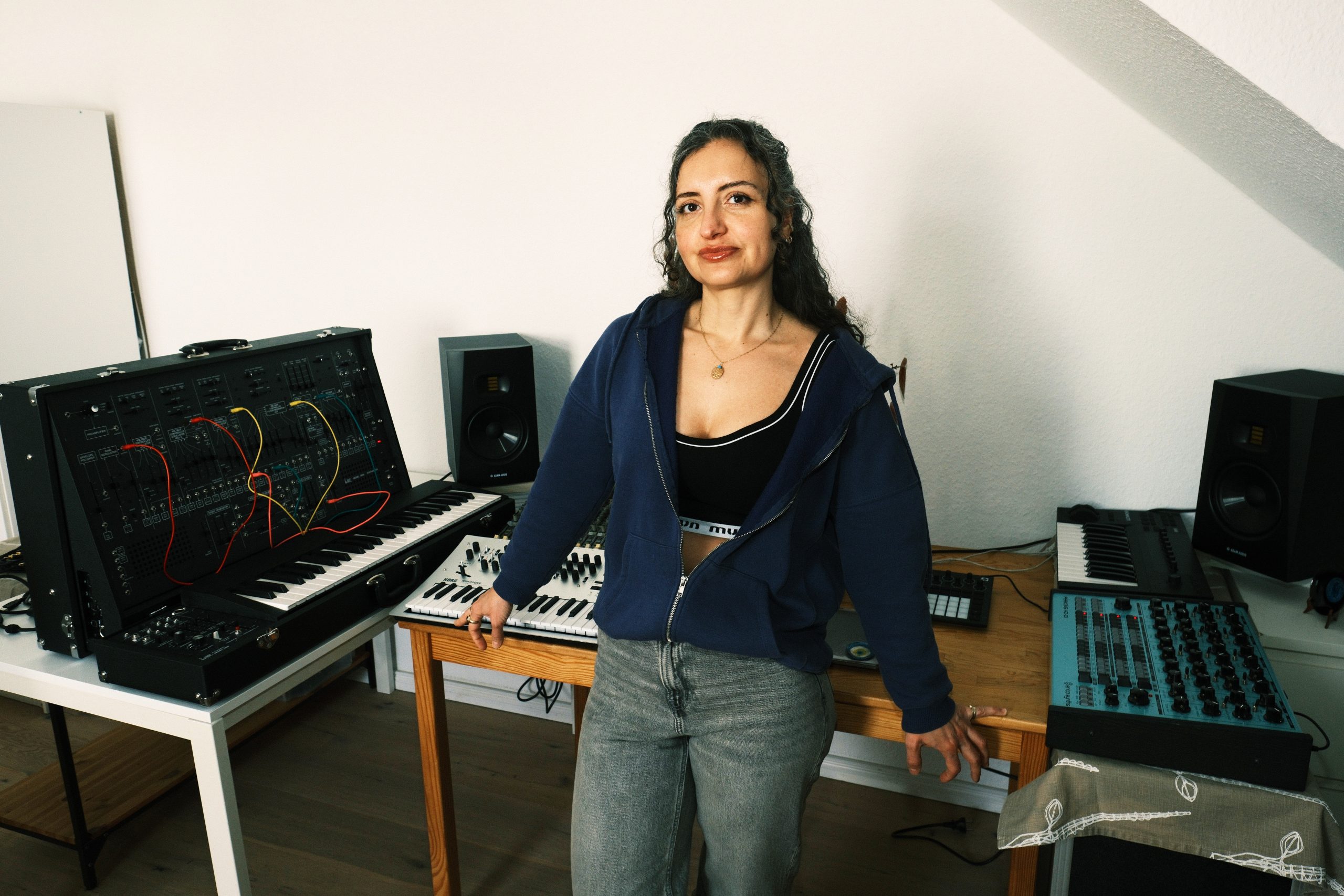
INTERVIEW SERIES: Culture, Art, and Sound Studies INTERVIEWER: Gokhan Colak & Arzu Karaduman INTERVIEWEE: Banu Cicek Tulu

Thinking Through Sound, Creating Through Sound
With a background in urban design, your practice has evolved into a compelling trajectory encompassing sound art, music production, and DJing. How do you define sound as a mode of thinking and expression? What does the concept of a “sound methodology” mean to you?
I have a multifaceted, interdisciplinary practice. My education in Urban and Regional Planning at Yıldız Technical University provided one of the first foundations for thinking about space, the city, and the public realm. Today, through my work in sound art, music production, DJing, and academic research, I continue to reconstruct and expand this perspective across different disciplines. Rather than seeing these fields as separate, I understand them as interconnected modes of thinking and making that continuously inform and enrich one another.
I would not describe what I do as inventing an entirely new methodology. Instead, I bring together approaches from urban design and planning, feminist and queer methodologies, artistic research, and critical theory, and reinterpret them through sound. For me, sound is not merely an aesthetic material; it is a way of thinking, conducting research, and engaging with the world.
This is precisely where what I call a “sound methodology” emerges. I understand listening not as a passive act, but as a method of producing knowledge and making sense of space. I bring together urban research methods such as walking, mapping, and observation with practices of listening, field recording, sound walks, and auditory memory. In this way, sound becomes both a method of inquiry and the material of artistic production.
Feminist and queer methodologies are particularly important in shaping this approach because they privilege multiple experiences over a single truth, while creating space for embodied knowledge, practices of care, and marginalized voices. Through sound, I seek to listen to experiences within the city that often remain unheard, suppressed, or rendered invisible.
For this reason, sound art, music production, DJing, and research are not separate fields for me. They all converge around the practice of listening. Whether I am in a DJ booth, creating a sound installation, or conducting academic research, I am fundamentally engaged in the same process of using sound as a means of understanding and reimagining space and social relations.

Sound, Politics, and the Social Imagination
In your work, sound is not only an aesthetic medium but also a social and political one. How did your understanding of using artistic, cultural, and political imagination as a “vehicle for social change” evolve?
I don’t think this approach can be traced back to a single moment or experience. Rather, it has taken shape over time through different educational paths, cities, and collective experiences. During the Independent Studies Program I completed in Barcelona, I engaged extensively with critical and Marxist theory. Later, after moving to Berlin, I became part of various collective networks where art, music, and activism intersected. My doctoral research in Design Theory at
the Hamburg University of Fine Arts further reinforced this perspective by encouraging me to see art not merely as a field of aesthetic production, but as a way of generating knowledge and critically examining social relations.
In many ways, the foundations of this political perspective were laid in Türkiye. The collective culture that brought together urban struggles, debates on public space, activism, and music showed me from an early age that sound and dance could function not only as artistic practices but also as political tools. Later in Berlin, this understanding evolved further through my engagement with queer and feminist collectives, rave culture, and an interdisciplinary art scene.
For this reason, I do not see art, research, music production, and DJing as separate domains. The political is not something added to my practice afterward; it is an integral part of the way I think, create, and live collectively. When I return home, I do not leave my work behind. Researching, listening, making music, dancing, and creating collective spaces are all continuations of my everyday life. It is precisely within this continuity that I see the potential of artistic, cultural, and political imagination to foster new encounters, forms of solidarity, and alternative ways of living. Sound is one of the most powerful means of activating that imagination.

The Intersection of Feminist and Queer Theory with Art
Your practice based artistic approach is informed by feminist and queer theory. Do these theories serve primarily as a conceptual framework in your work, or do they also function as methodological guides that shape your creative process?
For me, feminist and queer theory is not simply a conceptual framework placed on top of artistic production. It is a methodological approach that shapes the way I conduct research, listen, collaborate, and produce knowledge. For this reason, I do not see theory separate from my practice. Particularly in my work with sound and listening, feminist and queer thought encourages me to ask who is heard, who is silenced, and which forms of knowledge are rendered invisible. I understand listening not as a passive act, but as a practice of care, reciprocity, and ethical engagement. In this sense, sound is not merely an auditory experience, but a way of proposing a different relationship with the world.
Within this approach, Pauline Oliveros’s practice of Deep Listening, Salomé Voegelin’s work on listening as a mode of knowledge production, and Brandon LaBelle’s writings on the social and political potential of sound have been particularly influential references for me. At the same time, Donna Haraway’s concept of situated knowledge, María Puig de la Bellacasa’s ethics of care, and Astrida Neimanis’s work on embodiment and ecology have all shaped my research
methodology. While I draw inspiration from these thinkers, I am less interested in applying their ideas directly than in reinterpreting them through my own experiences, the places I have lived, and my ongoing practice with sound.
For me, feminist and queer theory shapes not only what I think, but also how I listen, how I conduct research, how I collaborate, and how I create. In this sense, it functions as a methodology rather than merely a theoretical position. Sound is one of the most powerful tools within this methodology. It is a relational practice that brings together diverse voices, memories, and experiences, challenges established hierarchies, and creates space for new encounters.

Digitalization, Participation, and Digital Culture
Digitalization is transforming not only ways of communication but also cultural production and sharing practices. In your work, participation, social design, and sound are central to your creative practice. How do you see this approach contributing to the development of digital culture? More broadly, how is digitalization reshaping the relationship between art and society?
Today, digitalization is transforming not only the ways we produce and circulate culture, but also how we listen, remember, and relate to one another. Although digital tools play an important role in my practice, I am ultimately less interested in the technology itself than in its capacity to foster collective experiences and create new forms of public engagement.
In my participatory projects, I use sound as a medium that brings people together and creates space for different experiences to coexist. Digital platforms can make these encounters visible and enable the exchange of knowledge and experience across geographical boundaries. At the same time, however, they create environments in which sounds are rapidly consumed and their visibility is increasingly shaped by algorithms. For this reason, I do not see digital culture as an inherently liberating space. It also generates new forms of power that require critical examination.
For me, the important point is not to replace physical encounters with digital tools, but to understand them as complementary. A sound walk, a collective listening session, or a DJ performance can certainly circulate in digital environments, yet the embodied, spatial, and collective experience of sound remains at the core of my practice. Listening is not simply an act performed by the ears; it is a relational experience that unfolds through the body, memory, and space.
In this sense, I believe digitalization has made the relationship between art and society more fluid and permeable. Knowledge is no longer produced solely by institutions; it circulates among artists, researchers, activists, and diverse communities. Through my work, I aim to support this circulation by creating spaces that encourage participation and allow different voices to coexist. To me, the greatest potential of digital culture lies not in producing more content, but in cultivating more inclusive modes of listening and fostering new networks of solidarity.

Urban Space, Colonial Histories, and Memory
In your analyses of urban space, you frequently engage with themes such as colonial history, apartheid, and Orientalism, with a particular focus on the Middle East and Africa. What is the intellectual foundation behind your engagement with these regions, and why have they become central to your research and artistic practice?
My interest in these regions did not begin as an academic research agenda. It emerged from a genuine curiosity to learn, and it remains an ongoing process. After moving to Germany, I began reading the histories of colonialism, Orientalism, and Europe’s relationships with the Middle East and Africa more closely. To be honest, while growing up in Türkiye, these histories and regions were not discussed in depth, at least not for my generation. As a result, I see myself as someone who is continually learning and trying to fill the gaps in my own understanding.
Living in Namibia gave me the opportunity to learn firsthand about the colonial history between Germany and Namibia and the ways its legacies continue to shape the present. Beyond what I could have learned from books, I experienced how this history persists in everyday life, collective memory, and cultural production. This process led me to focus particularly on sound archives, oral histories, and auditory memory. I came to realize that sound has a unique capacity to carry narratives that exist beyond the boundaries of official history.
This curiosity continues to shape my research today. I am particularly interested in the auditory cultures, sound archives, and listening practices of the Middle East and Africa. I do not claim to represent these regions or speak on their behalf. Rather, my aim is to listen, to learn, and to engage with different forms of knowledge. I believe this is the foundation of my practice: not to provide definitive answers, but to continue asking new questions through the act of listening.

The Importance of the Creative Process
You often emphasize that the creative process itself is just as important as the final work. Why is the process so significant to you? How do you approach the relationship between the process of making and the finished work?
For me, the process is not merely a preparatory stage leading to the final work; it is the work itself. Research, listening, encounters, collective thinking, experimentation, making mistakes, and transformation are just as valuable as the outcome that eventually emerges. More often than not, the finished piece is simply a visible manifestation of a much longer process at a particular moment in time. This perspective is closely connected to feminist and queer methodologies. Donna Haraway’s concept of staying with the trouble, in particular, has had a profound influence on my thinking. Rather than seeking to resolve uncertainty as quickly as possible, Haraway encourages us to remain within complexity, build relationships, and think collectively. In my own practice, I am less interested in arriving at definitive conclusions than in learning to live with questions and allowing the direction of the research to evolve over time.
Sound embodies this way of thinking particularly well. The moment a sound comes into being, it also begins to disappear. Yet at the same time, it resonates, reflects from different surfaces, and continues to exist within other bodies and memories. No sound belongs to a single moment or a single place. For this reason, I have never understood sound as something fixed or complete. Instead, I see it as a living process that continually circulates, transforms, and acquires new meanings through different encounters.
Perhaps that is why I never see my works as entirely finished. When a piece is exhibited or a performance comes to an end, I do not consider it complete. It continues to be recreated through different listeners, in different places, and at different moments in time. Just like sound itself, its vibration and resonance extend beyond the instant in which it is first heard, forming new relationships and continuing to evolve. This is precisely why the process is so valuable to me: it is an ongoing practice that resonates, remains open, and is continually reshaped through every new encounter.

Multilayered Modes of Presentation
Your works bring together multichannel sound and video installations with sculptural elements, textiles, found objects, and light. How did this multilayered language of presentation evolve? In what ways do form and technique shape the way you think and develop your ideas?
For me, material has never been something that comes after the idea. On the contrary, each research project suggests its own form and material. Some questions can only be expressed through sound, others through textiles, video, or sculptural forms. For this reason, my work is not tied to a predetermined aesthetic language. Instead, I follow the materials and media that each line of inquiry requires.
Sound is, of course, at the center of my practice. Yet I never think of sound in isolation. Sound is always in relation to a body, a space, a surface, and a memory. This is why textiles, sculptural elements, light, and video are not simply complementary components in my work. They operate alongside sound, carrying and transforming it. I am particularly drawn to working with textiles because they evoke memory, care, labor, and embodiment. Like sound, textiles create layered, tactile structures that unfold over time. I believe this approach also stems from the way I think about cities and space. We do not experience a city through sight alone. We hear it, touch it, smell it, and move through it. In the same way, I try to create installations that do not address only a single sense, but instead invite viewers into embodied experiences that they can physically inhabit.
For me, form and technique are not simply tools applied to an idea afterward. They actively shape and transform the thinking itself. I feel this especially when working with analog sound technologies. The limitations of a device, the way a loudspeaker interacts with a space, or the way a piece of fabric absorbs sound can all lead the research in unexpected directions. In this sense, technique is not merely a means of execution; it is also a way of thinking. Throughout the creative process, I try to listen to the materials themselves. More often than not, I do not determine how a work will ultimately take shape. Instead, the sound, the space, and the materials I work with collectively guide that process.

The Impact of International Programs
You have participated in a range of international programs, including IdeasCity, Sound of Our Cities, the Ankara Queer Art Residency, the Namibia Program, and Party as Form. How have these experiences influenced the evolution of your artistic practice and your intellectual approach?
The temporary nature of artist exchange and residency programs has always fascinated me. Even when they are relatively short, living in different places, collaborating with local communities, and developing new ways of listening continuously transform my practice. I see these programs not simply as opportunities to produce work, but as spaces for learning, exchanging knowledge, and rethinking my own methodologies. Every encounter becomes the starting point of a new line of inquiry and the foundation for long term relationships.
The Convergence of Academia and Artistic Practice
How have your academic experiences in Barcelona, Hamburg, and Berlin informed and been informed by your artistic practice? How do you understand the relationship between teaching and artistic production?
For me, this is actually a very personal story. Pursuing art and receiving a formal education in the arts had always been one of my aspirations. However, when I began university, arts education in Türkiye was far less accessible than it is today, and for many people, it still remains out of reach. Choosing art as a profession was not considered an easy or practical path. Women, in particular, were often encouraged to pursue careers that were regarded as more secure and stable. That was the context in which I chose to study Urban and Regional Planning. Looking back, I do not regret that decision. On the contrary, I still carry with me the way of thinking that education gave me. At the same time, I recognize that it was not simply an individual choice, but one shaped by the social and cultural conditions in which I was living. Moving to Barcelona marked the first time I found myself in an environment where I could engage with art directly, both as a practice and as a subject of critical reflection. My doctoral research in Design Theory in Hamburg brought my academic work and artistic practice even closer together. For me, academia and art have never been two separate worlds. They have continuously informed and enriched one another.
Teaching is also an essential part of this relationship. In every teaching environment, I find that I am learning as much as I am teaching. Conversations with students, encounters with people from different cultural and geographical backgrounds, and collaborative research projects continually challenge me to rethink my own practice. Rather than seeing myself as someone who transmits knowledge in a one way direction, I value learning as a shared and reciprocal process.
Perhaps that is why I have never drawn a clear boundary between my academic journey and my artistic practice. Both are driven by curiosity. Both are part of an ongoing process of learning, transformation, and mutual exchange that continues to evolve.

Sonic Journey and the Culture of Public Listening
Your monthly radio program Sonic Journey, broadcast from Berlin, transforms sound into a shared public space. What kind of experimental platform does this program represent for you? Do you believe it has the potential to reshape contemporary listening culture?
What makes Sonic Journey so special to me is that Refuge Worldwide is much more than a community radio station. It is one of the places in Berlin where I truly feel a sense of belonging, almost like being part of a family. I believe it plays a vital role in the city’s cultural life by creating space for diverse communities, amplifying independent voices, and, perhaps most importantly, standing firmly behind its values without fear. In today’s climate, I think that kind of commitment is more valuable than ever.
The trust they place in me when it comes to shaping the program and inviting guests is equally meaningful. That freedom allows me to bring together people I am genuinely curious about, introducing listeners to musicians, sound artists, and researchers who pass through Berlin. At the same time, I share sounds, stories, and music from the different cities where I travel and conduct research. What matters most to me is creating unexpected sonic connections across different places while making space for voices that are less often heard within mainstream cultural platforms. In many ways, Sonic Journey is a natural extension of my research practice. Every episode becomes an opportunity to meet new people, learn from them, and continue exploring. That is why I do not see it simply as a radio program, but as a living practice of listening, grounded in curiosity, sharing, and solidarity.
References:
• Haraway, D. (1988). Situated Knowledges: The Science Question in Feminism and the Privilege of Partial Perspective. Feminist Studies, 14(3), 575–599.
• Haraway, D. (2016). Staying with the Trouble: Making Kin in the Chthulucene. Duke University Press.
• LaBelle, B. (2010). Acoustic Territories: Sound Culture and Everyday Life. Continuum.
• LaBelle, B. (2018). Sonic Agency: Sound and Emergent Forms of Resistance. Goldsmiths Press.
• Neimanis, A. (2017). Bodies of Water: Posthuman Feminist Phenomenology. Bloomsbury Academic.
• Oliveros, P. (2005). Deep Listening: A Composer’s Sound Practice. iUniverse.
• Puig de la Bellacasa, M. (2017). Matters of Care: Speculative Ethics in More Than Human Worlds. University of Minnesota Press.
• Voegelin, S. (2010). Listening to Noise and Silence: Towards a Philosophy of Sound Art. Continuum.
• Voegelin, S. (2014). Sonic Possible Worlds: Hearing the Continuum of Sound. Bloomsbury.
Leave a Reply