The Anatomy of Sound and  Image in Contemporary Media: A Conceptual Journey with Arzu Karaduman in the Footsteps of Chion

Interview Series: Beyond Synchrony: Dialogues on New Media and Sensory Aesthetics
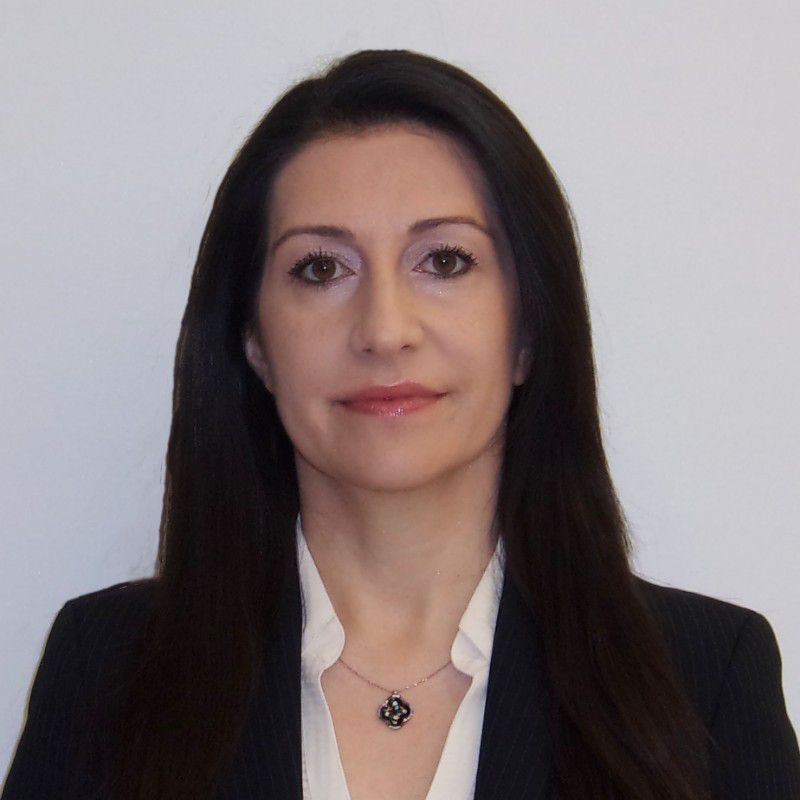
1. Within the framework of your academic trajectory and theoretical orientation, what were the main intellectual or aesthetic motivations that led you to focus on moments in which synchronization breaks down? Could you explain how this interest emerged and what kind of shift it created in your research path?

My focus on asynchrony emerged from a moment of analytical failure. One evening at Georgia Tech, I was watching Nuri Bilge Ceylan’s Once Upon a Time in Anatolia with friends from the Turkish Student Organization who organized the screening. Midway through a dialogue scene, something happened that stopped me cold: the characters’ voices continued, but their lips no longer moved. I remember physically turning to scan the faces of my friends sitting next to me, curious to see whether anyone else was as startled as I was. The shock of the moment of my realization that I witnessed a genuinely new technique of cinematic audiovisual asynchrony compelled me to consult with my cohort as well as my professors in the Moving Image Studies program at Georgia State University. I knew this new technique was not an instance of internal monologue, not acousmatic voice, not a voice-over, not an ellipsis; none of the established categories in film sound theory applied. Out of my fascination with this technique emerged the concept of the “cryptic voice,” a voice that is simultaneously present and absent, uttered and withheld, audible yet refusing to align with the moving lips of its speaker. One of my most exciting publications is the forthcoming chapter in the Oxford Handbook of Media and Vocality, because it will introduce this foundational term more fully with an extended analysis of the dialogue scene in Once Upon a Time in Anatolia as well as another scene in Ceylan’s Three Monkeys.

The cryptic voice became the conceptual spark that redirected my research toward identifying and naming the new sound-image relations as they emerge in contemporary cinema. This shift eventually led to my broader methodological framework, anasonicity, which examines what I describe as spectral, barely audible, or structurally “unsyncable” sounds in contemporary global cinemas. My project “Sounding Anew: Anasonicity in Contemporary Global Cinemas” revisits existing film sound terminology and proposes “anasonicity” as a new methodological approach designed to address emerging sound techniques that transform conditions of audibility and inaudibility in contemporary cinematic experiences. Taken together, these sounds radically disrupt synchronization and require new modes of listening, while the films that deploy them unsettle linear temporality by rendering the sounds of past, present, and future indistinguishable within their narrative worlds.

I call “Sounding Anew” the sonic counterpart of Akira Lippit’s Atomic Light (Shadow Optics). The conceptual seed for anasonicity –or asonority, as I use the terms interchangeably– was planted in Lippit’s formulation of avisuality, his term for the paradox of what is visual yet invisible, an impossible type of visuality that emerges with the birth of cinema, the X-ray, and psychoanalysis in 1895. Lippit’s insight is that by the late twentieth century, the image itself had begun to exceed the limits of visibility. Anasonicity takes up that provocation on the terrain of sound. If avisuality charts the limits of seeing, anasonicity attends to a parallel shift in our experience of hearing that happens a hundred years later: sounds that slip between the audible and the inaudible, voices that fall out of synchronization in completely new ways, sounds that refuse to anchor themselves in time. Attending to the contemporary anasonic nature of cinema then, I name the emerging sonic techniques that trouble what we think sound is supposed to do in cinema, and, by doing so, ask us to critically attend to such moments that demand a new ear and a new thinking.
2. Your work appears to resonate with Michel Chion’s approach to the sound–image relationship. How has Chion’s theoretical framework shaped your scholarly orientation, and in what ways do you expand, reinterpret, or challenge the conceptual space he opened?

Michel Chion remains foundational for thinking about cinematic sound: his attention to the phenomenology of listening created the conceptual template many of us have inherited. While serious scholarly engagement with sound and sound–image relations began in earnest with the 1980 Cinema/Sound special issue of Yale French Studies under Rick Altman’s editorship, it was Chion’s Audio-Vision that became truly indispensable to the evolution of film sound studies. Since the 1980s, the field has expanded and transformed, but Chion’s framework endures as one of its most generative intellectual anchors.

I was particularly impressed by Chion’s capacity to generate incisive terminology in Audio-Vision, especially his formulation of the acousmêtre, which offered a model for how conceptual precision can illuminate phenomena that had long remained elusive. Among all the formal elements of cinema, sound is notoriously difficult to analyze, and Chion’s work demonstrates a rare patience, rigor, and passion for close listening.

Chion visited Atlanta to give a talk at Emory in 2017. Having encountered the cryptic voice in Once Upon a Time in Anatolia, I carried my bewilderment directly to him. After his lecture, I approached him to recount the dialogue scene and to ask what he made of the voice emerging from unmoving lips. He knew the film well and immediately remembered the scene, and yet his response, “It’s just the ambience!” sounded unexpectedly dismissive and was invaluable precisely because it exposed the limits of our established vocabulary. My aim is not to overturn Chion’s legacy but to expand and complexify the conceptual field by naming new audiovisual phenomena that contemporary cinema is producing. In this sense, I see terms such as anasonicity, cryptic voice, echoing sonic flashback, and muted image as the next theoretical steps after Chion: concepts that build on his groundwork but are calibrated for an emerging audiovisual landscape and explained through deep philosophical engagements.

3. The original English terms you have developed to describe moments in which synchronization slips, breaks, or is intentionally disrupted offer a significant contribution to the literature. How does your process of conceptual creation unfold? What theoretical, aesthetic, or phenomenological criteria guide the emergence of a new term?

A new term never precedes the phenomenon; it arises only when a film insists on it. My process is grounded in close listening —what I call a gesture of “listening through,” borrowing from Derrida’s method of “reading through” texts against themselves— and in allowing films to challenge the limits of the theoretical lexicon we already possess. This careful act of listening through these films involves returning to a scene again and again, hearing it anew each time, in repetitions that arrive with difference and produce something new each time. After all, many of the sounds I study are barely audible, and some of the techniques I name appear only fleetingly in most films rather than in extended sequences like the example in Once Upon a Time in Anatolia. So an attentive ear is the key to the process.

Sometimes colleagues and friends help direct my attention to certain films. After my first presentation on the “echoing sonic flashback” in The Revenant (Alejandro González Iñárritu, 2015) at the Sinefilozofi Symposium in 2022, Dr. Serdar Öztürk mentioned a brief but striking use of the cryptic voice in Pelin Esmer’s Something Useful (2017), which I am presenting on at this year’s symposium. I am equally grateful to Jordan Chrietzberg, who recommended The Zone of Interest (Jonathan Glazer, 2023); to Jazmine Hudson, who pointed me toward Sinners (Ryan Coogler, 2025); and to Cameron Kunzelman, who suggested Memoria (Apichatpong Weerasethakul, 2021). These recommendations become invitations to texts that demand to be listened to with care. I am currently extending my research on what I term The Anasonic Zone of Interest, have begun developing a piece on Sinners, and still await the opportunity to encounter Memoria, whose limited circulation has made it particularly difficult to find.
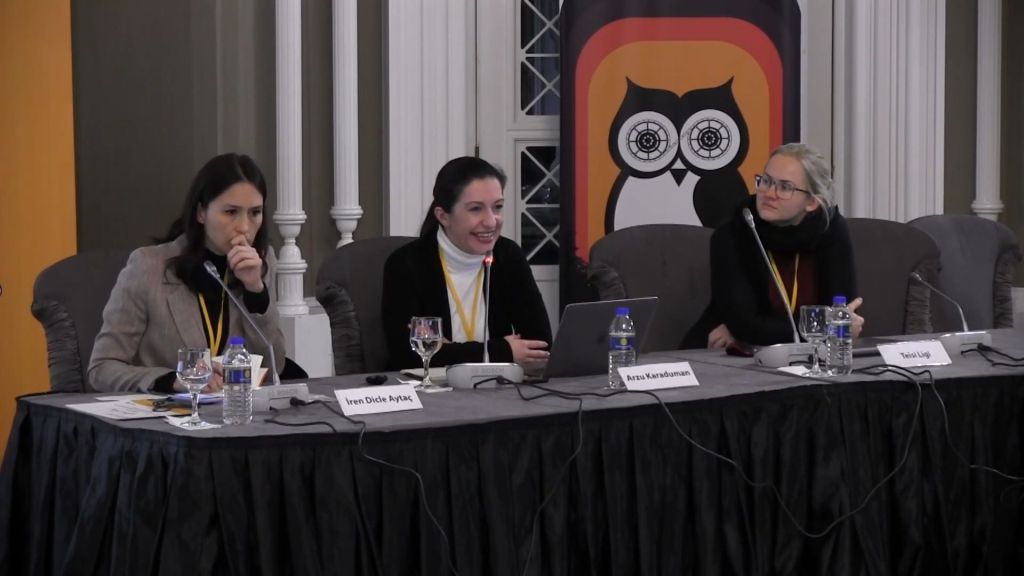
To clarify the process of conceptual creation, I could list three simultaneous criteria that guide the emergence of terminology:
• Phenomenological precision: What exactly is being heard? At what level of perception: audible, barely audible, spectral, remembered, virtual?
• Narrative function: How does the sound alter temporality, embodiment, relations to memory, or the ethical space between characters?
• Theoretical necessity: Can existing terminology account for the phenomenon? If not, what new concept is required, and what conceptual gap does it fill?

I call these subcategories of anasonic sounds “impossible,” because their functions stretch the boundaries of audiovisual asynchrony as defined in established film sound scholarship. Cryptic voice, for instance, emerged from recognizing a voice that is spoken, heard by other characters, and fully audible—yet unaccompanied by lip movement. Echoing sonic flashback, which I explore through Park Chan-wook’s Lady Vengeance in my recent chapter for Derrida and Film Studies, names a distinctive form of aural flashback that operates like an echo, where past sounds reverberate closely following the present sounds like an echo. The muted image (bridge), which I introduce in a forthcoming 2027 article for a Derrida Today special issue on Anatomy of a Fall (Justine Triet, 2023), describes an impossible form of synchronization between images and sounds across two scenes, creating an impossible match that dislocates spatial or temporal continuity.

In each case, I am identifying an impossible doubleness: sounds that are both present and absent, synchronous and asynchronous, grounded or embodied and spectral. I guess my genuine curiosity drives the will to coin new terms each time I notice a mismatch between sound and image in contemporary films. Ultimately, conceptual creation begins with listening to what cinema is doing—and inventing terminology only when existing language can no longer describe its operations.

4. In contemporary cinema and television, the sound–image relationship is increasingly heterogeneous, fragmented, and often deliberately detached. How do you interpret this trend in relation to the broader transformation of contemporary narrative structures? What does this growing separation reveal about the perceptual habits of today’s audiences?

Contemporary audiovisual storytelling has moved further from classical notions of linearity, audiovisual unity, and strict synchronization, even in realist films or TV dramas. Rather than treating the soundtrack as a stable accompaniment to the image, or simply as its subordinate, many contemporary films mobilize sound as an autonomous and sometimes unpredictable force, which I find exhilarating. This fragmentation or destabilization reflects a broader transformation in contemporary narrative structures; stories increasingly unfold not as single temporal continuums but as intertwined temporal planes: memory, anticipation, dream, trauma, regret, and potentiality. For instance, my work on “crystal sounds” in contemporary global cinema and television traces multiple instances of these destabilizing sonic formations, even in otherwise completely disparate texts such as Barry Jenkins’s Moonlight and HBO’s Westworld. And I am certain there are further cases that similarly stray from conventional sound–image coherences. 

New forms of asynchrony, in this context, become a perceptual challenge even in the already fragmented and contemporary narratives. These texts ask audiences to feel before they identify, to listen before they decode, and, to borrow from my own method, to “listen through,” again and attentively. Their refusal of easy comprehension is not unwarranted; I think they resist disposability. These works gain their ontological power from their radical sonic, audiovisual, and narrative experimentations. They force us to return to certain scenes repeatedly, to be able to engage with them at the philosophical level they operate.

Contemporary viewers are accustomed to media environments where multiple temporalities and sources coexist; streaming interfaces, multi-screen displays, algorithmic feeds inundate our everyday realities. Their perceptual habits have become layered, fragmented, and non-linear. Cinema is responding in kind, producing radical forms of asynchrony that not only resonate with these habits but also challenge the audiences further by demanding deep philosophical engagements.

Many of the films I study enact what Derrida calls différance, a temporal and spatial deferral, or what Deleuze theorizes as the “crystal,” an indiscernibility between the actual and the virtual. In this sense, the separation of sound from image is not fragmentation for its own sake. It is a mode of attunement to contemporary subjectivity, a way of making perceptible the disjunctions, overlays, and spectral echoes that define our media-saturated lives. And it is often precisely this radical rethinking of audiovisual relations that allows these films to do philosophy.

The digital media ecosystem—including streaming platforms, social media videos, and multi-screen environments—introduces new technical and aesthetic challenges to sound–image synchronization. How do you think these environments reshape the audiovisual relationship? Do you see these synchronization shifts evolving from technical glitches into deliberate aesthetic strategies?

Yes, what once appeared as “errors” or “glitches” are now being absorbed as expressive strategies. Digital media environments including streaming platforms, TikTok videos, algorithmically compressed sound files, autoplay transitions, and skip functions normalize the experience of rupture, elision, and discontinuity. Cinema has responded by formalizing these experiences: asynchronous editing, displaced soundtracks, spectral voices, or echoes of the past that intrude on present time. For example, the echoing sonic flashback or the cryptic voice are not accidents of mishandling but deliberate manipulations that express heterogeneity of time through memory, trauma, displacement, or temporal paralysis.

Of course, tight synchronization between image and sound and the accompanying expectations of temporal continuity and linear narrative progression remain the norm if we consider the thousands of films produced globally each year. However, the shift from analog to digital has introduced new aesthetic sensibilities and technical possibilities that continue to reshape what filmmakers can do with the soundtrack. For example, Mark Kerins was one of the first scholars to trace a level of sonic complexity to the creative potential of surround-sound multichannel formats. Others have similarly noted the increasing indistinction between sound effects and music in contemporary digital sound design, where layers of sonic material can be manipulated with extraordinary precision.

Digital tools have made it possible to craft soundtracks that are denser, richer, and more structurally complex. As a result, synchronicity is no longer the default formal expectation but merely one option among many. Digital media and digital culture defined by compression artifacts, algorithmic modulation, nonlinear temporality, and platform-specific listening habits have fundamentally transformed the conditions of auditory perception. In my scholarship, I see that cinema has responded the transformed conditions of audibility by experimenting with the dramatic and philosophical possibilities of what I call “unsyncability”. Conversely, and perhaps more intriguingly, we can argue that cinema has anticipated and even instructed the audiovisual logics of emerging technologies and those who design them. For instance, I claim that the technique of the muted image that foregrounds voice as media in the impossible synchronization between the voice and a pair of foreign lips reappears today in the artificial synthesis of prosthetic voices and faces in deepfakes and AI-generated content of our current media ecology.
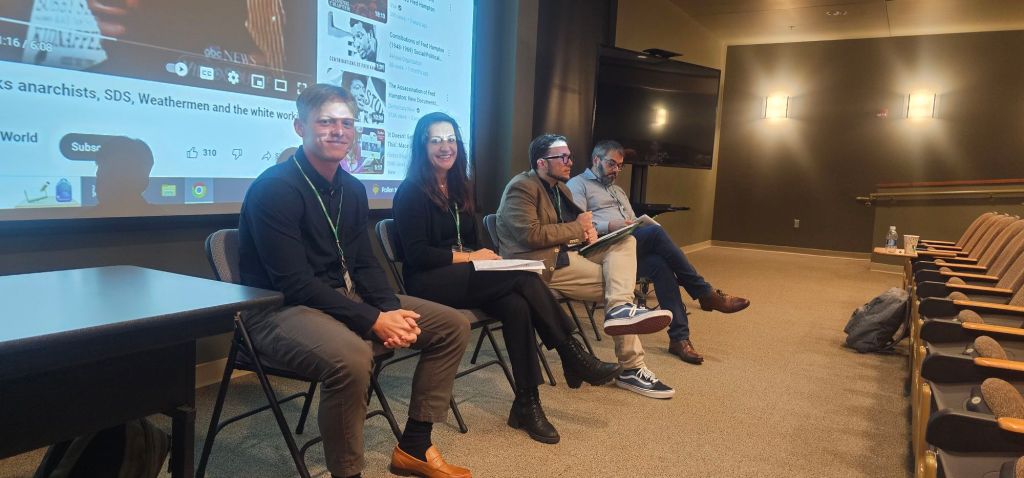
Publishing all your work and terminology in English makes your concepts more visible in international scholarship. How does this linguistic choice influence your theoretical framework? In what ways does producing terminology in English shape the nature or boundaries of your conceptual work?

To be completely honest with you, I have never pursued scholarly work in any language other than English. I attended Zonguldak Atatürk Anatolian High School, where nearly all courses were taught in English. My B.A. in American Culture and Literature and my M.A. in Media and Visual Studies at Bilkent University continued this trajectory, as English was the institutional language of instruction. As a result, my intellectual formation, reading habits, writing practices, and theoretical vocabulary have all been shaped entirely in English.

At the same time, English is the primary language of global academic discourse in Film and Sound Studies, and developing my terminology in English ensures that the concepts circulate widely beyond national contexts. I see scholars writing in languages other than English like German, Portuguese, or Finnish citing my published works. I am not sure that publishing these concepts first in Turkish would have enabled that kind of international reach.

English also imposes a productive rigor. It demands conceptual precision: a new term must justify itself etymologically, analytically, and philosophically. This pressure toward clarity ultimately strengthens the concepts. For example, asonority could not have existed merely as a convenient linguistic parallel to Lippit’s avisuality, that is an elegant analogy invented in the final sentences of a 16-hour comprehensive exam. That day at GSU, I simply coined it without knowing what it meant or how to fully theorize it, and I finished my exam with a long list of questions in the space allocated for answers. Asonority/anasonicity had to accrue methodological and analytical clarity, enough to withstand the scrutiny of my dissertation committee: Angelo Restivo, Alessandra Raengo, Calvin H. Thomas, and especially Akira Lippit as my outside reader. I am deeply grateful for their patience, which allowed the concept to mature into the methodological framework it finally evolved into. In short, English, despite being my second language, has been a conceptual and philosophical playground for me throughout my entire academic life. 

Looking toward the future of your research, what new theoretical questions are you pursuing within the study of sound–image relations? Are there particular themes or conceptual directions you plan to deepen in your upcoming work?

My current trajectory continues to expand the conceptual umbrella of anasonicity. At present, I am in conversation with Palgrave regarding my first book project, which will likely take the form of a short pivot, given that I have already published several peer-reviewed articles and chapters that have divided the larger project into smaller, thematically coherent components. I am also working on an article titled “Au revoir to voix: Muted Images in Anatomy of a Fall,” which introduces the term muted image as a technique that produces an impossible synchronization by pairing the visuals of one scene with the soundtrack of another. To my knowledge, the first use of this technique appears in Park Chan-wook’s Lady Vengeance (2005) and later at the climax of Justine Triet’s Anatomy of a Fall (2023).

A second term I am developing is the “meta-burden of representation,” which I use to analyze the self-reflexive structure of Cord Jefferson’s American Fiction. Here, Jefferson responds to the long-discussed “burden of representation” placed on artists from marginalized communities, yet does so within a work that becomes, through its very critique, burdened by the same representational expectations. This concept expands existing theories of race and representation by foregrounding the recursive, self-conscious pressures placed on creative labor itself.
Concurrently, I am pursuing a chapter for Bloomsbury’s The Music Video Industry: Interviews, Close Looks, and Takes, in which I examine the expanded terrain of the music video through an interview-based study of The Seasons, a large-scale audiovisual collaboration between composer Sebastian Currier and filmmaker Paweł Wojtasik. Among the questions I will bring to the artists first and then elaborate upon analytically in the second part are: How might we understand the lineage between expanded cinema as presented in concert halls (where films are screened with live accompaniment) and in museums (as installation-based, multi-format objects) and the contemporary music video? And, conversely, do music videos or experimental films with a music-video logic—Álvarez’s Now!, Conner’s Cosmic Ray and A Movie, Anger’s Scorpio Rising, Workman’s Precious Images, Devo’s Mongoloid—inform The Seasons’ approach to structure, rhythm, and montage?
Finally, although my published scholarship has thus far been exclusively in English, I intend to return to Turkish cinema with sustained attention. I have long been drawn to the sonic textures of New Turkish Cinema (mid-1990s to the present). Therefore, my next major project will be a second monograph on the sounds of this cinematic movement, exploring how the oeuvres of Reha Erdem, Pelin Esmer, Nuri Bilge Ceylan, Emin Alper, and Tayfun Pirselimoğlu respond sonically—as much as thematically—to the country’s evolving political landscape. This project will allow me to bring my conceptual framework into dialogue with the cinematic traditions that shaped my sensibilities, potentially in a bilingual format.

Across these endeavors, the guiding question remains constant:
What new forms of listening does contemporary media demand, and what new vocabulary must we devise to account for them?
A Feminist Lens on Memory: Griselda Pollock on Art, Trauma, and Representation

Interview Series: “Memory, Representation and Resistance: Thinking Alternative Media Cinematically through Academic Perspectives.”


I. Feminist Art History and Representation

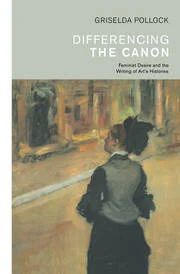
In Differencing the Canon, you propose a feminist re-reading of Western art history. How does this approach challenge traditional ideas about “greatness” and the exclusion of women artists? > [Reference: Differencing the Canon (1999)]

This is a slight misreading of the purpose of my book Differencing the Canon.  A canon is the official version of knowledge, and it is official story of Western art that  I am challenging Not only does this official story exclude almost all women artists, but it does also so because the issue is structural. The canon is formed to achieve a particular purpose: to establish a mythology of masculine creativity, that is further shaped by racial and geopolitical hierarchies, sexual normativity, and a hierarchy of materials and processes favouring the chosen media used in  Western art ( painting and sculpture versus ceramics and cloth).

Firstly, I had to establish what a canon is: a body of accepted knowledge and  method for making this knowledge appear to be an unquestioned truth. So, we have to show how the official story of art is constructed both by what it excludes and makes unthinkable and  by what it presents as being transparently the sole  truth.  The title of the book identifies such  selectivity, suppression  and exclusion as an active ideological process.

Feminist deconstruction of the canon is neither offering an alternative nor trying to include what was systematically excluded.  It has to reveal the power systems and their ideologies which naturalize a version one version of knowledge making invisible the ‘politics’ that produce these systematic exclusions and hierarchies of value. Another version of this idea is from British literary critic Raymond Williams who proposed an idea of a ‘selective tradition’ created by scholars that favours the dominant class, and I add, gender and  socio-geo-political nations. dominant religions and normative sexualities.

Differencing is a grammatical form— a gerund—of  a verb that does not exist in English. To differ is to disagree. To be different is the condition of variety.  To difference is my invention of a word that enables me to create a feminist concept. It is drawn from the work of French philosopher Jacques Derrida and his theory of deconstruction, and also indirectly from Michel Foucault. Derrida’s deconstruction is a process that reveals how the  ‘the selective tradition’ is created and suppresses certain knowledge and produces a smooth surface that makes any alternative unimaginable. Foucault , writing about the formation of the archive, taught us, however, that what has been made to become invisible has not disappeared. Rather it is folded out of sight.  We can open the fold and find that history that was suppressed. So, we are not adding women back into art history. My book exposed how  actual history is suppressed through folding some knowledge out of sight or by suppressing historical and social  conditions of production or denying the role of ideology: systems of belief and ideas that favour the dominant social groups.

Knowledge of women as artists was folded out of sight, given the massive documentation in history of their constant presence, for the purpose of creating a mythology about the individualism of each artist ( personality, intellect, interests, desires expressed in art: the expressionist thesis of art) in a society in which individualism was granted only to men of certain privileged classes.  To exclude artists as women can only happen in societies in which their social and ideological systems have already created a hierarchy amongst human beings on the basis of gender. Gender divisions are no more natural than class divisions or religious divisions.

These are created divisions, and the word woman signifies not a just a person of one type or another. Woman means not-man and the term functions as a negative  through which Man comes to signify the only pure type of the human.  The canonical denial of artistic and intellectual creativity to women is necessary for men to claim that they alone are the pure human with intellect and creativity.    We have to deconstruct the process by which man and woman are not two equal forms of humanity but are an opposition of plus and minus. This is why however many times we put on exhibitions or write books about women artists, we make almost no change, no progress. For 50 years I have watched this happen over and over again and every new exhibition gathers women artists together as ‘rediscoveries’. Differencing the Canon was an analysis of the ideological structure that  has in effect defeated our feminist  attempts to normalize the creativity of both women and men.  Greatness  like genius has also been stolen by men for men alone.  From a feminist deconstructionist perspective, we are not wanting to select some women for ‘greatness’.  We have to develop as curators and art historians and critics ways of seeing their art, ways of interpreting what women in all their diversity and singularity are creating, not because women all share some essential femininity. Each artist-woman is unique as an artist but also is living in a patriarchal, racist, often  religiously fundamentalist, capitalist and sexist and heteronormative world. Artists challenge us to see the world differently and from many perspectives. The issue is what art does, what it reveals, what we learn.  The art market  is not interested in art. It buys and sells brands.  Contemporary art world is based on names  of artists that become brands for  a massive  speculative investment market.

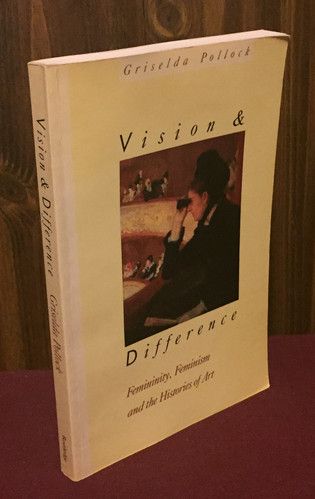
Your early work in Vision and Difference critiques how women have historically been portrayed in art. In what ways do these gendered visual patterns continue to influence today’s cultural and visual practices? > [Reference: Vision and Difference (1988)]

Let me make another small correction. Vision & Difference is a collection of ‘essays’ addressed to Art History, the academic discipline that studies art  while the essays challenge the story that Art History has made canonical: the only authorized version of art and its histories.  The essays are also about  studying art as representation: that means not as the individual expression of one artist’s imagination. Representation means that all artists participate in a cultural activity in which there are traditions of visual representation and also patterns of ideological meanings that these representations have affirmed or sometimes contested and even changed.  

Whose interests have the visual arts served? What visions of the world and how it is ordered have the visual arts produced by means of signs, materials, media, scales, locations. Whose vision of world has dominated, become normal? We know in the past the powerful rulers,  religious leaders, ruling classes commissioned artists to make works for the purposes of confirming the vision of the world of the powerful.  This is why the central essay in this book is ‘Modernity and the Spaces of Femininity’ which was my feminist  conversation with and challenge to the social historian of art, T J Clark,  who had transformed my understanding of 19th century French art by focusing on the significance the new metropolis and its new urban culture.

My question was: what does the modern city mean for women of different classes. The  bourgeois women do not work but can go to the park, go shopping, drive around in carriages, or go to the theatre. Working class women are exposed  in their often-visible work to predatory sexual exploitation by the men of the leisured classes. So, I analysed which spaces of the city the men and women involved in creating Impressionism, an egalitarian independent art society with both women and men artists involved in its creation, chose to paint and how.

I then asked myself if I can discern a difference in the space they chose and the way they represented women in these spaces. Thus, I introduced the idea of the gaze, developed in film theory. Who is looking at whom? Who is being  subjected to a sexualizing gaze?  How did Mary Cassatt and Berthe Morisot not only reveal the pressure of the masculine heterosexual gaze in public places but also represent the mutual gazing between women, or between adults and children?      This is another earlier example of differencing the canon of Impressionist painting and revealing that the division between what artist-men and artist-women represented was not public space versus private space, but between those parts of the city where men and women of all classes moved about and those spaces where bourgeois men looked at or purchased working class women for sexual reasons.

Does this still happen? In the West, the sexualization of women is even more rampant and normalized in certain cultures overtly or secretly. Why do we think we have made any progress at all when we look at the major platforms of representation today: social media. It reflects back to us a picture of the dominant imagination.  People believe that progress will happen. Being a structuralist feminist,  I do not hope.  I analyse the systems of representation and the social systems and their ideologies.  We appear to have forgotten these terms and these modes of deconstructive analysis. Representation of women has deteriorated and with social media, and beyond on the dark web, the brutalization and dehumanizing sexual abuse of women is beyond  horror. Given that one woman is killed every 40 minutes world-wide by a partner or family member, we must stop believing childishly in automatic progress and start naming patriarchal and phallocentric systems that produce  ‘men’ as beings who believe they have rights—including to life—over women and ‘women’ who accept that this is normal.  I see very little evidence of any real or systematic change in the representation of women because we have made so little progress to changing this system.

II. Trauma, Memory, and Feminist Aesthetics

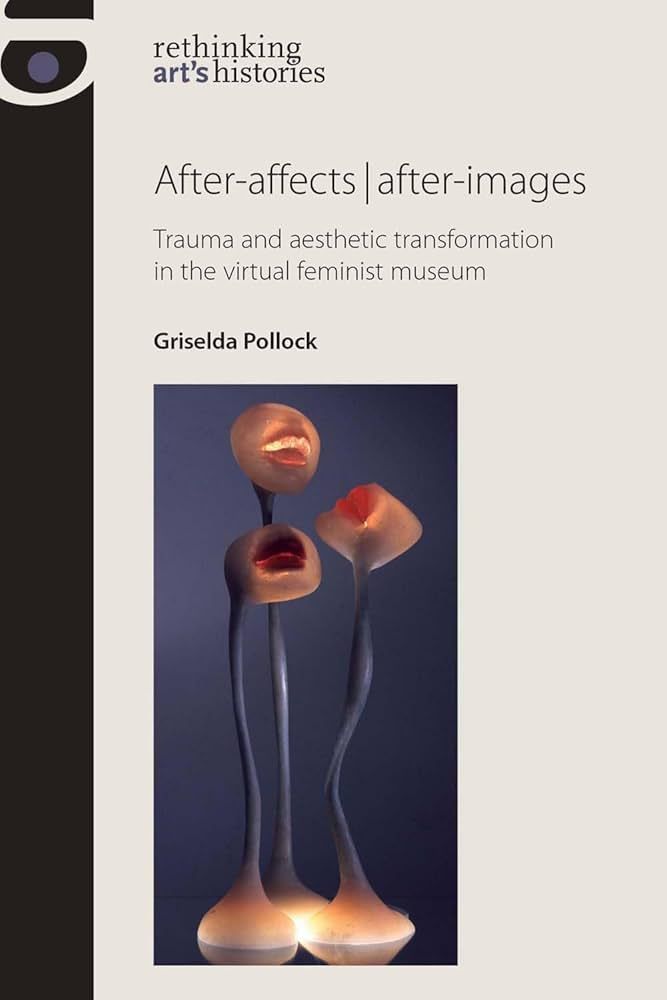
In After-affects / After-images, you explore how trauma shapes the experience of art. How can visual art provide a space for processing or representing traumatic experiences? [Reference: After-affects / After-images (2013)]

My argument in this book is not that traumatic experiences are processed or represented. Neither is possible.  The core conclusion of that book is that artists, who have endured horrendous experiences  such as famine, near death in genocide, sexual abuse, bereavement, exile and survival of extreme suffering may spend a lifetime of making art to create a formal  framework for a possible  ‘encounter’ with the trauma which is then transformed aesthetically.  This is not about cure or relief. It is about the relations between forms, colours, processes, time, spaces and the potential for this encounter with trauma that was a missed encounter: an event that overwhelmed the psyche’s capacity to process it and left the artist possessed or haunted by a shapeless pressure of an unknown ‘thing’ that occupies her or his psyche without she or he being able to grasp it .

In all the case-studies in the book, I noted that the processing of this shapeless, unknowable pressure of  the trauma was not a cathartic event but a matter of a lifetime of creating an aesthetic procedure or structure for a transformation through aesthesis: colour, mark, form, process: some painting, some film making, some sculpture, some video and installation. Each case study needed the most rigorous formal, material, structural analysis of how each artwork did its work. Work in German is Arbeit and Freud chose that word for what the psyche does in processing life events: in his terms the work of mourning, Trauerarbeit, working through: Durcharbeiten.  I want to stress the importance of psychoanalytical theory rather than everyday psychology. You will know that I have drawn in this book on the theories proposed by artist and psychoanalytical theorist Bracha L Ettinger who created the term artworking, Kunstarbeit as it were, to propose a specific mechanism for understanding what I was naming aesthetic transformation in which aesthetic is not about the beautiful but about how we, the viewers, are affected by colour, touch, movement, duration, sound: the senses when we experience artworks.

Trauma cannot be a topic or subject matter for art: that would merely represent something as an event. Particularly in the wake of modernist acknowledgement of the autonomous affects of colour, field, medium, temporality, etc.  art  can be a site for this managed ‘encounter’ with residues of trauma that can also touch and move a spectator not with a topic or sense of specific event, but to compassion and hospitality to suffering.

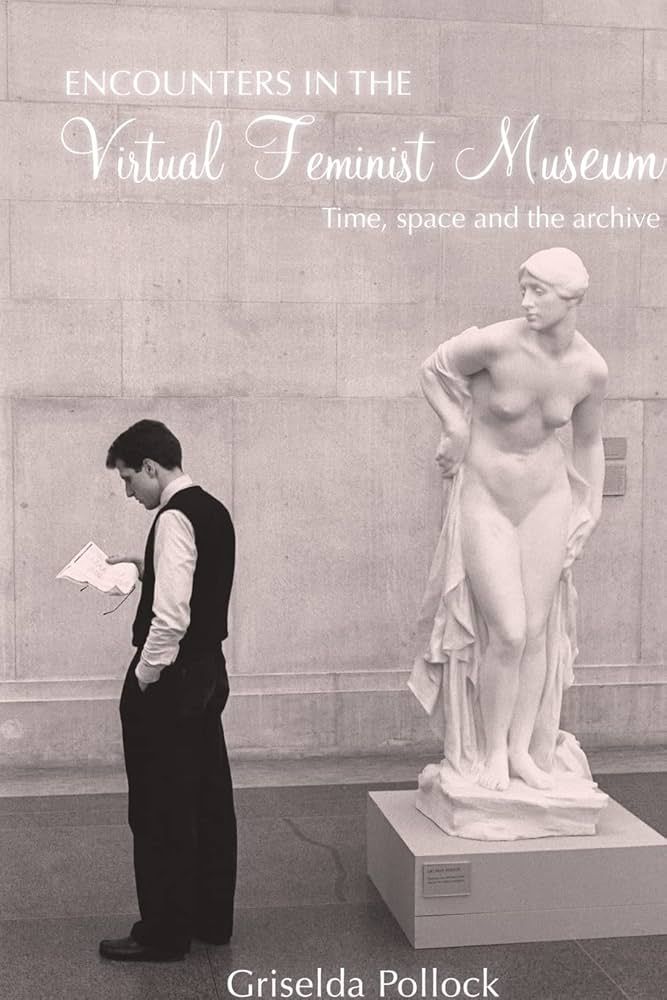
In Encounters in the Virtual Feminist Museum, you argue that memory is not only personal but also political. How does feminist aesthetics reshape our ways of remembering?  [Reference: Encounters in the Virtual Feminist Museum (2007)]

It is not feminist aesthetics that reshapes our way of remembering, it is that aesthetic practices may facilitate new ways of our responding to the encounter with art, as I suggested in the last question.  Are there feminist aesthetics? Certainly, there are philosophers who ask questions about the aesthetic experience from feminist perspectives: that is to challenge the masculine as the sole position of such experience or analysis.

Feminist is not an entity but a position of questioning, that is constantly questioning itself. Since women are the majority of the population and the only group who is systematically killed just for being women on a mass scale (femicide is the term for this), attention to the life and dying of women is a preoccupation of feminist thought. This means defining patriarchy as a form of socio-political-economic domination and phallocentrism as the psychological, linguistic and ideological justification of a system of male domination and privilege.  Feminist means analysis, deconstruction, contestation of how phallocentric patriarchies intersect with and are integrated with various economic systems such as capitalism or feudalism and with religious-theological-political systems.   Feminist is a mode of enquiry and research, not a women’s alternative. Feminist means caring for all oppressed, disadvantaged and suffering minorities including the world’s majority, women and girls. If art and its histories form cultural memory, the canons of art preserve and that justify male domination and hence the violation of the human rights of women and girls whose humanity is diminished and whose lives are put at risk. 

My virtual feminist museum is a concept and a device for asking: what would the world be like and what would we as people be like if we encountered in museums those forms and works of art that were oriented to and celebrated life: the preservation of life? Without idealizing women, who are as deformed as men are in their mentalities and ideologies by the phallocentric and patriarchal systems of power, feminist thought and analysis functions as a critical space of resistance and transformation that has to question and challenge itself, to learn from its own blind spots and negotiate its internal differences and potential hierarchies of privilege.

I do not work with feminist aesthetics but what I termed feminist desire: desire for the end of oppressive dehumanizing systems of power, of the kind of greed that is destroying our planet and rendering millions of lives almost unliveable and dehumanized.  Rather than worrying about keeping women in their places,  we all need to ally to keep the planet alive, and to do so we need feminist thought that names and challenges the basis of inhumanity: which is that one group of humans treat their fellow humans as instruments not people.

In 1972, a French writer, Françoise D’Eaubonne, an art historian, wrote a book titled Feminism or Death. It was the first feminist eco-critical texts linking the fate of nature and the planet to the fate of women… feminism is thus not a specialty for feminists. It is a condition of future existence for the planet and humanity. Can art do some work in this direction? Yes. Must we all deconstruct and denounce patriarchy and phallocentric thinking. Indeed.

III. Visibility, Institutions, and Feminist Curating

What curatorial practices or institutional strategies have you seen succeed in making space for women and other marginalized artists within mainstream art institutions?

Very few, for the reason that the issue is structural and cannot be mended by gestures of mere correction.  But we can and must study strategies that propose different models and address the key elements of curation. These are not packaging ‘art’ as an experience  for visitors to gain pleasure or acquire cultural capital. Currently museums and galleries, shaped above all by a rampant art market and art fairs where vast  amounts of money are being made and from whom they get their funding to make exhibitions and purchase artwork, are not examining alternative models. They are about entertainment, cultural capital and further securing financial investment in objects branded by artist names by giving collectors  and foundations that now own lots of works of art the seal of high cultural value. 

I used to teach courses on  exhibition histories and focused on a history of five DOCUMENTA exhibitions since 1989, a key moment in European history with the fall of the Soviet Union and the Berlin Wall.  This was a study of curatorial strategies in this major exhibition of contemporary  every five years and its was fascinating since these platforms of the biennials are now the major exhibition form.

In the few exhibitions I have curated, the framework has been conceptual: not just a theme, a period, an artist, a topic. My aim has been to encourage visitors to grasp the relations between the works they encounter and the histories, concerns, traumas, and indeed aesthetic transformations that are being tipped into visibility and aesthetic encounter by artworking.  It is not that the art is made a woman, a category, already defined by  the hierarchy of value of men versus women. It is the position from which she intervenes into a field of meanings, a pattern of discourses, a conversation about practices and modes of art making.  How do these works of art do their work to transform my understanding of the world, my sense even of self, of others, of changing perspectives. My recent exhibition was titled Medium & Memory, and I selected eight artists all of whom have different practices, different concerns, yet all were brilliant transformers of their chose media: painting, video, drawing, collage, photography. All were deep thinkers about their practices. All were very engaged with different kinds of memory: memory of a book that has been read, memory contained in images that we collect and encounter that shape patterns of thought,  memories that are missing because political trauma made them beyond imagining and remembering.  I try to bridge the worlds of critical social historical feminist art historical writing and the intense issues of the present world through artworks that provoke responses and indeed incite words as we describe what the artwork is doing and how they lead us to discuss issues and concepts.

Medium refers to the great lesson of modernism. Memory addresses the burden we carry from our consciousness of the modern world that we inherit and this fearful, endangered and violent world in which we are now living,  with uncertainty and dread.  Can we, will we ever create a humanity shared by all and with the living planet on which we depen? Can we come together in thoughtful, ethically sensitive and life-oriented artmaking that is not about speculative profiteering of the very few who having made billions and get richer and richer while people starve, are washed away in floods caused by climate change caused by fossil fuel use, die from heat, or are murdered, as women are with relentless regularity.

Art has been a rich and brilliant site of  creative thought in aesthetic languages. I still believe in its criticality.  But as you ask me questions about my project over 50 years as a feminist art historian, I am hoping that some memory of what feminism has tried to achieve over 200 years worldwide will survive or even now challenge our complacency as disaster looms even as it has already has destroyed life worlds of many vulnerable peoples.

Feminist is one form of attention to women, certainly, but also to life, a life that is human for all and in being human, knows that we are the ones who must care for this planet or  die. Art is not about entertainment, prices,  fashion, celebrity or an even earning a living writing about it.  It is a uniquely human activity that is called to account for the same responsibility. Often it is already performing that, if only we knew better how to read what it is doing and can do to affect us and change our understanding.

You often reflect on “absence” in dominant art histories. Can absence itself become a meaningful feminist strategy of presence or resistance?

Not at all!  Resistance comes through being present, writing, creating, arguing, surviving, persisting.   I do not have confidence that the feminist revolution of which I was a part since 1968 is being preserved, fully studied and remembered, understood in all its complexity and intellectual and artistic brilliance. It can become a  category, an investment potential. For me it has always been a politics of practice and of knowledge. It is continuing and self-challenging and adapting and learning. The artists are always one-step ahead.

Feminism is now a memory, sometimes presented in distorted and reductive fashion. It has a very long history and dispersed geography. It was never one thing. It is a partner in continuously imagining how we might all live together, all living forms, in dignity and safety from violence and impoverishment of spirit and bodily life. This is very urgent. Those called men and those prepared to be the women that patriarchal cultures design and the violently police must be challenged to realize that this a moment of choice for humanity and life on this planet itself.  Capitalism is still  a force that has not been tamed for life, and we see this is an obscenity of  the divisions of wealth and poverty , greed and indifference on this planet.  Feminism, art and thought are partners in this continuing struggle.

CINEMA AESTHETICS IN THE ANTHROPOCENE: AN INTERVIEW WITH JENNIFER FAY

Interview Series: Climate Crisis in Cinema: Rewriting the Planet’s Story Through Visual Narratives

Gertrude Conaway Vanderbilt Professor of Cinema & Media Arts Professor of English | German, Russian, and East European Studies Vanderbilt University

Cinema and the Anthropocene

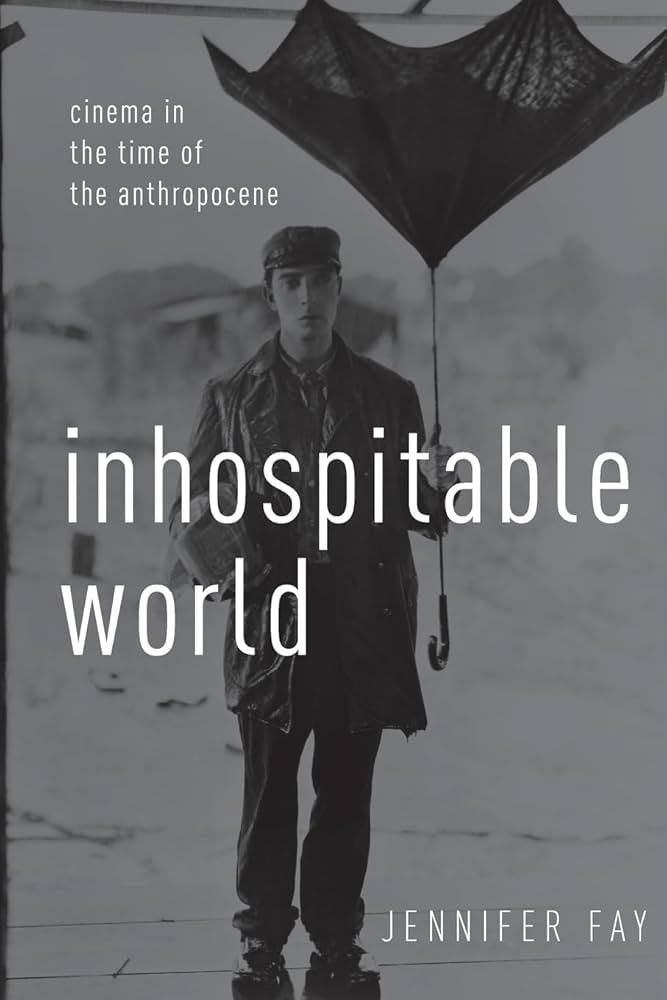
In Inhospitable World, you explore how cinema functions not only as a medium of representation but also as a site of environmental struggle and aesthetic refusal. How do you think cinema—especially narrative cinema—responds to the epistemological and material challenges of the Anthropocene?

Narrative cinema, as opposed to documentary, responds to the Anthropocene in a few different ways. And, of course, much depends on how the Anthropocene is defined as a political and environmental crises, historical phenomenon, and/ or cultural logic. I’ve been interested in narrative films that thematize anthropogenic weather and pointedly artificial environments, on one hand, and others that bring to the fore, as a matter of design, massive infrastructure projects such as mega-dams, highways, big agriculture (to name a few) that have altered, profoundly and at a planetary level, the surface of the earth and the movement of water, animals, and people. There are contemporary narrative films that respond to the Anthropocene thematically by taking up plots about climate change. But there are others that can be more interesting to study that set fictional stories against backdrops in which the forces of the Anthropocene are on display, but not at the forefront of the story.

And we can also study fiction films made in studios, long before the Anthropocene was discovered, that thematize weather and atmosphere as designed or artificially produced rather than naturally given. Sometimes this is obvious in the plotting or a matter of knowing production history. This idea of artificial or anthropogenic weather, “nature,” and world have always been at the center of narrative films where the need to control and reproduce environmental conditions is paramount to efficient production, perhaps especially when, in the film, the effect is supposed to look contingent and natural. In this way, we can see designed environments (including calamitous weather) as an aesthetic practice of cinema that is connected to the cultural forces and impacts that give rise to Anthropocene conditions.

The term “inhospitability” that you foreground resonates with the unlivable conditions of both planetary ecosystems and cinematic spaces. How does this notion help us understand the aesthetic or ethical function of discomfort in environmental film?

Inhospitality is meant to describe a few things. First, it refers to the world of the Anthropocene that is increasingly unlivable to most Holocene life. I focus on the 20 th century and period of the Great Acceleration in which the explosive rise of consumer capitalism and visions of a “good life” in the mostly white western world destroy the environmental conditions on which all life on the planet are predicated. Cinema is complicit with this culture of accumulation.

Historically Hollywood films have advertised images of “the good life” to spectators all over the world to imitate, and cinema is, for the most part, a resource-intensive entertainment in all phases of production, distribution, and exhibition, whether as celluloid projected in the theater or as streaming content. But this also an artform that sheds light on the climate catastrophe. The world we see projected on screen represents and may mirror the one we inhabit. Thus, cinema offers a way of viewing our world at a remove from which we may contemplate the relationship between a pattern of life and the natural resources or petrochemicals that give rise to it.

Second, hospitality speaks to the ethical relationship between guests and hosts, of who welcomes whom. Inhospitality gestures to a refusal of these terms, and not only between people. Hospitality between people presumes that the earth is a home to the lifeforms that have evolved here. The earth’s hospitality is no longer assured. Finally, I am interested in the world of the film and the image. What does it mean to take up residence in an image? Are there forms of environmentally-minded cinema that refuse that invitation? Other films may welcome us to an image where we may not find a place for living in the world.

How might film’s aesthetic choices—such as composition, sound, duration—contribute to either revealing or concealing ecological fragility?

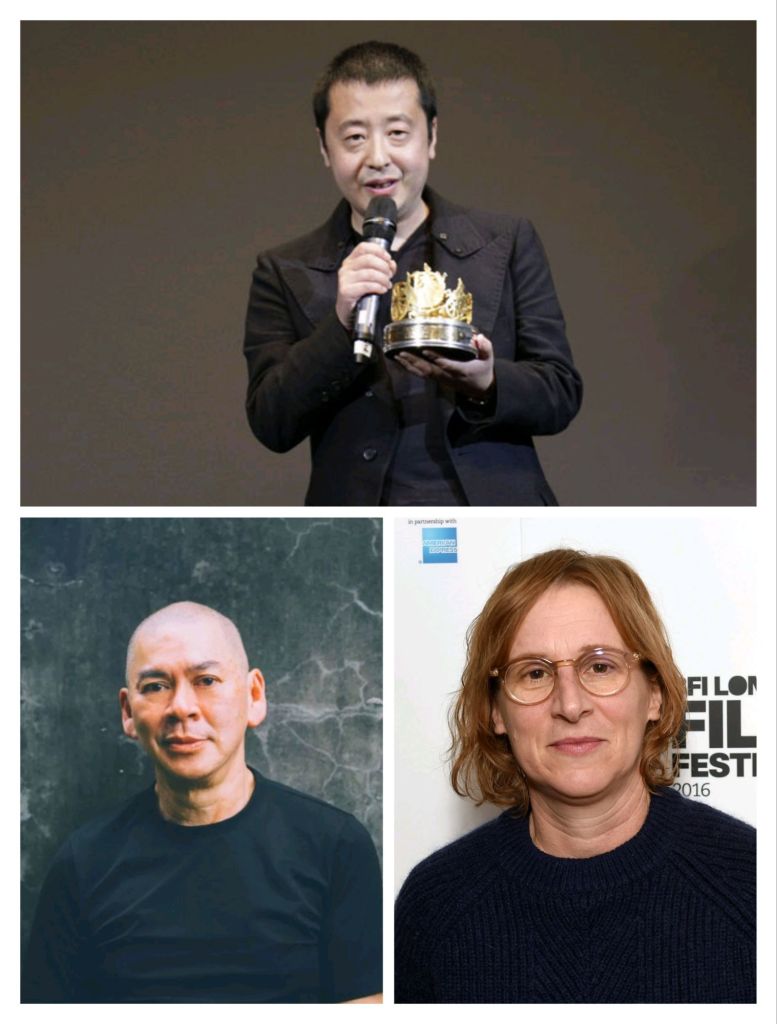
Cinema is an aesthetic arrangement of material that viewers may not otherwise perceive or take the time to notice in the real world, and this goes for a range of phenomena people, animals, places, and environments. Cinema allows us to take another look and have a second or third thought about the things we see and hear; a film may give us a view on the world that exceeds or defamiliarizes human perception and attention. I am among scholars interested in so-called slow cinema, Tsai Ming-liang, Jia Zhang-ke, Kelly Reichart, to name just three directors with environmental attunements and a penchant for long takes that give us time to become absorbed in an image and its sounds and also to become curious about what is beyond the frame. At the same time, cinema may also keep the world and its crises from view. It all depends on who is conceiving of the film, controlling the camera, and making decisions about what film-goers get to see.

Genres and Forms

There is often a tension between mainstream cinema’s spectacular tendencies and its capacity to provoke ecological awareness. Do you believe that popular genres (sci-fi, disaster, thriller) are capable of engaging critically with the Anthropocene—or does this role fall more effectively to experimental or documentary forms?

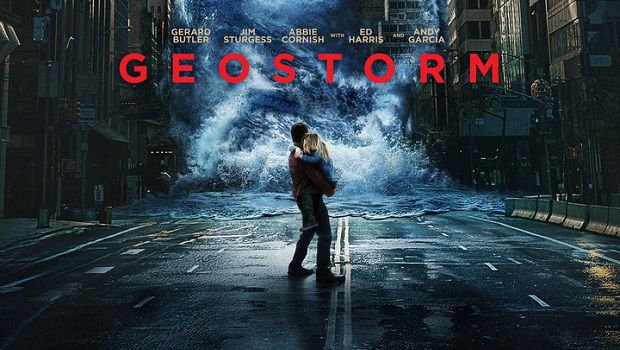
Big-budget mainstream films may not take the political risks of documentary and experimental films, and so it makes sense to look beyond the cineplex for meaningful work about our climate crisis. But this is also where film criticism intervenes to consider how even seemingly apolitical or banal genre films are saying something worthy of attention. For example, I find the totally banal Geostorm to be kind of interesting as a post-apocalyptic film. The scenario is that the planet’s entire climate system has collapsed and is now regulated through satellites. When we encounter this post- apocalyptic world, however, it is exactly like the pre-apocalyptic world that brought about the catastrophe in the first place; i.e. the current world. Nothing has changed (not that any character remarks on this fact). And, thus, this silly genre film says something about climate catastrophe, a fantasy of geo-engineering, and a desire to maintain the unsustainable the status quo.

Are there particular films, auteurs, or cinematic practices that you believe manage to narrate environmental precarity without reducing it to cliché or moralism?

There are genres that I think of as having an environmental sensitivity if not sensibility. For example, film noir and its attraction to built environments, bad air, and desiccated urban spaces has deep connections to naturalism and pessimism in ways that show how urban worlds built for human life become unlivable for these characters who rarely survive the film. These are low-budget movies, often shot on location, and feature characters who want but who cannot achieve the “good life” of consumer capitalism that is underwriting the Great Acceleration.

How do genre conventions affect how we conceptualize ecological time, space, and agency?

The film historian and theorist Karl Schoonover is currently writing about auteurs like Max Ophüls and Douglas Sirk in terms of their attention to soot and waste (Ophüls) and the byproducts of petroleum—from plastic to make-up—that are everywhere in the mise- en-scene (Sirk). Another film scholar, Nadine Chan, researches the history of colonial cinema in Malayasia. Chan focuses on the relationship between colonial extraction and the educational films made for colonial subjects whose labor is being extracted along with the colony’s raw materials. Cinema both archives this process and participates in the colonial economy. Finally Brian Jacobson’s recent book The Cinema of Extractions considers how the form of early cinema, especially, is parallel to the raw materials and infrastructures on which cinema relies. If there are many early films about trains, to take just one example, it is because trains carry the materials needed for cinema.

Temporality, Scale, and Representation

The Anthropocene demands that we think across scales—geological, planetary, human. What role can cinema play in making “deep time” and slow violence perceptible to audiences who are accustomed to fast-paced storytelling?

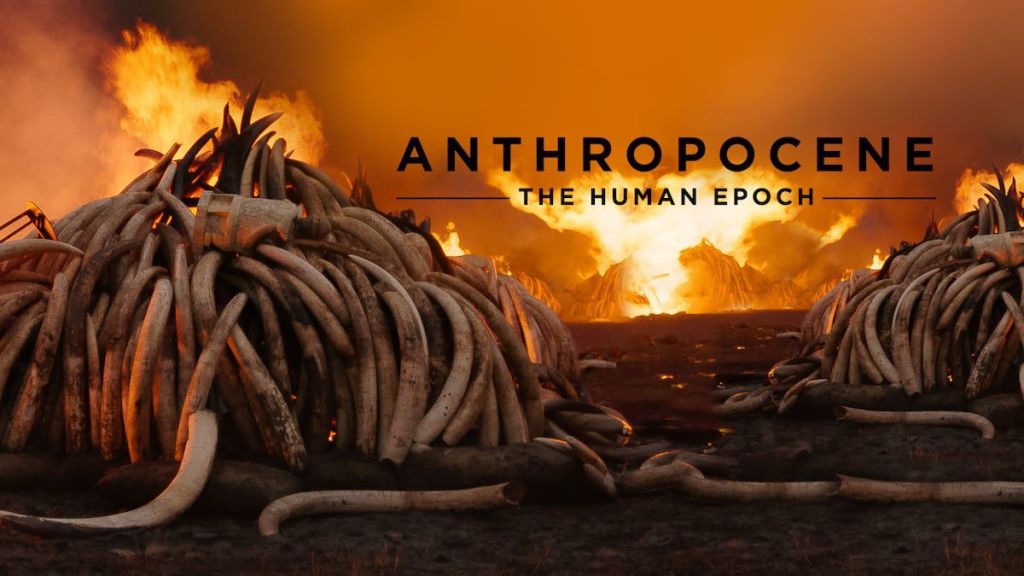
No one film or even group of films alone can tackle a crisis that is so totalizing, planetary, and yet uneven in its signs and stresses. One challenge of representing the Anthropocene is that it is not reducible to a singular event so much as a “step change” in socio-economic activity that accumulates in impact and changes quickly in geological- scale time, but slowly in terms of human perception. Films that have attempted explicitly to illustrate the Anthropocene concept or thesis – such as The Anthropocene: The Human Epoch (2018) or Erde (2019)—can be a bit mystifying to viewers not already familiar with the nomenclature. The visual evidence is not always clear in its illustration. But these films do provide a kind of snapshot of resource extraction and resource depletion, the kinds of human labor and modes of living occurring all over the world that have reshaped the planet and changed its chemistry, with attention to those who suffer most to sustain a way of life in the wealthy global North. The films show us the uneven distribution of wealth and risk, and they move between the scales of satellite images of earth down to the microscopic. The scales of space find a rejoinder in strategies of representing deep time through stratigraphic layers of rock or ice. But the data that geologists use to make the case for a new epoch are not always the most compelling material for films (even if the evidence they produce can be breathtaking). There is also the threat of producing a generalized humanity as opposed to a particularized history of exploitation, racialized capitalism, and the uneven impacts of global warming. As numerous historians and anthropologist tell us, there is nothing inevitable about the way our climate culture has developed, and this is also a danger.

In what ways might film temporality challenge anthropocentric or progress-based narrative structures?

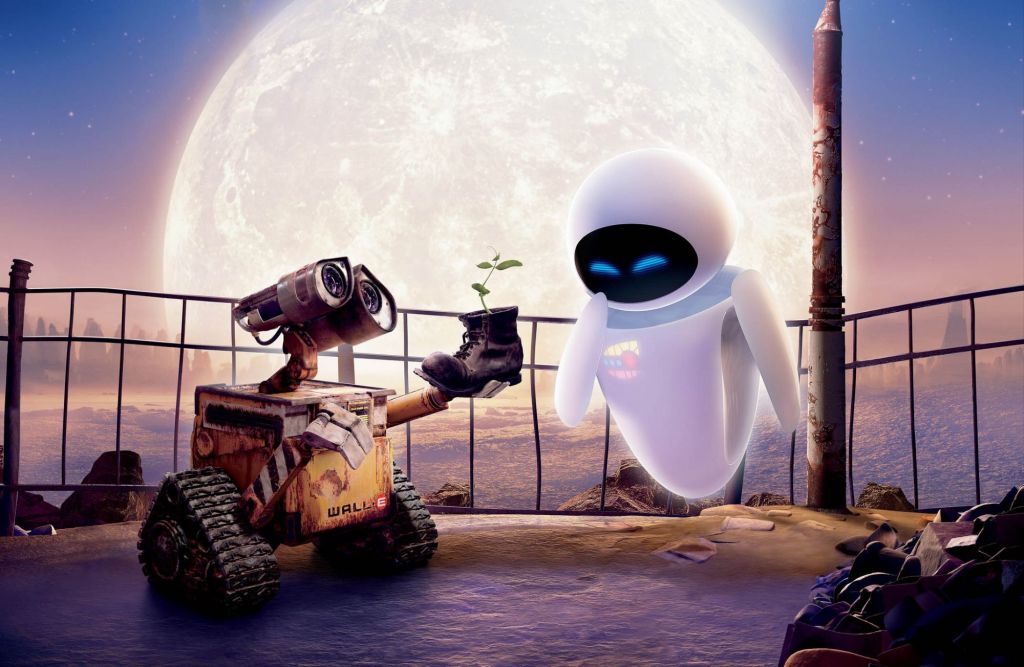
As a geological term, the Anthropocene is also a projection into a deep future. It is a concept that concerns not only the place of human history in the context of Earth’s 4.5 billion-year existence; it is also about the trace that human culture will have left on the planet millions and billions of years from now. The very question should have us consider the long legacy of modern industrial culture. What will be nested in the geological strata to announce that people once roamed this earth? Likely not the meaningful archives of literatures, laws, art, film, and history, but plastics, nuclear materials, and so-called “techno-fossils” discarded by wealthy nations in pursuit of an unsustainable, resource intensive, quality of life and an equally destructive and toxic property of war. A few geologists have proposed that the fallout from nuclear testing has already left a distinct mark all over the planet that could be the most distinct trace of the Anthropocene, since many of the radioactive materials are not “naturally” of this Earth. What is likely to remain in the geological record are not the artifacts we hold dear, but the refuse that capitalist culture discards along with the weapons that destroy us all. In its arresting opening scenes, Wall-E (2008) gives us one version of this future: a planet with abundant trash minus humans and all signs of natural life. How does a robot sort the significance of these remains? This will be the task of alien archeologists who visit our planet the deep future.

What dangers exist in making climate stories overly personal (e.g., through individual heroes or family dramas) or too abstract (e.g., anonymous data, satellite imagery)? Can cinema cultivate a collective emotional register—one that resists neoliberal optimism but still affirms the urgency of ecological care?

There are genres that I think of as having an environmental sensitivity if not sensibility. For example, film noir and its attraction to built environments, bad air, and desiccated urban spaces has deep connections to naturalism and pessimism in ways that show how urban worlds built for human life become unlivable for these characters who rarely survive the film.

What ethical obligations arise when filmmakers attempt to visualize planetary scale processes or speculative environmental futures?

It is a challenge to keep all of these data points in mind and hard not to feel utterly full of despair. So, it is important to find important stories of resistance and scenarios of world repair. We learn that our current state of disastrous ecology is not a natural progression of human life on earth, but a consequence of colonial land-grabs and the capitalist bid to turn the earth and many of its people into raw material and profitable commercial resources.
Darwin’s Nightmare (2004) explores the ecology of Lake Victoria and the disastrous commercial cultivation of invasive species of Nile Perch in its waters. The trade in perch has led to a neo-colonial economy and massive extinction events in the world’s second largest fresh-water lake. Bacurau (2019) turns the table on who or what counts as an invasive species.
Still Life (2006) and This is Not a Burial, It’s a Resurrection (2019) are movies of quiet but powerful protest against state-sponsored mega-dam constructions that force the relocation of everyone in the floodplain and submerge entire cultures under the devastating waters of “development.”
There is no way to completely reverse the course of modern industry and rapacious capitalism, but we may glimpse visions of repair. Honeyland (2019) is one such vision where taking only what you need in moderation is the difference between life and death, not only of bee colonies, but of all life on the planet. If Hollywood once projected an image of the good life based on American style consumer capitalism, cinema can now show us a different way of living, a new version of “the good” in light of our entangled and differently endangered lives.

Narrative Language and Ethics

Do you think cinema must cultivate a new narrative grammar in the Anthropocene—one that goes beyond individual agency or resolution?

Cinema, like the Anthropocene by some accounts, is a product of the industrial revolution. The medium’s radical possibilities with regard to space and time are already attuned to the epochal rupture of the Anthropocene. Indeed, I think cinema is one of the best archives of the Anthropocene because it is so fully implicated in the industrial, cultural, racial, and colonial practices that have laid waste to the planet. It is also a medium that can, as I write above, shows us a vision and version of the world without us.
How might cinematic ethics be redefined to account for nonhuman entanglements, multispecies justice, or posthuman subjectivity?
While much of narrative cinema revolves around people and their psychology, cinema has long been celebrated as an optical medium that, like photography, flattens the ontology between humans, animals, and things, and that may allow us to see a world outside of our ideas and feelings for it. This is a theme in much classical film theory that cinema is a non-human if not post-human artform. By this I do not mean that the cinematic image is neutral. But this possibility for cinema means that it is possible to decenter or even eliminate altogether the human in the frame. There are few films—outside of nature documentaries and experimental films-that do this. But one way to think of film’s role with regard to multi-species justice is to simple look at other creatures, take in their mysteries, their separateness from us, on one hand, and our entanglement with them, on the other.

What risks do filmmakers face when trying to “represent” ecological devastation? Is there a line between visualizing collapse and aestheticizing it?

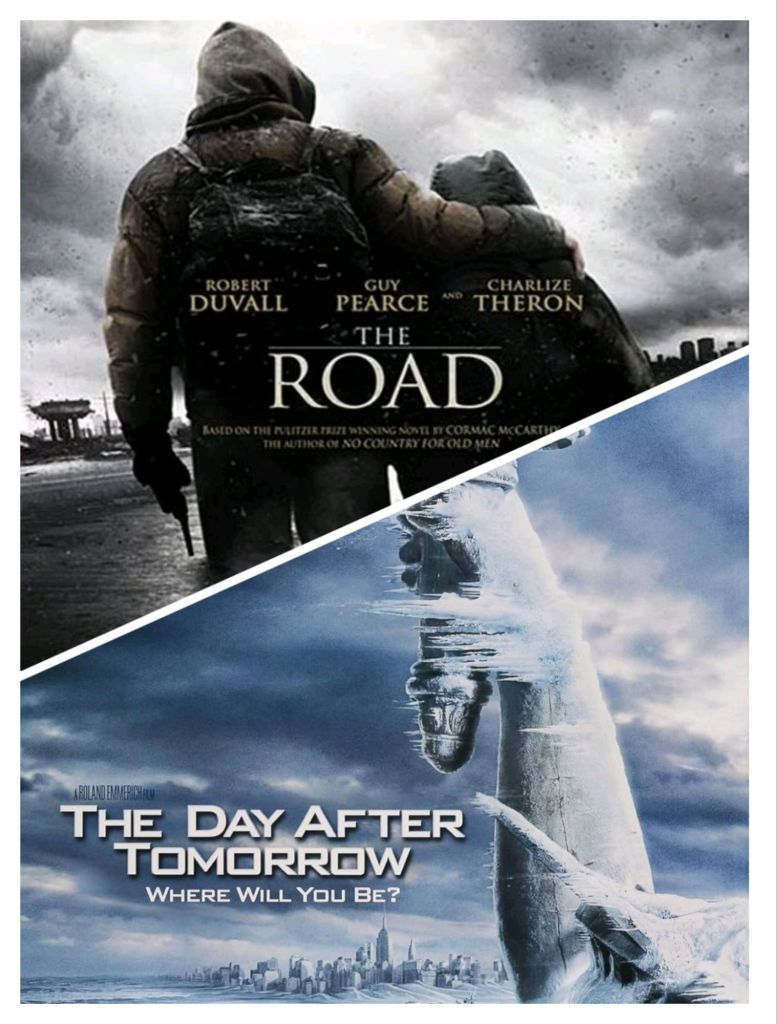
There is a risk in representing climate change that we see in more mainstream climate fiction and eco-disaster movies, such as The Day after Tomorrow (2004, dir. Roland Emmerich), The Road (2009, dir. John Hillcoat), and the Mad Max franchise. These are movies that frighten or distress us with the future loss of a familiar world and homey habitat: a projected future without nature. Rather than push us to reorder the status quo, they threaten with scenarios of its withdrawal. Rather than opening a portal to a new, and hopefully more just world, such dystopic projections want us to want things as they are, to prevent the current world from changing or disappearing. These films make us worry more about the big storm or unnamed event that wipes out the contemporary world. Some eco-disaster movies may even prevent us from seeing that the current state of the world – our giant coastal cities, monocrop agriculture, fossil-fueled mobility – is itself the environmental catastrophe.

Emotions and Audiences

Climate narratives often rely on affect—fear, hope, grief—to mobilize audiences. In your view, what role should emotion play in ecological cinema?

E. Anne Kaplan has written about how climate disaster movies can prompt a form of pre- traumatic stress. These are symptoms viewers suffer not from the violent past, but, proleptically, from the future as it is envisioned on film. In immersive and alarming detail, these eco-disaster movies confront us with a version of a future human subject in motivate viewers to prevent that future ecological collapse, they also keep the emergency in the present from view. As I write above, the petro-cultures and habits of global North consumerism (these are shorthand terms for larger and historically longer phenomena) are the catastrophes.
An alternative to this narrative tendency may be found (to provide just one example) in the films of Tsai Ming-liang, a master auteur for the Anthropocene, and not only because he features inclement weather, failing infrastructure, and epidemiological emergencies in his films (I have written about Tsai’s work in the edited collection What is Film Good For?). Tsai’s queer narrative arcs and long-take slow cinema reveal characters living in a post-apocalyptic world of the present. The catastrophe has arrived, and its effects are already felt, especially by those living on the economic and social margins of Taipei and Kuala Lumpur. Lingering with these people who hardly speak—they convey themselves by the way they walk, gesture, cough, eat—we come to care for them and the conditions that render their world unlivable. Rather that mourn the loss of the world to come, his films may bid us to pause and to consider leaving behind all that was already unwelcoming to these characters, a world we should not want to preserve or carry with us beyond the catastrophes of our current moment.

What dangers exist in making climate stories overly personal (e.g., through individual heroes or family dramas) or too abstract (e.g., anonymous data, satellite imagery)? Can cinema cultivate a collective emotional register—one that resists neoliberal optimism but still affirms the urgency of ecological care?

I think long form documentary, for those with the patience to watch it, can be such a powerful re-set. One film I especially admire is Frederick Wiseman’s Zoo (1993). Today we are in the midst of what several researchers label the Sixth Mass Extinction. Half of the species on Earth are experiencing rapid population declines as a result of human activities, or what one 2023 study in Biological Reviews calls “Anthropocene defaunation.” Zoos and national parks are the few places designated for animal welfare and species management. Wiseman’s observational documentary takes place in the Miami Zoo, celebrated for its new, more natural habitats and limited use of cages. We learn about complex care for animals, the artifice of their surroundings, and the curious ways that wild, domestic, and feral animals are labeled and handled. As an enclosure separated from the rest of the city or the natural world, the zoo resembles a theme park and a film studio. It is as if each species of animal has its own fake backdrop. Wiseman takes us behind the scenes of this institution, which is the last refuge for many species. I find this film deeply sad and, at the same time, so frank about the conditions of animals and humans living in a second nature. It made me curious about scenarios of re-wilding, on one hand, and the ways that nature, animals, and people are partitioned and, in many ways, lonely.

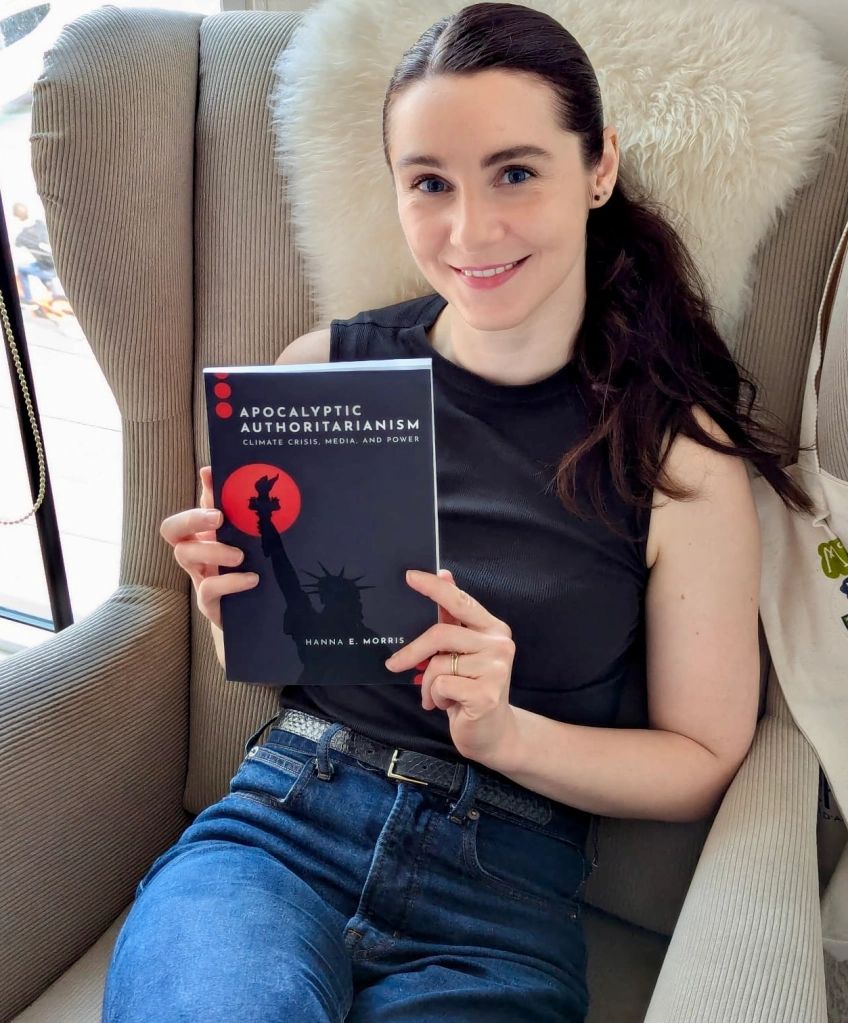
Apocalyptic Frames, Authoritarian Echoes: An Interview with Hanna E. Morris on the Climate Crisis and the Power of the Media

Interview Series: Eco-Media Dialogues: Climate, Culture, and Critical Communication

Based on the Book Apocalyptic Authoritarianism

In your book, you introduce the term “apocalyptic authoritarianism.” What led you to develop this concept, and how do you see it shaping media narratives around the climate crisis?

Critical scholars of social change often refer to particularly influential ruptures or events in historical time as “critical junctures” or “hot moments”, within which there is the opportunity to both challenge the status quo and imagine different societal relations and more equitable political structures, as well as the profound risk of falling back onto traditional structures of power and simplified narratives that deepen as opposed to upend existing inequities. The year 2016 in the US—where I am originally from and was living at the time—certainly felt like a very “hot moment” where a lot was in flux, and this heat hasn’t come close to letting up with yet another highly fraught Trump electoral victory in November 2024.

In place of uncovering and combatting Trump’s authoritarian aspirations head-on, however, in this “hot moment” of heightened national anxieties, I found that US news reports and commentaries opted for an apocalyptic rendering that obscured—as opposed to illuminated—what was going on. It became difficult to distinguish one catastrophe from another, let alone remember and keep track of each specific assault on democracy that merged into one indecipherable throng of disarray. And within this reported disarray, simplified narratives came to steer news media coverage. Through these simplified narratives, traditional figures of power were positioned as “visionary sages” that needed to be followed in order to return the US back to its supposed previous steady state. Conversely, young progressives who questioned these traditional figures and who demanded more transformative change were cast as destabilizing forces that needed to be stopped for the sake of the nation.
It’s here where, in my new book, I identified a new mode of reactionary politics that I’ve called “apocalyptic authoritarianism” to describe the reactionary posturing and political alignment of historically privileged figures transcendent of the partisan center and right who are united through a common enemy of the so-called “new” New Left and a shared appeal to apocalyptic visions of “total crisis.” According to this reactionary logic, only “traditional” authorities and “pro-American” saviors can bring back order by eliminating all “unruly” Others leading the nation astray and away from the US’s exceptional and supposedly God-ordained and glorious destiny. In my book, I show how many mainstream news stories and commentaries on climate change—which for the first time was extensively picked up and covered by the US press in the late-2010s—was subsumed within this “total crisis” narrative. In turn, climate journalism in the US began to entrench as opposed to question the reactionary currents of apocalyptic authoritarianism.

Many climate stories in mainstream media carry a nostalgic tone, often idealizing the past. How do you think this framing impacts society’s perception of the crisis? Does it discourage meaningful action?

Yes, notably, at the center of the US climate beat today are nostalgic memories of America’s yesteryears that have been especially brought forward in news stories, images, and commentaries since 2016 to, in part, provide a clearer sense of direction amid the perceived “total crisis” of the present. National myths of grandeur, exceptionalism, and dominion are reactivated and used to orient the news media’s interpretation of unfolding events. Significantly, there is an evident desire for a return to an imagined post-World War II “golden age” in particular—which is a period when many Americans imagine that the US was at its pinnacle of global power.

It is not inconsequential that this romanticized postwar period pre-dates the Civil Rights movement and radical, pro-democracy politics of the late-1960s. This pre-Civil Rights, early postwar era was a period when historically privileged figures were on more solid ground in the US. This privilege is precisely what young social and climate justice activists are again questioning today just like their progressive forbears, and also precisely what traditional centers of power are desperately trying to cling to, protect, and fortify once more. Ultimately, the rampant media fearmongering of climate justice activists across the US national press, concerningly, works in favor of an antidemocratic political project and it is often a deliberate strategy used to delay and obstruct any and all climate action by those with a stake in maintaining the status quo.

You note that climate reporting increasingly relies on “us versus them” framings. How does this affect democratic dialogue? Did you notice a specific shift in this narrative during the Trump era?

In my book, I show how via an “us versus them” media framing, there is a concerning concretization of the boundaries around who should and who should not be included in climate decision-making process and in American politics altogether. Young progressives—and especially young, progressive women of color such as Congresswoman Alexandria Ocasio-Cortez who is a key champion of the Green New Deal— are clearly being Othered and delegitimized as dangerous and militant “Others” who should not be included in climate, party, or national deliberations. There is a growing consensus across the US national press from the center to the right that a “woke” or so-called “new” New Left is a de-stabilizing force that must be stopped.
At the same time as these young, progressive women of color are being represented as threatening to national stability and impeding a return to “normalcy,” many news reports conversely celebrate green tech and market “fixes” developed by older, whiter, and more “moderate” and “reasonable” men as the “right” response to climate change, fully capable of steadying the ship and reorienting the nation back on to its previous course of Manifest Destiny.
This demarcation of right and wrong responses to climate change via the disparagement of young women of color – a historically marginalized group in the US, and glorification of older white men – a historically privileged group in the US, is indicative of wider, patterns in U.S. media and political discourse following Trump’s 2016 election of which I refer to as apocalyptic authoritarianism.

Are issues like class, race, and geography sufficiently addressed in climate reporting today? What role can alternative or community-based media play in making these dimensions more visible?

My book shows how in the age of Trump, the most prominent news publications of record in the US are not sufficiently reckoning with issues of class, race, gender, and justice. And with the increasingly privatized enclosure of social media spaces, such as Elon Musk’s takeover of Twitter, coupled with the increased physical policing of progressive movements and gatherings on the ground, there are fewer and fewer alternative forums where these mainstream narratives can be countered and contested.

Climate journalism does not need to be like this. It can move beyond a nostalgic longing for an imagined national past and overt celebration of traditional figures of power. But despite notable efforts by a few climate media initiatives such as Covering Climate Now’s recently launched “89% Project”—which urges journalists to report on the 89% of people in the world who want strong, government-led climate policy programs like the Green New Deal, most major news publications still continue to cover the “climate story” with wary caution directed at  protest movements and grassroots politics. A reimagined climate journalism capable of contending with and combatting apocalyptic authoritarianism must engage with as opposed to fear and fearmonger about radically democratic politics. This is an entirely possible as well as incredibly needed task that many community-based and local climate media outlets are already doing despite the many financial and political obstacles they face.

Media, Culture, and Activism

How should global media approach the climate crisis? Is it possible to reshape the language of news reporting? What does a critical climate communication framework offer as an alternative?

In the conclusion of my book, I detail some tangible proposals for how to begin this re-imaginative work. One thing is clear: apocalyptic authoritarians gain their legitimacy through the construction of a so-called “woke” and “extreme” contingent of leftist “radicals” who are blamed for present-day chaos. Fearmongering and dualisms of “us versus them” are used to legitimize antidemocratic dynamics of power and must be broken. A reimagined climate journalism capable of contending with and combatting apocalyptic authoritarianism, therefore, must center many different subjectivities, knowledges, and experiences in stories on climate change.

What role do artists, designers, and activists play in the visual narrative of the climate crisis? Can visual culture shift the way people engage with ecological issues?

A visual culture that moves away from apocalyptic renderings is crucial. Artists and activists can create more deeply contextualized images and can show how there are many possible responses to climate change proposed by lots of different people from diverse places. Different ways of visually representing climate change beyond an apocalypse can poke holes in the fantasies of would-be apocalyptic authoritarians. It’s here where the myth of a “silver-bullet” technological or green capitalist “fix” can be countered by alternative media and open more radically democratic pathways.


You work across media studies and environmental studies. What are the strengths and challenges of this interdisciplinary approach when thinking about the climate crisis?

An interdisciplinary and transdisciplinary approach that integrates and learns from different knowledges and experiences is essential. While it’s challenging to do this kind of work, all climate scholarship should be interdisciplinary and transdisciplinary, I think! 

What potential does digital media hold in the struggle for climate justice? Can alternative digital platforms or local media initiatives help reshape dominant narratives?

Local and digital media that actively reclaim spaces that are currently dominated by authoritarian figures and a wealthy and powerful few are needed now more than ever. It’s so important that we push back against the antidemocratic seizures of public forums for communication. We can and must push back. Many amazing activists and media-makers are already leading the way on this. It’s so crucial to support the work of independent and local media-makers, especially amid this boiling hot moment of antidemocratic and climate threats.

The Problem of Reality in Digital Mass Communication: An Interview with Melissa Zimdars on Fake News, Trust, and Education

Merrimack College Professor of Media and Communication | Melissa Zimdars

Media and Reality: Critique of a New Era A Pr Carnet World Interview Series

1. Academic Background and Motivation

What initially motivated you to work in the field of media literacy and combating misinformation?

My primary field is Media Studies, and in the fall of 2016 I taught an Introduction to Media course that included working on media literacy. I created an in-class assignment to help students evaluate and identify different kinds of online media sources, from fake news and clickbait to satire and political reporting.

I posted that assignment online asking my peers for feedback and it went viral! However, when some news organizations picked up the story, my in-class assignment turned into a “fake news list”! I realized that if such a silly thing could be reported on so wrongly by reputable organizations, it’s going to be an uphill battle for them—for everyone, really—to responsibly engage with media.

Your project “List of Fake News Sites” gained significant public attention. Could you share the motivation behind it and the academic/social impacts it had afterward?

After my work went viral I tried really hard to make it a stand-alone resource or a more public-facing document to help people. I better defined terms, expanded the list of sources, and added tips for evaluating sources. A number of libraries added it to their collections as a resource. Eventually the document expanded to over a thousand different sources with the help of some awesome librarians, and it became a dataset for researchers to use when examining fake news and mis/disinformation sources and networks. Now, that dataset has been folded into other, larger datasets that are more consistently updated to help people analyze these kinds of sources.

Personally, I’ve turned more toward understanding how people engage with mis/disinformation, how it travels from fringe to mainstream social media platforms, how hands-off rules and regulations by both platforms and governments enable its spread, and how reputable news organizations sometimes play a role in amplifying and laundering it for wider audiences.

2. Fake News, Disinformation, and Digital Media

After the 2016 US presidential elections, the term “fake news” became widely discussed. Do you think this term still holds meaning today, or has it become diluted?

I never found ‘fake news’ to be particularly helpful. In Media Studies, we previously used the term to talk about satire and other comedic forms of news. But around 2016 it became a kind of catchall for problematic content rather than a specific kind of quickly produced false content that mimicked the style of news. Now, non-satirical ‘fake news’ is typically considered a kind of mis/disinformation alongside things like political propaganda, pink slime websites (political sites that look like local news sources), and other types of sources that primarily produce content to persuade rather than to inform.

How does the decline in trust toward traditional media and the rise of social media as a primary news source affect efforts to combat disinformation?

Declining trust (in media, in government institutions, in health and science information and systems, and so much more) is a huge problem, especially among people who identify with the political right.

Whether people trust a source of information is deeply connected to their own political beliefs, and rightwing media figures and organizations within the United States have spent decades undermining and vilifying legacy media institutions while simultaneously building up their own incredibly robust and lucrative rightwing media system. Their system is incredibly insular, repeating the same talking points over and over, regardless of their accuracy, across articles, podcasts, websites, and social media accounts or platforms, creating what is called a propaganda feedback loop. If anyone in that system pushes back and challenges a talking point, they are then also deemed to be untrustworthy and risk losing their credibility with rightwing audiences.

So, basically, we have a situation in the United States where there are two media worlds. One of those worlds connects to legacy media organizations and the other serves the political right and is deeply connected to the Trump administration. Engaging in one means distrusting the other, so trying to reach people who engage the latter with accurate information is unlikely to work because they are very unlikely to trust it.

3. Media Literacy and the Future of Education

In your view, how can media literacy education be made more accessible not just for students, but for the general public as well? Are there any initiatives you find particularly effective?

We definitely need to incorporate media literacy much earlier in our educational systems, but outside of accessible public resources and library events, I’m honestly not sure. I’ve actually become pretty cynical in this area. Media literacy is necessary but it’s not a solution. We really need an overhaul of our media and social media systems: more public service journalism, less profit-motivated and rage-enhancing social media platforms, regulations and policies surrounding AI and the slop it churns out, structural changes to our political institutions and systems, actual political consequences for public figures who repeatedly lie, and so much more. We need to fix fundamental aspects of our media environments before we can fully depend on people to successfully navigate them.

What role should academics, journalists, and content creators play in fostering media criticism? How important are interdisciplinary collaborations in advancing critical media literacy?

Academics and educators obviously play a critical role in helping students develop critical thinking skills and media literacy. Journalists and content creators can and should do more in helping remove the barriers that people face when they have to practice or use those skills when navigating media environments. That means creating news or content with integrity and responsibly and quickly correcting mistakes. But journalists and creators can only do so much as individuals working within and via broken systems. It’s ultimately the organizations and platforms that need to do a lot of the fundamental work.

For example, it would be helpful if news organizations did away with mis/disinformation-spreading sponsored content that litter their own websites in the form of “chumboxes.” 

4. Gender and Digital Representations

From the perspective of feminist media studies, what are your observations on the representation of women on digital platforms? How do these representations intersect with the production of misinformation?

We’ve seen a huge amount of political propaganda in the U.S., including mis/disinformation, that is deeply sexist, racist, and xenophobic. For example, anti-abortion mis/disinformation frequently underpins anti-abortion policies across many states. Anti-abortion policies also connect to growing resentment that many young men feel over the gains that women have made in education and in the workforce, and that resentment is manifesting in social media content and propaganda arguing that a woman’s  “true” role is to be in the home raising children. Political influencers and propagandists convince young men that the past was better for them, legitimizing their grievances, blaming the gains of women for whatever they feel like they do not have, and inspiring their support of regressive policies that try to exert more control over women’s lives. And the propagandists spewing this nonsense, who are usually but not exclusively men, somehow receive fawning profiles rather than criticism in outlets like The New York Times and applause rather than condemnation for the highest figures in the United States government.

5. Future Outlook

What are your predictions for the next five years regarding media consumption, content production, and access to information? How should we prepare for these changes?

I think things are going to get much worse over the next five years. Public media in the U.S. is being further stripped of funding alongside research into mis/disinformation, legacy media organizations are laundering extremist political information and governmental actions to the general public, social media platforms and search engines are integrating “AI” into everything at a breakneck speed despite its propensity to hallucinate and churn out slop. Thus, our already “enshittified” media environments are on track to become even moreso. There isn’t much any of us can do as individuals since we do not own the means of media production and distribution, but we can be more mindful of how we use social media, particularly in terms of what we might post or reshare and how much time we spend endlessly scrolling. We can and should directly support news organizations that are doing good work, that are holding people in positions of power accountable. Ultimately, we can and should continue to work toward making our media environments better while teaching people how to best navigate them despite the road before us being long and likely quite bumpy.

Forced Migration and Social Adaptation Through Digital Identities: Semay Buket Şahin Presents at Marmara University

One of Pr Carnet’s editors, Semay Buket Şahin, delivered a compelling presentation on May 6, 2025, at the International Marmara Graduate Communication Students Conference hosted by Marmara University. Her talk, titled “Social Integration through Forced Migration and Digital Identities,” focused on how Russian influencer communities who migrated to Turkey following the Russia-Ukraine war reconstruct their digital identities and adapt socially through TikTok, within the framework of media ecology.

Utilizing digital ethnography as her method, Şahin examined the role of social media platforms in the integration of migrant individuals into a new society. She emphasized how TikTok’s open and merit-based structure plays a significant role in this process. Şahin also analyzed Turkish audience comments to demonstrate how the interaction between content creators and viewers contributes to cultural adaptation.

This comprehensive presentation was recognized as an original academic contribution at the intersection of media ecology, digital cultural industries, and identity theory.

Who is Semay Buket Şahin?

Semay Buket Şahin completed her master’s degree in Classical Philology at Istanbul University and is currently pursuing her doctoral studies in Radio, Television, and Cinema at Marmara University. Her academic work focuses on media archaeology, digital culture, migration, and identity studies, and she has published various scholarly articles and books in these fields.

She is also one of the co-founders of Pr Carnet Journal, where she produces content on current developments in media and communication. Her book “The Archaeology of Civilization and Communication” is considered one of the first publications in Turkey to explore the field of media archaeology.

In addition to her contributions in Turkey, Şahin has also delivered presentations at international conferences on media archaeology, further expanding her academic presence and influence abroad.

An Interview with Silvia Garcia on Art, Media, and Community: A Conversation on Digital Transformation

Cultura Inquieta Content Manager Silvia Garcia

THE EVOLUTION OF DIGITAL ART AND THE ROLE OF CULTURA INQUIETA

What has been the most impactful transformation you’ve witnessed in the development of Cultura Inquieta as a digital platform for culture and art?

Seeing how Cultura Inquieta has become a community—growing larger and more emotionally connected—has been the most impactful transformation.
We don’t just share art, we share sensitivity, conversations, doubts, beauty, and critical thinking. We’ve learned to listen as much as we publish, and that has allowed the platform to evolve with a soul of its own.

How has the way people connect with art changed through digital platforms?

The connection is now more immediate. People don’t just consume art—they comment on it, reinterpret it, and share it as part of their identity. It’s become more democratic, more everyday… and also more emotional.
There’s a lot of information, a lot of stimuli, but also more opportunities to be creative, to make and share the beauty around us with the rest of the world.

AESTHETICS AND NARRATIVE IN CONTENT CREATION

What aesthetic and narrative elements do you prioritize when creating content for Cultura Inquieta?

Emotion—always. The first thing we look for is something that stirs us. Aesthetically, we value whatever has soul: it can be minimalist or baroque, but it must speak.
Narratively, we prioritize the beauty of simplicity, poetry, and honesty. We care about substance, but also about how we tell the story—above all, it must have humanity.

ALGORITMS VS. CREATIVITY

How do you think algorithms affect creativity and originality in digital media?

They’re a double-edged sword. On one hand, they can amplify what we do and connect valuable content with more people. But they also sometimes push us to repeat formulas, to play the game of “what works.”


The key is not to lose our center. At Cultura Inquieta, we ask ourselves: Does this add something? Does it make sense for us to tell this? If the answer is yes, we trust it will find its way, even if the algorithm doesn’t bless it right away.

COMMUNITY ENGAGEMENT AND DIGITAL STRATEGY

What strategies do you use to keep the audience engagement alive and meaningful at Cultura Inquieta?

We talk. We ask questions. We listen. We make those on the other side feel involved. Sometimes it’s with an open question, sometimes with a story we know resonates with all of us.
Our commitment is born out of respect: we don’t treat the community as a passive audience, but as a chorus of voices with whom we build something together.
And we also leave room for silence—where reflection often takes root.

THE FUTURE OF DIGITAL ART

What trends or directions do you think will shape the future of digital art?

I see art becoming increasingly hybrid, sensory, and participatory. Artificial intelligence, immersive environments, augmented reality… they’re going to change how art is created and experienced.
But I also believe the future lies in reclaiming emotion, even in the digital realm: works that challenge us, that make us feel human amidst the code.

PERSONAL CREATIVITY AND SOURCES OF INSPIRATION

What inspires your own creative process? Are there digital platforms, artists, or themes that especially influence you?

I’m inspired by whatever makes me pause. A photograph I can’t stop looking at for no clear reason. A sentence that sticks in my chest.
I draw a lot from everyday life: from the silences in a conversation, from the way someone talks about what they love.
I’m also inspired by artists who cross disciplines—people who write through music, who paint through words.
Digitally, I like platforms that care for both visuals and text equally, like It’s Nice That or Another Magazine. But above all, I’m inspired by the Cultura Inquieta community: what they share, what they comment, what moves them.

ART AND SOCIAL TRANSFORMATION

How do you see Cultura Inquieta’s role in contributing to cultural or social transformation through the public visibility of art?

Cultura Inquieta is a loudspeaker for beauty, but also for justice. We believe art is not only about contemplation—it can also be a form of resistance, of protest, of embrace.
Our mission is to shine a light on stories that matter, on artists who give voice to the unspoken.
If we can get someone to look at the world with a little more empathy after reading or watching us… then we’re already transforming something.

A Bilingual Journey of Visual Narrative: Interview with Leila Sofia Medina on Documentary, Journalism and Representation

Is bilingual journalism for you merely a method of communication, or is it also a matter of identity and representation?  

Bilingual journalism is deeply tied to my identity. As an Ecuadorian video journalist living in New York, being bilingual allows me to tell stories that often go unheard—stories of people who navigate two languages and two cultures. It’s not just about translating words; it’s about representing lived experiences and ensuring that our communities are accurately portrayed, while also highlighting narratives that are often overlooked.

What role does language play in visual storytelling? How do you develop methods to transcend linguistic boundaries?  

Language is essential when connecting with the people you’re interviewing—it helps you understand them better and even relate to their story. But visual storytelling allows us to go beyond words; it becomes a universal language. The power of video lies in showing a story in a way that allows viewers to connect with characters, even if they don’t speak the same language.

What kind of connection do you draw between bilingual journalism and documentary filmmaking?  

For me, the two are inseparable and work hand in hand. Documentary gives me the space to explore stories in depth, while bilingual journalism lets me represent my community. Both require trust, empathy, and immersion in the context of the story, as well as connecting with the people involved.

Creating multilingual content requires more than just a technical skill. What kind of ethical or cultural responsibility do you believe it entails?

Regardless of language, I believe it’s essential to stay true to what your sources are saying and to their lived realities. When translating, writing, or editing, I always ask myself: Am I keeping the context intact? Could this harm the person or community involved? Am I portraying them fairly? That ethical responsibility is always present.

When telling stories in different languages, is it more important to remain faithful to the spirit of the language or to universal narrative structures?  

I don’t believe there’s a single universal narrative structure. There are many ways to tell a story, and as a storyteller, you need to understand your subject to determine how best to tell it. Every story, character, and context is different. So rather than forcing a formula, I prioritize preserving the spirit and authenticity of the story.

How do you manage the processes of translation and subtitling in your multilingual projects?  

If the project is in Spanish, I usually do the translation and subtitling myself. I try to maintain the richness of the language, knowing that some expressions may not directly translate. When working in other languages, it’s important to collaborate with someone who understands the language and can provide an accurate, culturally aware translation.

How does this linguistic diversity affect the global circulation of your stories?  

Being bilingual is definitely an advantage—it allows me to collaborate with a wider range of publications and outlets and to shape stories for different audiences. It’s also helped me understand how to tailor storytelling styles based on whom the viewer is.

For you, is documentary filmmaking a transmission of reality or a form of creative reconstruction?  

I think it’s both. It’s a transmission of reality, but with your vision as the filmmaker. Documentaries allow for creativity and deeper emotional connection while staying rooted in truth. As long as you’re honest with the facts and the people involved, you can bring in creative elements to strengthen the story—otherwise, it becomes fiction.

When choosing your subjects, do you look for a personal connection, or are you more guided by societal needs?  

You need to feel connected to a story to tell it well—not necessarily on a personal level, but emotionally and intellectually. That connection helps you invest the time and care the story deserves. At the same time, I also ask myself: Why this story? Why now? What impact can it have? That’s where societal relevance comes in.

What are some of the most difficult ethical dilemmas you’ve faced during fieldwork?  

One challenge is deciding whether to include moments of vulnerability—moments that might make a story more powerful but could leave someone feeling exposed. I ask myself: Is this adding something meaningful, or is it just emotional drama? Another dilemma is knowing when to protect someone’s identity and making sure they understand what it means to be on camera or have their name shared.

Compared to classical cinematic language, how would you define the unique expressive power of documentary?  

Documentary is cinema—there’s no doubt about it. It might be less polished sometimes, but the goal is the same: to tell a compelling story that connects with audiences. The difference is that documentary is grounded in real life. There’s room for imperfection, but that doesn’t make it any less powerful or cinematic.

Among your projects so far, which story has impacted you the most, and why?  

Two projects stand out. One is a short documentary I made about migrant families from Ecuador who journeyed to New York. It opened my eyes to the reality so many face—not just the struggle to arrive, but the continuous challenges they face even after getting here.  

The second is a school documentary I did about a local drag artist in Astoria. It explored themes of family, grief, and chosen community. It helped me discover a world full of resilience and passion, and I learned so much from this artist and their journey.

What themes tend to stand out in your documentaries—such as migration, identity, or social struggles?  

I’m drawn to stories about identity, gender, and migration—especially within the Latin community. I find power in stories of people who are finding or rebuilding themselves. Those narratives are deeply human and universally resonant.

What is your process of developing a project—from the moment you first conceive the idea to the final edit?  

It varies depending on the project. For short stories, I usually start with a question or something I’m curious about. I research, identify potential sources, and start interviewing. After filming, editing is my favorite part—it’s where everything comes together, like solving a puzzle. For me, it’s the moment where the heart of the story really takes shape.

How has your experience at CNN en Español contributed to your independent projects?  

It was my first real experience in journalism, and I see it as my school. It taught me how to structure a story, how to shape it in a way that connects with people. I covered stories from many different communities, which made me even more passionate about storytelling. That experience definitely pushed me toward pursuing documentary filmmaking more seriously.

The Digital Journey of Words: An Interview on Writing with Arielle Gonzales

Columnist, Storyteller and Culture and Art Dırector of Pr Carnet World Magazine Arielle Gonzales

In an era where words travel faster than ever, digital platforms have redefined the way we write, read, and connect. We sat down with digital writer Arielle Gonzales to talk about her creative journey in the world of online storytelling. From inspiration to audience engagement, from navigating social media to building a writer’s voice in the digital age—this is a candid conversation about writing beyond the page.

INTRODUCTION TO WRITING AND THE DIGITAL SHIFT


When and how did you first start writing?

I started writing when I was in middle school because I was different from others. I was very creative and loved watching others in different aspects. My mind would create ideas for short stories that I would share with my family. For years, I stopped until college, when I
started to figure out why I loved creating and writing. Now, I’m writing more but waiting for my big break to do it full-time forever. Writing speaks to my soul, especially since I’m not the best at speaker.


Someone told me, “ Why don’t you write about what you think?”

What led you to shift towards digital platforms? What influenced this transition the most?

Growing up I wanted to write for magazines like Sex in the City, Ugly Betty, and Living Single, however, newspapers are not really there anymore. So in college, I switched to digital platforms such as Medium, freelancing and Substack. The switch wasn’t hard to do because
the digital world is better for getting the stories across.

CREATIVE PROCESS AND INSPIRATION

What themes do you enjoy exploring the most in your writing?


Where do you draw inspiration from? What digital sources or environments nurture your creativity?

The themes I enjoy exploring is the ones that make the audience think, feel, and be
open-ended. Everyone can have a different opinion, but sometimes the story is the same. Stories can be the same yet in different fonts. People want to feel related to something that feels. The soul understands.

My inspiration comes from people and the things around me. Most of the time, its like a light blub that went off like “people would want to know about this”. I just go with my gut then research if needed too. Most of my writings come from the soul, meeting people in passing.
Writing is a space where pictures and seeing sometimes don’t express what it is. Words can run deep and can make you change that thought as you try to understand what it is. I would say for digital platforms, TikTok, Facebook and Medium.

THE IMPACT OF DIGITAL MEDIA


In your opinion, how does digital writing differ from traditional writing?

Digital writing differs from traditional writing in format, tone, and interaction. While traditional writing is linear, formal, and mostly text-based, digital writing is dynamic, conversational, and often includes multimedia elements like images or links. It encourages reader interaction through comments and shares, and it’s usually produced and consumed much faster than traditional writing. I love both but digital has this way of speaking to the audience due to being more personal.

What are the most challenging and empowering aspects of writing on platforms like social media or blogs?

I prefer blogs to social media. The reason for this is that there is more freedom than on social media. It’s very empowering to be in spaces that are very much similar and open like Medium and Substack communities. Social Media can be overwhelming since I only use it for
updates or reposting for my blog (a marketing tool for networking)

READER INTERACTION

How does engaging directly with your audience affect your writing?


When I engage with the audience, It’s usually in the process. I like to ask questions and learn. So I pretty much write off that. I want my writings to make a person feel, whether it’s an opinion, essay, story, poetry, or article. I want to have the audience think and come back to ask me questions, such as the recent blog story on The Lover Era due to months of seeing, hearing, and learning from others.


Do feedback or comments from readers influence your writing style or topics?

Of course, but not so much that I will change my whole writing for them. I enjoy feedback and comments so I can become a more advanced writer. I still have growing to do and learn as well.

FUTURE PROJECTS AND ADVICE

What upcoming projects are you currently working on or excited about?

I am working on putting out another Lover Era one and Unmasking Yourself: Why We Hide What We Love (And How to Stop)”. I have a couple of freelancing things coming up. I’m just trying to be a full-time writer since I went to school for that, as well as digital media. So, if you know anyone who needs a writer, I can be that!


What advice would you give to those who want to start a digital writing career?

Don’t stop writing. I know the world is crazy and bittersweet. Do what you enjoy always. I’m glad I came back to it even though it was always there. I still have my middle writings, my family wants me to publish one day. Even if you think it’s not going to be interesting, write it. I recently put out an article that was raw, love, and emotional called “Soft, But Not Stupid: The Lover Era (But Not Too Much Tho).” It’s about being a lovergirl (or guy) who has done the work, yet it’s complicated to be vulnerable. Parts of the emotional viewpoint is The Photograph, Sade song “Is it a crime” interwined with my mom’s story as a woman who told me how she was a lovergirl yet let fear take over to
the point she let her work be her love. That broke her up as she grew older.

“Reporting on the World: Ana María Betancourt on Journalism, Social Issues, and the Future of Media”

Interview with Ana Maria Betancourt

Starting Your Journalism Career and Sources of Inspiration

What experiences or events in your life had the greatest impact on your decision to start a career in journalism? What motivated you the most when you decided to pursue this field?

I loved writing and I wanted to have a job that allowed me to write as much as I could. But also at that time I was in high school and my History professor asked us to start being aware of the news because Colombia was living a historic moment: the State was going to sign the peace agreement with one of the oldest guerrillas of our country.

I wanted to be a reporter of peace and that somehow encouraged me to pursue my career in journalism.

During your time at Javeriana University studying Social Communication and Literature, what were the most important academic or personal lessons that shaped your journalism career?

Well in the university I started to actually feel disappointed about journalism. I felt journalism in Colombia was struggling, most outlets were financed by large corporations with a lot of political interests. And I saw little to no space to do journalism in a creative way.

So I started to see myself writing fiction and poetry. But I knew I wouldn’t make a living with just my creative writing because I wasn’t still prepared to publish my literary work. However, literature for sure opened my horizons and made me ask myself questions about the form and how the aesthetic part of writing can also be challenged in journalism.

Work on Social Issues and Its Impact

How did your personal passion for critical societal issues such as climate change, health, and gender inequality develop? How did working on these issues affect your career as a journalist?

I think it developed at a very early stage and it was because of two things: my older sister and my high school. My sister was studying Environmental Engineering and wanted to focus her studies in the social part of the environment. She planted a seed of multiple questions in my brain and since that moment I started to care a lot about climate change and the environment. It is also because I come from a country that is mega-biodiverse and I have always loved the nature that surrounded me.

My high school had a class of gender and literature where I started to be more aware about gender inequality and social justice. So when I started my studies in the university, I already had in me an objective of contributing to social justice in whatever I chose to work on in my life. Then, I guess that my studies also guided me through that path, I read a lot of gender, reception, literary and communications theory, as well as philosophy.

What methods have you used to make an impact with your stories on these topics? Particularly in gender equality, what were the biggest challenges you faced when covering such sensitive issues?

I started covering gender as a freelance in a small digital outlet and I tried to talk about topics that I did not see anywhere else at the moment: life feminist motherhood or menstrual disorders. But later, when I worked at Mutante I learn about the power of engagement journalism and how this method can actually amplify the impact of journalistic stories, because they are being useful and interpellating a particular type of person who was seeking for that information.

Now, if we talk about challenges, I would say that finding sources and accessing information. A lot of people experienced the topics I was covering, but they did not want to talk and it is because of social stigmas. Then large corporations, like fertility clinics, like to stay on the safe side, so they rather answer in a polite but incomplete way than respond to your questions.

International Experience and Your Journalism Perspective

How did your experience with the United Nations Environment Programme and the Colombian Consulate in New York transform your approach to journalism? What kind of global perspective did these international platforms offer you?

These experiences changed my approach in journalism significantly. The Consulate helped me connect with the Colombian immigrant community and the needs they had. I was not very aware of the way the community is living and the geopolitical relations behind massive immigration.

Then, UNEP was a place to understand international treaties, public hearings and the international environmental agenda. It helped me to see climate change in a global way, meaning that it showed me the relations of power behind greenhouse gas emissions, food waste and renewable energies. It wasn’t only UNEP as an institution, but the people who were there. Most people were from the Global North and had that kind of approach to the climate emergency, but the Global South has a knowledge that has not been appreciated but is essential for the survival of humanity.

While studying in New York, how did interacting with different cultures shape your understanding of journalism? How do you compare your experiences with the media landscape in Colombia to the global perspective you gained?

In NYC I’ve been covering particularly Latinx communities, and that means I am very exposed to multiple cultures, because Latinxs are not a monolith. So I’ve connected with Peruvians, Mexicans, Hondurans, Venezuelans, Ecuadorians, and of course Colombians. This has showed me that we are very similar, but our national histories are different and that crafts our paths heterogeneously. I see how Latinx people are all classified in the same box, but our culture and life experiences are utterly different. However, there is for sure something that unites us: our region has suffered oppression and colonialism even later than we started being “free nations”.

This approach contrasted with the media landscape in Colombia because in Colombia we mostly cover the national context, and when we cover the international it usually is from the same few countries that call our attention.


Cortazar once said that for him, living in France wasn’t a way to be apart from Argentina, it was actually a tool allowing him to see his country as a whole with perspective and distance. And I feel very much like that.

Digital Media and the Future of Journalism

How do the innovative approaches brought by working in digital media shape the evolution of journalism? What do you think about the impact of digital transformation on media content and audience engagement?

The innovative approaches brought by digital media have fundamentally reshaped journalism, not just in how stories are told, but in how communities are included in the storytelling process. Jeff Jarvis, in A Journalism of Belief and Belonging, argues that journalism’s role isn’t just to inform, but to “build bridges among communities” and “make strangers less strange.” That belief has been central to my work as a journalist who constantly thinks in engagement as an essential part of this craft.

Digital transformation has also allowed journalism to build trust in new ways. When we treat engagement not as a strategy to reach more people, but as a practice to foster community, we deepen the public’s relationship with journalism.

Did your experience at Mutante contribute to establishing your expertise in digital media? What are your thoughts on the impact of digital platforms on the future of journalism?

Digital transformation has opened up new ways to move beyond one-way communication and instead create dynamic, participatory spaces for dialogue. At Mutante I experienced firsthand how digital tools can be used not only to distribute content, but to actively listen to communities and co-create journalism with them. We built our editorial agenda around the real informational needs of our audience, using digital platforms to host conversation communities—safe spaces where people affected by issues like fatphobia or gender inequality could connect, share experiences, and help shape coverage.

This shift has had a profound impact on media content and audience engagement. Stories are no longer just produced for people—they’re created with them. Content becomes more relevant, empathetic, and actionable when it emerges from the lived experiences of the communities it aims to serve. For example, through engagement strategies like newsletters with high open rates, explainer content, and social media conversations, we were able to make complex topics like climate displacement or mental health more accessible and urgent.

Challenges and Opportunities as a Female Journalist

What have been the biggest challenges you’ve faced as a female journalist? How have you overcome these challenges, and how have they influenced your journalism practice?

One of the biggest challenges I’ve faced as a female journalist is navigating the intersection of economic precarity, immigration status, and gendered expectations—especially as a Latina, immigrant woman working in the U.S.

Feminist journalism isn’t just about telling stories—it’s about interrogating the systems that shape people’s lives. At La Papaya, a feminist publication I co-founded, and later at Mutante, I embraced a kind of reporting rooted in radical care, tenderness, and community.

These challenges didn’t just shape what I report on—they shaped how I report. I learned to approach journalism as a tool for both inquiry and empowerment, one that must offer not only critique but pathways for action. At Mutante, this meant pairing investigative stories with community dialogues and support networks. In New York, it’s meant spotlighting immigrant communities through stories that resist reduction to labor or struggle—showing instead how they build joy, resilience, and systems of mutual support.


Ultimately, the challenges I’ve faced have taught me that journalism must make space for both vulnerability and resistance. They’ve pushed me to tell stories that go beyond exposing injustice to also enable hope, healing, and transformation.

What are your thoughts on how women are represented in the media? What steps should be taken within the industry to make more women visible in journalism?

Women are often represented in the media through narrow, stereotypical lenses—either as victims or as exceptional figures who’ve “overcome” adversity, rarely with the full complexity of their identities, contributions, and struggles. This lack of nuance not only flattens our stories, but reinforces systems that make women—especially immigrants, and working-class women—invisible unless their pain is deemed newsworthy.

As a feminist journalist, I believe the problem isn’t just who tells the story, but who gets to be seen as a source of knowledge and power. At outlets like La Papaya and Mutante, I worked to challenge those dynamics by co-creating journalism with women who are usually excluded from traditional narratives—whether they were survivors of obstetric violence, informal workers, or community leaders.

To make more women visible in journalism, the industry needs to go beyond diversifying newsrooms. It needs to value and invest in alternative storytelling methods that center care, collaboration, and community engagement. That includes hiring more women—especially women from marginalized backgrounds—not just as reporters, but as editors, decision-makers, and strategists. It also means rethinking what we consider “newsworthy,” and creating space for stories rooted in lived experience, emotion, and collective knowledge.

Vision for the Future and Career Goals

How do you plan to shape your journalism career in the future? Are there specific projects you’d like to be involved in, and what kind of societal changes do you hope to contribute to through these projects?

I plan to shape my journalism career around the core belief that information is a tool for dignity and transformation—especially for those who have historically been excluded from mainstream narratives. My goal is to create journalism that starts by asking communities what they need, and that turns information into a pathway toward action and justice.

One project I hope to develop is a bilingual, hyperlocal resource hub for Latinx and immigrant communities in New York. Resources exist in the U.S.—like free clinics, subsidized food markets, and language classes— but information about them is fragmented, inaccessible, or simply not reaching the people who need it most.

More broadly, I want to be part of initiatives that challenge dominant narratives about Latinx and immigrant communities—stories that move beyond deficit framing and instead highlight resilience, contributions, and systems of mutual aid. Through community engagement, investigative reporting, and narrative storytelling, I hope to contribute to a media landscape that empowers rather than marginalizes, and that pushes for policies rooted in equity and care.

How do you think the experiences you’ve gained in journalism have transformed into a service to society? What is your personal mission in journalism in both the short and long term?

My experiences in journalism have taught me that storytelling is not just a profession—it’s a public service. From reporting on reproductive justice in Colombia to covering immigrant canners and nostalgia-driven plays in Queens, my work has always aimed to dignify lives often ignored by mainstream media. These stories are not just content—they are windows into systems, tools for empowerment, and sometimes, lifelines.

Living in New York as a Latina immigrant radically reshaped my understanding of identity, visibility, and structural inequality. For the first time, I saw myself racialized—as just another “Hispanic” or “Latina”—in a system that often treats our communities as statistics rather than individuals. This shift fueled a deeper commitment to what Eduardo Galeano called los nadie—the nobodies who don’t appear in history books, who are denied voice, name, and presence. My journalism now strives to rewrite that narrative.

In the short term, my mission is to continue building journalism that centers community needs, provides practical resources, and opens space for dialogue and participation. In the long term, I want to contribute to transforming newsrooms—structurally and culturally—so that they truly reflect the diversity of the people they serve. That includes advocating for more Latinx journalists in leadership roles, creating mentorship pipelines, and championing forms of storytelling that embrace care, complexity, and co-creation.