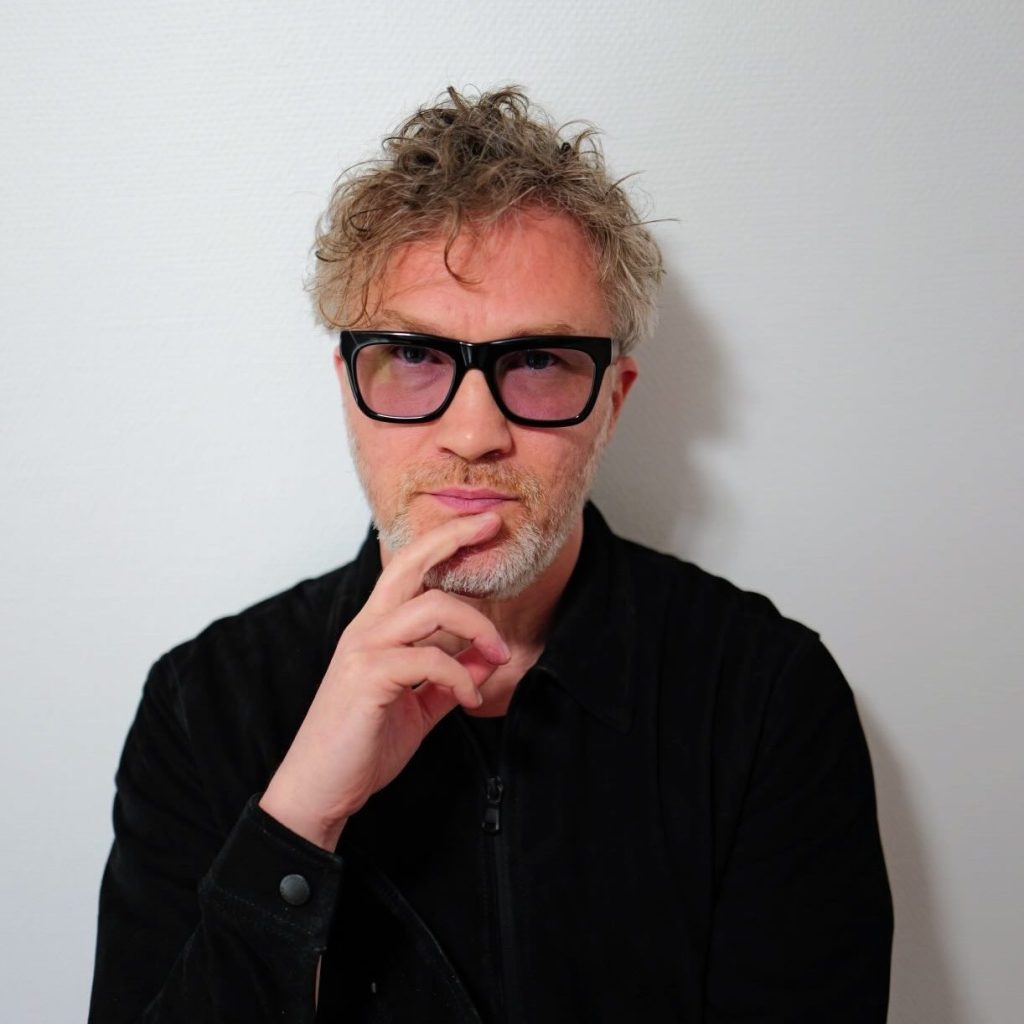
Interview Series: Media Arts, Visual Communication Design, and Technologies | Interviewer: Gökhan Çolak
Esen Kunt | Istanbul Nişantaşı University Faculty Member and Author; Founder and Creative Director of Istanbul Deleuze Studies.
Image, Thought, and Film Theory
How do your studies, which center on the relationship between image and thought, establish a theoretical affinity with Gilles Deleuze’s theories of cinema and the image? Laura Mulvey’s concept of the male gaze remains a central reference in film studies. In your view, how should this concept be rethought in the face of digital and post-cinematic images?
I conceive the relationship between image and thought not as a hierarchical link between an image that represents and a consciousness that reads it, but as two thresholds that mutually produce and transform one another. For this reason, the image is not, for me, the visual counterpart or illustration of thought; rather, it is a surface upon which thinking itself takes place—an evental field.
This approach, of course, establishes a direct connection with Deleuze’s texts—particularly Cinema 1: The Movement-Image and Cinema 2: The Time-Image. However, this connection is not so much a mode of reading that applies Deleuze’s concepts as it is a relationship that folds the possibilities of thought he opened toward other directions. Deleuze’s treatment of the image not as a mental representation but as a force operating through the body, space, and time constitutes one of the fundamental thresholds of my work.
I often approach the relationship between image and thought on a cartographic plane. In other words, the image is not an object that carries a fixed meaning; rather, it is a practice of mapping that traverses memory, the body, geography, and time. Deleuze’s notion of the ‘brain-screen’ marks a critical turning point for me: thought is no longer an internal representation but becomes an event that occurs outside—on the surface, on the screen. At this point, the image is no longer a vehicle for thought; it becomes thought itself.
In my own work, I develop this approach particularly through rhizomatic memory, cartographic imagination, and bodily surfaces. I treat the image not as a record that represents the past, but as a passage—continually rewritten—that opens between past and present. This intersects with Deleuze’s understanding of the time-image: a nonlinear, branching, and layered conception of time. For me, however, this temporality is not only cinematic; it is also geological, bodily, and spatial.
For this reason, I interpret the relationship between image and thought less through ‘meaning production’ than through relations of force. What interests me about an image is not what it shows, but what it sets into vibration—which layers of memory, which bodily sensations, and which spatial associations it activates. This orientation leads me not so much to read the image as to think with it, even to observe the image in the act of thinking.
In short, Deleuze’s philosophy of cinema and the image functions in my work less as a reference point than as a threshold for thinking. My effort to remove the image from the domain of representation and approach it instead as a shared surface of thought, memory, and the body establishes a line that both converses with Deleuze and opens toward other directions. I sustain this line as a field of production that moves between text, image, map, and body—fluid, unsettled, and resistant to fixation.
Laura Mulvey’s concept of the male gaze remains powerful because it makes unmistakably clear that the gaze is never innocent—that seeing is always bound up with power, desire, and the body. However, in my view, this concept is no longer sufficient on its own in the face of digital and post-cinematic images. The issue today is not merely who is looking, but where the gaze is constructed, how it circulates, and the extent to which it no longer belongs to any single subject.
In classical cinema, the gaze was largely fixed within a single perspective—anchored in the position of the camera and at the center of the narrative. In digital and post-cinematic images, however, the gaze loses its center. What we now encounter is not merely the gaze of a male subject, but dispersed, fragmented, and plural regimes of vision produced by algorithms, interfaces, platforms, and data flows. For this reason, I believe it is necessary today to rethink the male gaze not as belonging to a stable subject, but as a visual apparatus.
At this point, Deleuze’s understanding of the image becomes decisive for me. The image is no longer an object viewed by a subject; rather, it is a field of force that affects the body, time, and space. In post-cinematic images, the gaze spreads beyond the eye to encompass the entire body—manifesting in scrolling movements, tactile gestures, and repetitive viewing loops. The gaze is no longer purely visual; it transforms into a haptic, temporal, and embodied experience.
For this reason, it seems more meaningful to me today to read the male gaze not merely as a ‘male’ gaze, but as normative modes of looking. Although this normativity may appear independent of gender in digital images, it establishes a regime that re-disciples the body through speed, exposure, transparency, and constant visibility. In other words, the gaze does not disappear; it changes form.
In my work, what interests me about this transformation is not so much reversing the gaze as dispersing it. I engage with images that disrupt the camera’s dominant position, refuse to fix the gaze, and do not place the viewer in a position of comfort. This is less a feminist counter-gaze than a strategy that destabilizes the gaze itself. Here, the image does not satisfy desire; it suspends it, delays it, and leads it astray.
In this sense, post-cinematic images do not invalidate the male gaze; rather, they multiply it, branch it out, and render it less visible. We are no longer speaking of the dominance of a single gaze, but of gazes that intersect, collide, and at times become subjectless. This invites us to ask not so much who wields the gaze, but what the gaze does. For me today, the central issue is this: an image concerns not only whom it belongs to, but also whom it touches. And perhaps the most political question now is not how these images compel us to look, but how they compel us to feel.
Visual Culture and the Agency of the Image
Within the context of W. J. T. Mitchell’s question ‘What do pictures want?’, what does it mean for you to approach visual culture not merely at the level of representation, but as an active and thinking field? How does Hans Belting’s anthropological approach to the image offer a theoretical framework for understanding the historical and cultural circulation of images in your work?
For me, W. J. T. Mitchell’s question ‘What do pictures want?’ became a threshold that radically transformed the direction of how I understand images. This question invites us to move beyond seeing the image as a passive representation and instead to think of it as if it were a subject endowed with desire, demand, and agency. What matters here is not whether images literally ‘want’ anything, but how we come to recognize them as a field of activity.
I approach visual culture not as a display window through which meanings are presented, but as a field in which thought, memory, and the body are set into motion. The image does not merely show something; it calls, compels, unsettles, and delays. Mitchell’s question shifts the focus from ‘What does the image say?’ to ‘What does the image do?’ This is a crucial displacement in my work, because here the image is no longer a representation—it is an event.
At this point, Hans Belting’s anthropological approach to the image provides a complementary theoretical ground for my work. Belting treats the image neither solely as a mental representation nor merely as a material object; rather, he conceptualizes it as an entity that circulates between body, environment, and media. While this approach explains the historical and cultural continuity of images, it also takes into account how they are experienced in embodied ways.My concept of Pellicule Corporalis comes into direct contact with Belting’s line of thought. Here, the body is not the carrier of the image; it is the surface upon which the image takes place. The image inscribes itself onto the body, resonates within it, and is deferred through it. When it comes to cinematic or post-cinematic images, the image no longer resides solely on the screen; it circulates across the skin, within the folds of memory, and along sensory thresholds.
While Belting’s image anthropology demonstrates how images historically change hands and migrate, my interest concentrates on the traces this migration leaves on the body. As images circulate across cultures, they do not merely change form; they also transform regimes of embodied perception. For this reason, visual culture is, for me, not only a domain in which images proliferate, but an ecology in which bodies are recalibrated.
When I think Mitchell and Belting together, the image is no longer a silent object nor merely a text to be read. It becomes an entity that demands, circulates, relocates, and compels us to shift our own positions. In my work, the relationship established with the image aims less at decoding it than at thinking alongside it. Because, to my mind, the image wants this:
Not to be looked at, but to be responded to.
Not to be understood, but to be sustained within the body. And perhaps most of all, to be displaced.
Performativity, Text, and the Body
With the work of Judith Butler in particular, debates on performativity have redefined the relationship between text and body. How do you position performative literary texts within this theoretical framework?
Judith Butler’s notion of performativity fundamentally transformed the relationship between text and body, because it demonstrated that language does not merely represent—it acts. What is spoken, written, and repeated comes to constitute the body, revealing identity, gender, and subjectivity not as outcomes but as processes. This marked a critical threshold for me: the text is no longer about the body; it happens within the body.
I position performative literary texts within the framework opened by Butler, yet by extending it further. I conceive of the text not as a vehicle of expression, but as a bodily event. Writing here is not a structure that carries meaning; it is a sequence of actions that leaves traces on the body, generates rhythm, and organizes breath and time. The reader, in turn, is no longer simply one who ‘reads’ the text, but becomes a body that shifts position along with it.The concept of rhizomatic memory carries this performativity onto a non-linear plane. A performative text is not a structure with a single beginning or end; it is a multi-centered network that connects different temporalities, voices, and bodily sensations. As the text is repeated, it does not become fixed; with each reading, it activates another layer of embodied memory. In this sense, the performative text operates within a regime of repetition, as Butler suggests—but this repetition produces less the reproduction of the norm than a deviation that sets the norm into vibration.
The concept of Pellicule Corporalis defines the surface of the text here. The body is not the carrier of the text; it is the pellicle upon which the text is inscribed. Words come into contact with the skin, spread through the voice, and are cut by the breath. The performative literary text does not exist to be read, but to take place within the body. For this reason, such texts often do not feel complete; they remain open, fragile, and inclined toward incompletion—because the body itself is never a closed whole.
For me, performative literature releases language from representation and places it within a bodily temporality. The text here is not a repository of meaning, but an instruction for movement, a call to gesture, a sensory threshold. The reader does not decode the text; rather, they pause with it, walk with it, wait, and hesitate. In this way, literature ceases to be a silent domain and becomes an encounter between bodies.
In this context, the performative text is also politically significant. Every text written upon the body is simultaneously negotiating with regimes of power, normativity, and visibility. My interest is drawn not to forms that stabilize the body, but to those that displace it—disturbing its comfort and disrupting its rhythm. This constitutes a writing practice that reverses the normative repetitions of Butlerian performativity and opens lines of flight.
Ultimately, for me, the performative literary text is neither merely a literary genre nor simply a theoretical application. It is a form of writing that thinks together with the body.
“The text does the following here: It does not narrate. It touches.
It does not define. It sets into vibration. It does not represent. It happens.
And perhaps most importantly: It remains in the memory of the body.”
Space, Visual Culture, and Poetic Cartography
Considering figures such as Edward Soja and Henri Lefebvre, who think visual culture together with space, how does your approach of ‘poetic cartography’ relate to this body of literature? In your work The Tacit Geologies of the Bosphorus, you address space as intertwined with narrative and thought. Is it possible to read this approach alongside Michel de Certeau’s understanding of space and everyday practices?
“To think space together with visual culture does not, for me, mean treating it as a measurable or representable surface. On the contrary, I conceive of space as a process woven through time, memory, and embodied experience. In this respect, Henri Lefebvre’s notion of the production of space and Edward Soja’s concept of Thirdspace mark important thresholds for me, as they demonstrate that space is neither merely a physical nor a mental category, but a domain that is lived, felt, and continuously reconstituted.
However, my approach of poetic cartography establishes less a relation of full alignment with this literature than one of deviation. While Soja and Lefebvre open space through social relations and structures of power, I approach space also as a sensory, fragile, and tacit entity. Poetic cartography is not a map that explains space; it is a practice of drawing that renders perceptible the inner rhythms, gaps, and interruptions of space. The map here is not an outcome. The map is the movement of thought. The line does not impose a boundary; it carries vibration.The Tacit Geologies of the Bosphorus emerged precisely as a result of this approach. I did not treat the Bosphorus as a historical or geographical object, but as a layered memory—an embodied, geological, political, and affective entity. Space here is not the backdrop of the narrative; it is the narrative itself. Stone, water, current, and silence shape the language of the text.
This approach can certainly be expanded—without confining it—by extending the discussion to Giuliana Bruno’s Atlas of Emotion and reading it alongside Michel de Certeau’s understanding of space and everyday practices; indeed, such a reading generates a productive tension. De Certeau’s idea of ‘writing space through walking’ intersects, for me, with the notion of space as a surface of bodily inscription. Yet I do not regard this walking as solely a human-centered practice. In The Tacit Geologies of the Bosphorus, it is not only the body that walks; geological time, currents, sediments, and suppressed memories walk as well.
While de Certeau demonstrates how space is appropriated through everyday practices, my interest lies in how space resists, how it remains tacit, how it never fully discloses itself. Poetic cartography is a practice that respects this reticence. It does not attempt to render everything visible; rather, it deliberately leaves certain gaps and silences outside the map. For this reason, my maps are never complete—because space itself is never complete.
Poetic cartography is not an aesthetic that represents space within visual culture; it is a mode of writing that thinks alongside space. Here, space is not read; it is listened to. It is not merely seen; it is excavated. The map does not orient; it disorients.
And perhaps most importantly, it proposes this:
“Space is not a surface that belongs to us;it is a memory through which we pass.“
The Digital Image, Circulation and the Archive
In the context of the circulation of digital images, Hito Steyerl’s concept of the ‘poor image’ makes visible not only the loss of resolution, but also the historical and spatial layers of images. Within your approach of poetic cartography, what kind of intellectual and aesthetic possibility does this ‘impoverished yet dense’ state of the image offer?
Hito Steyerl’s concept of the ‘poor image’ is highly significant for me because it demonstrates that digital images are not merely copies degraded by a loss of resolution; rather, they are entities that intensify, accelerate, and leave traces through circulation. As the poor image loses visual quality, it gains historical and spatial weight. In a sense, the more the image relinquishes resolution, the closer it moves toward memory.
In my approach of poetic cartography, this ‘impoverished yet dense’ image is not an object to be represented, but a line of circulation to be mapped. The image’s loss of pixels is not, for me, a deficiency; it is the way layered time rises to the surface. Low resolution strips the image of smoothness, producing cracks, gaps, and delays. It is precisely within these fissures that the image begins to think.
A sentence I frequently return to from The Tacit Geologies of the Bosphorus in this context is this:
“Blur is sometimes not the absence of vision, but the density of memory.”
Steyerl’s poor image operates in my poetic cartography as a trace in displacement. The image does not belong to a fixed location; it circulates between screens, loses context, and reconnects. This circulation renders the image less archivable and more experiential. The map here is not a collection, but a network of passages.
When considering questions of the archive, memory, and layered temporality in visual culture, at which points does Georges Didi-Huberman’s approach to the image intersect with your work?
At this point, a strong intersection emerges with Georges Didi-Huberman’s understanding of the image. Didi-Huberman never conceives of the image as a completed whole; for him, the image is a remnant, a shell, a burn mark. It does not represent the past; it carries the wound that the past continues to open in the present. This approach directly resonates with my conception of rhizomatic memory.
Following what glimmers in the dark—what remains unsaid, what is unseen—has profoundly shaped my methodologies of writing and thinking with both passion and insistence. I am, moreover, an ardent and even obsessive reader of Didi-Huberman’s texts—devoted enough to follow the trail of the fireflies.
Didi-Huberman’s relationship with the archive is particularly decisive for me: the archive is not a sealed repository of memory, but a structure that continually reopens, leaks, and remains incomplete. Poetic cartography is concerned precisely with this leakage. The image does not freeze within the archive; on the contrary, it displaces the archive.
In this context, Pellicule Corporalis offers a critical threshold for thinking about the embodied dimension of the digital image. The poor image is not merely a file circulating across screens; it is a vibration that resonates within the body. The condition of ‘survival’ that Didi-Huberman seeks in the image acquires here a form of embodied continuity. The image may lose resolution, yet it does not lose its bodily impact. As I often emphasize in my texts and visual works:
“The more the image becomes impoverished,the closer it moves to the body.“
For this reason, the circulation of digital images is not, for me, a story of loss, but a geography of intensified memory. Steyerl’s poor image and Didi-Huberman’s residual image converge in poetic cartography: both read the image not through lack, but through its capacity to survive. Ultimately, in my work, the digital image is not data to be archived, but a layered sediment of time. It is not mapped; it is traced.
It does not represent; it wounds. And perhaps most importantly, it reminds us of this:
“Even in its poorest state, the image continues to think.“
Theoretical Communities and Interdisciplinarity
How do the discussions carried out under the umbrella of Istanbul Deleuze Studies provide a theoretical opening for visual culture, cinema, and philosophy studies in Türkiye?Rosi Braidotti approaches interdisciplinarity as a mode of thinking that transcends anthropocentric regimes of knowledge while carrying ethical and aesthetic dimensions. In your work—particularly in The Tacit Geologies of the Bosphorus—which brings academic production into dialogue with creative writing, mapping, and aesthetic experience, what kind of intellectual and productive positioning does this posthumanist interdisciplinarity represent for you?
The most significant contribution of the discussions conducted under the umbrella of Istanbul Deleuze Studies to visual culture, cinema, and philosophy in Türkiye lies in approaching Deleuze not as a ‘theoretical authority,’ but as a practice of thinking. Here, Deleuze does not offer a closed system of concepts; rather, he creates an open intellectual field that circulates across disciplines, branches outward, and comes into contact with local experiences. Such a theoretical community functions by decentering theory. As cinema, visual culture, architecture, literature, and philosophy become articulated with one another under this framework, concepts lose their fixed meanings; they shift, relocate, and become re-embodied. In a city like Istanbul—dense with historical, political, and geological layers—discussing Deleuzian thought in this way prevents concepts from remaining abstract, bringing them instead into contact with space, the body, and everyday experience.
For me, the primary space opened by Istanbul Deleuze Studies lies in transforming theory from an individual domain of expertise into a collective ground for thinking. Within this terrain, theory is used not to explain, but to think together, to deviate, and to take risks. This, in turn, offers visual culture and film studies in Türkiye a perspective oriented toward becoming, process, and force—one that moves beyond representation-centered readings. Additionally, there is a long-developed project of mine—emerging from my postdoctoral research, which will begin operating interdisciplinarily in 2026. Let us simply say that it is a multilayered initiative through which we will establish significant entanglements among architecture, contemporary art, visual culture, literature, performance arts, and, of course, philosophy—very soon.
At this point, Rosi Braidotti’s understanding of interdisciplinarity as a posthumanist ethical and aesthetic practice provides a highly formative framework for my own work. Braidotti conceives interdisciplinarity not merely as a passage between methods, but as a positioning that transcends anthropocentric regimes of knowledge. The issue, then, is not simply to place different disciplines side by side; it is to rethink, together, the subject who produces knowledge, the body, and the world.
The Tacit Geologies of the Bosphorus can be read as a work in which this posthumanist interdisciplinarity becomes concrete. In the text, the human is not the center of the narrative. Geological layers, currents, stone, sediment, and silence become active components of thought. Writing here is not a human story, but a field of encounter with nonhuman forces. This approach, as Braidotti suggests, renders thought not only a critical practice, but also an ethically responsible one.
When I think of academic production as intertwined with creative writing, mapping, and aesthetic experience, interdisciplinarity becomes for me not a method, but a mode of existence. Text, map, and image do not explain one another; they displace one another. This disrupts the linear progression of knowledge. In The Tacit Geologies of the Bosphorus, the map does not represent geography; it thinks alongside writing. Writing does not explain; it excavates.
In this context, posthumanist interdisciplinarity signifies, for me, the redistribution of thought—no longer as an activity belonging solely to the human mind, but as something dispersed among bodies, materials, spaces, and images. This distribution is as much an aesthetic gesture as it is an ethical choice. For a mode of thought that does not place the human at the center is also one that is more attentive, slower, and more responsible.
Ultimately, theoretical communities such as Istanbul Deleuze Studies and Braidotti’s posthumanist interdisciplinarity converge in a shared space within my work: theory here is not a closed domain of knowledge, but a common ground opened by thinking, writing, and mapping together.
And perhaps most importantly, it reminds us of this:
“Thought is never produced alone. It gathers, circulates, and transforms— toward what shimmers in the dark.“
I would also like to thank you for these thoughtful and evocative questions; it is truly valuable for us, as a journal, to be part of this collective project. I extend my gratitude to the entire team for their meticulous and dedicated work.
Interview Series: “The Ecology of Narrative Between Writing and Nature”
You mentioned that Fallout was the result of a nine-year-long effort. Which phase of this process was the most challenging for you?
I didn’t write it in one pass. It was a process of starting and stopping as the ideas unfolded, and I made time in between my work and childrearing. I think the hardest part was figuring out how I was going to bring the story to a satisfying conclusion without being predictable, or too complicated or stretching plausibility.
How did you craft the psychological connection between Justine’s involvement with the eco-anarchist group and the loss of her child?
The character of Justine already has a connection to the eco-anarchist group before the loss of her child, but it seemed to clear to me that as a character who has suffered her worst fear and greatest loss, she now has “nothing to lose” in a sense. So it made sense that she is now freed in a new way to pursue this group that takes huge risks in pursuit of their goals. But it’s all, in its own way, a part of her avoiding her grief. The book is essentially trying to get her to face that grief.
The novel questions the “dirty” decisions that environmental movements sometimes must make. Do you think activism inherently involves such moral grey areas?
I don’t think of activism as requiring moral grey areas, per se—I think of it as answering and addressing the moral gray areas of larger systemic issues and systems of power that dominate. To undermine systems of power of means to “look” morally grey when really it’s that they’re forced to sidestep traditional, societal and even sometimes “legal” means of achieving their ends because they don’t have the power.
What kind of sensitivity did it require to address ecology and motherhood together?
I wrote from my own experiences as a mother (while not one who experienced child loss directly, I could quite easily connect to that feeling), and as someone watching climate change ravage my own state and the World. Where other kinds of “sensitivity” came to play was to make sure I wasn’t representing anyone of a different race or experience in a harmful way, so I engaged a sensitivity reader.
Your nonfiction books, especially Make a Scene and Writing the Intimate Character, focus on scene creation and character depth. Which of these techniques did you particularly try to implement in your novel Fallout?
I’ve written about writing craft and taught writing for over 20 years, so I think I’ve pretty much internalized these concepts now. Thus I’m not “focusing” on these particular techniques as I write—the story is just playing out in my mind. I think, if anything, I’m starting to focus more intentionally at the sentence level lately, however, as I feel I have the others pretty dialed in.
Your upcoming book, The Sound of Story, focuses on voice and tone. What aspects did you pay attention to when crafting character voices in Fallout?
It was important to me that the characters sounded unique, different from one another, particularly my three main co-protagonists, but also the many women of Project Nemesis. So, for example, I made Zoe a little more terse and to the point, and Justine more longwinded, and Hannah to sound like her youthful age. I tried to think about their lexicon and syntax given their experiences and jobs, etc. But I wrote Sound of Story after Fallout (Though I have been teaching courses on the topic).
Your novel highlights issues faced by low-income and Black communities in the context of environmental justice. What motivated you to include this theme in your fiction?
I credit my parents for always caring about justice of all kinds, and for raising me with maybe a little more awareness than the average person in my position. I also credit a lot of activists and writers that I’ve been exposed to over the last say 15-20 years for having really taught me how to fill in gaps in my own white privileged knowledge. But also reading. When you read widely and by people of all ethnicities and life experiences, it hopefully expands your mind to look at the realities of injustice all around us.
What narrative possibilities did writing an ecological crisis story through a journalist character offer you? How do you think a journalist character adds depth to an ecological crisis-themed narrative?
Well, I think writers are always creating ciphers for the experience of being a writer and I am a journalist, though not an investigative one like Justine, so it wasn’t a total stretch. I needed her to be persistent, someone who doesn’t give up easily, who has tenacity and strives for the truth. Journalism worked on several levels. It also gave her a way “in” to a group that otherwise would probably never have accepted her.
How did you maintain long-term creative motivation while writing your novel? Did your book, A Writer’s Guide to Persistence, serve as a guiding resource during this process?
Long term creative motivation is a process of coming back to my writing practice again and again. In in fact, part of what it means to me now (at nearly age 51) to be a writer is that: you start and stop, and start and stop, and sometimes the stopping goes on longer than before, but I have always always returned to it. I think A Writer’s Guide to Persistence was one of the ways I came back to my writing after my son was born (he’s now 17).
You have taught creative writing courses through the University of Oslo and Brown University’s summer program, as well as teaching online classes and keeping the Substack newsletter, Writing In the Pause. How do you discuss novel writing alongside technical writing practices within these platforms? How do they complement each other?
I teach many aspects of novel writing through my classes, and through my writing books. My Substack blog is where I process aspects of writing craft and personal experiences at the same time, hopefully in ways that keeps it from being dull. I like to talk about process almost more than craft these days, because I’ve grown very interested in the different ways we approach writing, and how we can keep ourselves creatively fulfilled even when so many terrible things are going on in the World around us.
In case you would like it, here is my most current bio: Jordan Rosenfeld is author of seven books on the craft of writing including How to Write a Page-Turner, the bestselling Make a Scene, Writing the Intimate Character, A Writer’s Guide to Persistence, Writing Deep Scenes and Write Free. She is also the author of three novels Fallout, Forged in Grace and Women in Red. Jordan’s articles and essays have been published in hundreds of publications, such as The Atlantic, LitHub, The New York Times, The Rumpus, Salon, and Scientific American. She teaches online writing classes and at numerous writing conferences, such as the Writers’ Digest Conference, the San Francisco Writers Conference, and the Redwood Writers Conference. She is a freelance manuscript editor and writing coach, and author of the popular Substack, Writing in the Pause. http://www.jordanrosenfeld.net
Interview Series: “Memory, Representation and Resistance: Thinking Alternative Media Cinematically through Academic Perspectives.”
I. Feminist Art History and Representation
In Differencing the Canon, you propose a feminist re-reading of Western art history. How does this approach challenge traditional ideas about “greatness” and the exclusion of women artists? > [Reference: Differencing the Canon (1999)]
This is a slight misreading of the purpose of my book Differencing the Canon. A canon is the official version of knowledge, and it is official story of Western art that I am challenging Not only does this official story exclude almost all women artists, but it does also so because the issue is structural. The canon is formed to achieve a particular purpose: to establish a mythology of masculine creativity, that is further shaped by racial and geopolitical hierarchies, sexual normativity, and a hierarchy of materials and processes favouring the chosen media used in Western art ( painting and sculpture versus ceramics and cloth).
Firstly, I had to establish what a canon is: a body of accepted knowledge and method for making this knowledge appear to be an unquestioned truth. So, we have to show how the official story of art is constructed both by what it excludes and makes unthinkable and by what it presents as being transparently the sole truth. The title of the book identifies such selectivity, suppression and exclusion as an active ideological process.
Feminist deconstruction of the canon is neither offering an alternative nor trying to include what was systematically excluded. It has to reveal the power systems and their ideologies which naturalize a version one version of knowledge making invisible the ‘politics’ that produce these systematic exclusions and hierarchies of value. Another version of this idea is from British literary critic Raymond Williams who proposed an idea of a ‘selective tradition’ created by scholars that favours the dominant class, and I add, gender and socio-geo-political nations. dominant religions and normative sexualities.
Differencing is a grammatical form— a gerund—of a verb that does not exist in English. To differ is to disagree. To be different is the condition of variety. To difference is my invention of a word that enables me to create a feminist concept. It is drawn from the work of French philosopher Jacques Derrida and his theory of deconstruction, and also indirectly from Michel Foucault. Derrida’s deconstruction is a process that reveals how the ‘the selective tradition’ is created and suppresses certain knowledge and produces a smooth surface that makes any alternative unimaginable. Foucault , writing about the formation of the archive, taught us, however, that what has been made to become invisible has not disappeared. Rather it is folded out of sight. We can open the fold and find that history that was suppressed. So, we are not adding women back into art history. My book exposed how actual history is suppressed through folding some knowledge out of sight or by suppressing historical and social conditions of production or denying the role of ideology: systems of belief and ideas that favour the dominant social groups.
Knowledge of women as artists was folded out of sight, given the massive documentation in history of their constant presence, for the purpose of creating a mythology about the individualism of each artist ( personality, intellect, interests, desires expressed in art: the expressionist thesis of art) in a society in which individualism was granted only to men of certain privileged classes. To exclude artists as women can only happen in societies in which their social and ideological systems have already created a hierarchy amongst human beings on the basis of gender. Gender divisions are no more natural than class divisions or religious divisions.
These are created divisions, and the word woman signifies not a just a person of one type or another. Woman means not-man and the term functions as a negative through which Man comes to signify the only pure type of the human. The canonical denial of artistic and intellectual creativity to women is necessary for men to claim that they alone are the pure human with intellect and creativity. We have to deconstruct the process by which man and woman are not two equal forms of humanity but are an opposition of plus and minus. This is why however many times we put on exhibitions or write books about women artists, we make almost no change, no progress. For 50 years I have watched this happen over and over again and every new exhibition gathers women artists together as ‘rediscoveries’. Differencing the Canon was an analysis of the ideological structure that has in effect defeated our feminist attempts to normalize the creativity of both women and men. Greatness like genius has also been stolen by men for men alone. From a feminist deconstructionist perspective, we are not wanting to select some women for ‘greatness’. We have to develop as curators and art historians and critics ways of seeing their art, ways of interpreting what women in all their diversity and singularity are creating, not because women all share some essential femininity. Each artist-woman is unique as an artist but also is living in a patriarchal, racist, often religiously fundamentalist, capitalist and sexist and heteronormative world. Artists challenge us to see the world differently and from many perspectives. The issue is what art does, what it reveals, what we learn. The art market is not interested in art. It buys and sells brands. Contemporary art world is based on names of artists that become brands for a massive speculative investment market.
Your early work in Vision and Difference critiques how women have historically been portrayed in art. In what ways do these gendered visual patterns continue to influence today’s cultural and visual practices? > [Reference: Vision and Difference (1988)]
Let me make another small correction. Vision & Difference is a collection of ‘essays’ addressed to Art History, the academic discipline that studies art while the essays challenge the story that Art History has made canonical: the only authorized version of art and its histories. The essays are also about studying art as representation: that means not as the individual expression of one artist’s imagination. Representation means that all artists participate in a cultural activity in which there are traditions of visual representation and also patterns of ideological meanings that these representations have affirmed or sometimes contested and even changed.
Whose interests have the visual arts served? What visions of the world and how it is ordered have the visual arts produced by means of signs, materials, media, scales, locations. Whose vision of world has dominated, become normal? We know in the past the powerful rulers, religious leaders, ruling classes commissioned artists to make works for the purposes of confirming the vision of the world of the powerful. This is why the central essay in this book is ‘Modernity and the Spaces of Femininity’ which was my feminist conversation with and challenge to the social historian of art, T J Clark, who had transformed my understanding of 19th century French art by focusing on the significance the new metropolis and its new urban culture.
My question was: what does the modern city mean for women of different classes. The bourgeois women do not work but can go to the park, go shopping, drive around in carriages, or go to the theatre. Working class women are exposed in their often-visible work to predatory sexual exploitation by the men of the leisured classes. So, I analysed which spaces of the city the men and women involved in creating Impressionism, an egalitarian independent art society with both women and men artists involved in its creation, chose to paint and how.
I then asked myself if I can discern a difference in the space they chose and the way they represented women in these spaces. Thus, I introduced the idea of the gaze, developed in film theory. Who is looking at whom? Who is being subjected to a sexualizing gaze? How did Mary Cassatt and Berthe Morisot not only reveal the pressure of the masculine heterosexual gaze in public places but also represent the mutual gazing between women, or between adults and children? This is another earlier example of differencing the canon of Impressionist painting and revealing that the division between what artist-men and artist-women represented was not public space versus private space, but between those parts of the city where men and women of all classes moved about and those spaces where bourgeois men looked at or purchased working class women for sexual reasons.
Does this still happen? In the West, the sexualization of women is even more rampant and normalized in certain cultures overtly or secretly. Why do we think we have made any progress at all when we look at the major platforms of representation today: social media. It reflects back to us a picture of the dominant imagination. People believe that progress will happen. Being a structuralist feminist, I do not hope. I analyse the systems of representation and the social systems and their ideologies. We appear to have forgotten these terms and these modes of deconstructive analysis. Representation of women has deteriorated and with social media, and beyond on the dark web, the brutalization and dehumanizing sexual abuse of women is beyond horror. Given that one woman is killed every 40 minutes world-wide by a partner or family member, we must stop believing childishly in automatic progress and start naming patriarchal and phallocentric systems that produce ‘men’ as beings who believe they have rights—including to life—over women and ‘women’ who accept that this is normal. I see very little evidence of any real or systematic change in the representation of women because we have made so little progress to changing this system.
II. Trauma, Memory, and Feminist Aesthetics
In After-affects / After-images, you explore how trauma shapes the experience of art. How can visual art provide a space for processing or representing traumatic experiences? [Reference: After-affects / After-images (2013)]
My argument in this book is not that traumatic experiences are processed or represented. Neither is possible. The core conclusion of that book is that artists, who have endured horrendous experiences such as famine, near death in genocide, sexual abuse, bereavement, exile and survival of extreme suffering may spend a lifetime of making art to create a formal framework for a possible ‘encounter’ with the trauma which is then transformed aesthetically. This is not about cure or relief. It is about the relations between forms, colours, processes, time, spaces and the potential for this encounter with trauma that was a missed encounter: an event that overwhelmed the psyche’s capacity to process it and left the artist possessed or haunted by a shapeless pressure of an unknown ‘thing’ that occupies her or his psyche without she or he being able to grasp it .
In all the case-studies in the book, I noted that the processing of this shapeless, unknowable pressure of the trauma was not a cathartic event but a matter of a lifetime of creating an aesthetic procedure or structure for a transformation through aesthesis: colour, mark, form, process: some painting, some film making, some sculpture, some video and installation. Each case study needed the most rigorous formal, material, structural analysis of how each artwork did its work. Work in German is Arbeit and Freud chose that word for what the psyche does in processing life events: in his terms the work of mourning, Trauerarbeit, working through: Durcharbeiten. I want to stress the importance of psychoanalytical theory rather than everyday psychology. You will know that I have drawn in this book on the theories proposed by artist and psychoanalytical theorist Bracha L Ettinger who created the term artworking, Kunstarbeit as it were, to propose a specific mechanism for understanding what I was naming aesthetic transformation in which aesthetic is not about the beautiful but about how we, the viewers, are affected by colour, touch, movement, duration, sound: the senses when we experience artworks.
Trauma cannot be a topic or subject matter for art: that would merely represent something as an event. Particularly in the wake of modernist acknowledgement of the autonomous affects of colour, field, medium, temporality, etc. art can be a site for this managed ‘encounter’ with residues of trauma that can also touch and move a spectator not with a topic or sense of specific event, but to compassion and hospitality to suffering.
In Encounters in the Virtual Feminist Museum, you argue that memory is not only personal but also political. How does feminist aesthetics reshape our ways of remembering? [Reference: Encounters in the Virtual Feminist Museum (2007)]
It is not feminist aesthetics that reshapes our way of remembering, it is that aesthetic practices may facilitate new ways of our responding to the encounter with art, as I suggested in the last question. Are there feminist aesthetics? Certainly, there are philosophers who ask questions about the aesthetic experience from feminist perspectives: that is to challenge the masculine as the sole position of such experience or analysis.
Feminist is not an entity but a position of questioning, that is constantly questioning itself. Since women are the majority of the population and the only group who is systematically killed just for being women on a mass scale (femicide is the term for this), attention to the life and dying of women is a preoccupation of feminist thought. This means defining patriarchy as a form of socio-political-economic domination and phallocentrism as the psychological, linguistic and ideological justification of a system of male domination and privilege. Feminist means analysis, deconstruction, contestation of how phallocentric patriarchies intersect with and are integrated with various economic systems such as capitalism or feudalism and with religious-theological-political systems. Feminist is a mode of enquiry and research, not a women’s alternative. Feminist means caring for all oppressed, disadvantaged and suffering minorities including the world’s majority, women and girls. If art and its histories form cultural memory, the canons of art preserve and that justify male domination and hence the violation of the human rights of women and girls whose humanity is diminished and whose lives are put at risk.
My virtual feminist museum is a concept and a device for asking: what would the world be like and what would we as people be like if we encountered in museums those forms and works of art that were oriented to and celebrated life: the preservation of life? Without idealizing women, who are as deformed as men are in their mentalities and ideologies by the phallocentric and patriarchal systems of power, feminist thought and analysis functions as a critical space of resistance and transformation that has to question and challenge itself, to learn from its own blind spots and negotiate its internal differences and potential hierarchies of privilege.
I do not work with feminist aesthetics but what I termed feminist desire: desire for the end of oppressive dehumanizing systems of power, of the kind of greed that is destroying our planet and rendering millions of lives almost unliveable and dehumanized. Rather than worrying about keeping women in their places, we all need to ally to keep the planet alive, and to do so we need feminist thought that names and challenges the basis of inhumanity: which is that one group of humans treat their fellow humans as instruments not people.
In 1972, a French writer, Françoise D’Eaubonne, an art historian, wrote a book titled Feminism or Death. It was the first feminist eco-critical texts linking the fate of nature and the planet to the fate of women… feminism is thus not a specialty for feminists. It is a condition of future existence for the planet and humanity. Can art do some work in this direction? Yes. Must we all deconstruct and denounce patriarchy and phallocentric thinking. Indeed.
III. Visibility, Institutions, and Feminist Curating
What curatorial practices or institutional strategies have you seen succeed in making space for women and other marginalized artists within mainstream art institutions?
Very few, for the reason that the issue is structural and cannot be mended by gestures of mere correction. But we can and must study strategies that propose different models and address the key elements of curation. These are not packaging ‘art’ as an experience for visitors to gain pleasure or acquire cultural capital. Currently museums and galleries, shaped above all by a rampant art market and art fairs where vast amounts of money are being made and from whom they get their funding to make exhibitions and purchase artwork, are not examining alternative models. They are about entertainment, cultural capital and further securing financial investment in objects branded by artist names by giving collectors and foundations that now own lots of works of art the seal of high cultural value.
I used to teach courses on exhibition histories and focused on a history of five DOCUMENTA exhibitions since 1989, a key moment in European history with the fall of the Soviet Union and the Berlin Wall. This was a study of curatorial strategies in this major exhibition of contemporary every five years and its was fascinating since these platforms of the biennials are now the major exhibition form.
In the few exhibitions I have curated, the framework has been conceptual: not just a theme, a period, an artist, a topic. My aim has been to encourage visitors to grasp the relations between the works they encounter and the histories, concerns, traumas, and indeed aesthetic transformations that are being tipped into visibility and aesthetic encounter by artworking. It is not that the art is made a woman, a category, already defined by the hierarchy of value of men versus women. It is the position from which she intervenes into a field of meanings, a pattern of discourses, a conversation about practices and modes of art making. How do these works of art do their work to transform my understanding of the world, my sense even of self, of others, of changing perspectives. My recent exhibition was titled Medium & Memory, and I selected eight artists all of whom have different practices, different concerns, yet all were brilliant transformers of their chose media: painting, video, drawing, collage, photography. All were deep thinkers about their practices. All were very engaged with different kinds of memory: memory of a book that has been read, memory contained in images that we collect and encounter that shape patterns of thought, memories that are missing because political trauma made them beyond imagining and remembering. I try to bridge the worlds of critical social historical feminist art historical writing and the intense issues of the present world through artworks that provoke responses and indeed incite words as we describe what the artwork is doing and how they lead us to discuss issues and concepts.
Medium refers to the great lesson of modernism. Memory addresses the burden we carry from our consciousness of the modern world that we inherit and this fearful, endangered and violent world in which we are now living, with uncertainty and dread. Can we, will we ever create a humanity shared by all and with the living planet on which we depen? Can we come together in thoughtful, ethically sensitive and life-oriented artmaking that is not about speculative profiteering of the very few who having made billions and get richer and richer while people starve, are washed away in floods caused by climate change caused by fossil fuel use, die from heat, or are murdered, as women are with relentless regularity.
Art has been a rich and brilliant site of creative thought in aesthetic languages. I still believe in its criticality. But as you ask me questions about my project over 50 years as a feminist art historian, I am hoping that some memory of what feminism has tried to achieve over 200 years worldwide will survive or even now challenge our complacency as disaster looms even as it has already has destroyed life worlds of many vulnerable peoples.
Feminist is one form of attention to women, certainly, but also to life, a life that is human for all and in being human, knows that we are the ones who must care for this planet or die. Art is not about entertainment, prices, fashion, celebrity or an even earning a living writing about it. It is a uniquely human activity that is called to account for the same responsibility. Often it is already performing that, if only we knew better how to read what it is doing and can do to affect us and change our understanding.
You often reflect on “absence” in dominant art histories. Can absence itself become a meaningful feminist strategy of presence or resistance?
Not at all! Resistance comes through being present, writing, creating, arguing, surviving, persisting. I do not have confidence that the feminist revolution of which I was a part since 1968 is being preserved, fully studied and remembered, understood in all its complexity and intellectual and artistic brilliance. It can become a category, an investment potential. For me it has always been a politics of practice and of knowledge. It is continuing and self-challenging and adapting and learning. The artists are always one-step ahead.
Feminism is now a memory, sometimes presented in distorted and reductive fashion. It has a very long history and dispersed geography. It was never one thing. It is a partner in continuously imagining how we might all live together, all living forms, in dignity and safety from violence and impoverishment of spirit and bodily life. This is very urgent. Those called men and those prepared to be the women that patriarchal cultures design and the violently police must be challenged to realize that this a moment of choice for humanity and life on this planet itself. Capitalism is still a force that has not been tamed for life, and we see this is an obscenity of the divisions of wealth and poverty , greed and indifference on this planet. Feminism, art and thought are partners in this continuing struggle.
THE EVOLUTION OF DIGITAL ART AND THE ROLE OF CULTURA INQUIETA
What has been the most impactful transformation you’ve witnessed in the development of Cultura Inquieta as a digital platform for culture and art?
Seeing how Cultura Inquieta has become a community—growing larger and more emotionally connected—has been the most impactful transformation. We don’t just share art, we share sensitivity, conversations, doubts, beauty, and critical thinking. We’ve learned to listen as much as we publish, and that has allowed the platform to evolve with a soul of its own.
How has the way people connect with art changed through digital platforms?
The connection is now more immediate. People don’t just consume art—they comment on it, reinterpret it, and share it as part of their identity. It’s become more democratic, more everyday… and also more emotional. There’s a lot of information, a lot of stimuli, but also more opportunities to be creative, to make and share the beauty around us with the rest of the world.
AESTHETICS AND NARRATIVE IN CONTENT CREATION
What aesthetic and narrative elements do you prioritize when creating content for Cultura Inquieta?
Emotion—always. The first thing we look for is something that stirs us. Aesthetically, we value whatever has soul: it can be minimalist or baroque, but it must speak. Narratively, we prioritize the beauty of simplicity, poetry, and honesty. We care about substance, but also about how we tell the story—above all, it must have humanity.
ALGORITMS VS. CREATIVITY
How do you think algorithms affect creativity and originality in digital media?
They’re a double-edged sword. On one hand, they can amplify what we do and connect valuable content with more people. But they also sometimes push us to repeat formulas, to play the game of “what works.”
The key is not to lose our center. At Cultura Inquieta, we ask ourselves: Does this add something? Does it make sense for us to tell this? If the answer is yes, we trust it will find its way, even if the algorithm doesn’t bless it right away.
COMMUNITY ENGAGEMENT AND DIGITAL STRATEGY
What strategies do you use to keep the audience engagement alive and meaningful at Cultura Inquieta?
We talk. We ask questions. We listen. We make those on the other side feel involved. Sometimes it’s with an open question, sometimes with a story we know resonates with all of us. Our commitment is born out of respect: we don’t treat the community as a passive audience, but as a chorus of voices with whom we build something together. And we also leave room for silence—where reflection often takes root.
THE FUTURE OF DIGITAL ART
What trends or directions do you think will shape the future of digital art?
I see art becoming increasingly hybrid, sensory, and participatory. Artificial intelligence, immersive environments, augmented reality… they’re going to change how art is created and experienced. But I also believe the future lies in reclaiming emotion, even in the digital realm: works that challenge us, that make us feel human amidst the code.
PERSONAL CREATIVITY AND SOURCES OF INSPIRATION
What inspires your own creative process? Are there digital platforms, artists, or themes that especially influence you?
I’m inspired by whatever makes me pause. A photograph I can’t stop looking at for no clear reason. A sentence that sticks in my chest. I draw a lot from everyday life: from the silences in a conversation, from the way someone talks about what they love. I’m also inspired by artists who cross disciplines—people who write through music, who paint through words. Digitally, I like platforms that care for both visuals and text equally, like It’s Nice That or Another Magazine. But above all, I’m inspired by the Cultura Inquieta community: what they share, what they comment, what moves them.
ART AND SOCIAL TRANSFORMATION
How do you see Cultura Inquieta’s role in contributing to cultural or social transformation through the public visibility of art?
Cultura Inquieta is a loudspeaker for beauty, but also for justice. We believe art is not only about contemplation—it can also be a form of resistance, of protest, of embrace. Our mission is to shine a light on stories that matter, on artists who give voice to the unspoken. If we can get someone to look at the world with a little more empathy after reading or watching us… then we’re already transforming something.
Mouri-san, we know you as an experimental sound artist, but could you tell us more about yourself? Who is Katsura Mouri?
I am a musician and sound artist who performs using toy turntables as musical instruments.
Rather than engaging in conventional turntablism techniques such as scratching or beat juggling, I amplify the hum noise produced by the turntable and perform with it as if it were a musical instrument. This hum noise can be modified through effects processors to create ambient tones or timbres resembling those of a guitar.
In addition to utilizing hum noise, I also amplify sounds picked up by the cartridge, following an approach similar to John Cage’s Cartridge Music. Furthermore, I incorporate circuit bending techniques that manipulate the internal circuitry of the turntable to generate sound.
In recent years, I have also been engaged in the creation of three-dimensional artworks and sound installations that incorporate turntables.
You recently visited Istanbul for Noise Istanbul. Could you share your experience of performing at the Noise Istanbul festival? How did the festival’s atmosphere and audience influence your approach to performance? Additionally, how did you find Istanbul in terms of its cultural and artistic energy? As an experimental sound artist, did you find anything particularly inspiring?
The festival venue was located in the new city district, lined with sophisticated shopping streets. It was a magnificent concert hall housed in a modern European-style building.
I was quite surprised by the number of young people in the festival audience. Some were leaning forward, listening intently, and I could tell that they were genuinely enjoying the music.
At a previous festival where I performed, I was influenced by the audience’s energy, which led to a highly energetic performance on my part. This time, since the audience was deeply engaged in the music, my performance became more focused on sound. While it was not perfect, I believe I was able to deliver a solid performance.
Istanbul was a fascinating city where European and Asian cultures seamlessly merged. One of the most memorable experiences for me was visiting the Blue Mosque. Its beauty and grandeur far exceeded my imagination, and I was instantly captivated. Inside the mosque, some people sat quietly in meditation while others prayed, creating an atmosphere of tranquility that contrasted sharply with the bustling streets outside.
Although the architectural form, scale, and color palette were entirely different, the sense of sacredness and the slow passage of time reminded me of Japanese Zen temples. I once created a three-dimensional artwork based on the theme of Zen, and I feel that my visit to the mosque might inspire me when I next work on a Zen-themed piece.
I found Istanbul to be a remarkable city that embraces and coexists with diverse cultures, including both historical heritage and modern urban life.
A short walk from the city center led to places where one could enjoy nature, and the presence of numerous travelers from around the world reminded me of Kyoto, where I live. This sense of familiarity gave me a strong feeling of connection to the city.
Experimental music often challenges conventional norms. What drives you to continue working in this niche genre? Through your work, what do you hope to communicate or achieve?
As many may already know, experimental music has been shaped by legendary artists such as Pierre Schaeffer, a pioneer of musique concrète, and John Cage, who explored the full potential of experimental sound and influenced countless artists. I, too, have been deeply inspired by them.
I find great joy in exploring how to innovate new and unconventional sounds. Of course, coming up with groundbreaking innovations like John Cage is no easy feat. However, even achieving small innovations brings me immense satisfaction, and that serves as my motivation.
Additionally, when an audience resonates with my work, I feel a profound sense of happiness, which also fuels my drive.
I do not create my works with the intention of conveying a specific message to others. I am simply doing what I love.
There is no set goal or destination in my artistic practice—I am not striving to achieve something specific. I am simply in pursuit of what is fun and interesting.Moving forward, I want to continue exploring the possibilities of the turntable.
What led you to choose experimental music and turntablism as your primary means of expression? Were there any specific moments or influences that shaped this decision?
When I was 19, I was a rather unconventional DJ—so much so that no one could dance to my sets. In fact, some audience members even left the venue.
Around that time, I started working part-time at Parallax Records in Kyoto, where I met a group of people with whom I formed an ensemble that performed with records simultaneously. Rather than following a typical DJ style, we experimented by striking the turntable cartridge, generating scratch noises, and exploring alternative ways to perform with turntables.
After the group disbanded, I found it difficult to transport two Technics SL-1200 turntables and a large collection of records to live venues on my own. This led me to start using toy turntables, which were lightweight and easy to carry. At the same time, I had grown tired of the conventional DJ setup, where the turntables were placed on a table.
Coincidentally, I was really into Jimmy Page at the time, which inspired me to develop a performance style where I held the turntable like a guitarist rather than using it in a traditional DJ manner.
In the collaborative album Various Histories, you explore the fusion of sound textures and soundscapes. Through this collaboration, what have you learned about your artistic identity and the possibilities of experimental music?
For tracks 1 through 4 on this album, I edited and restructured the recordings of our improvised performances. Not just for this project, but in all my works, I compose through a process of re-editing recorded sound. When improvisation is recorded, both the good and the bad elements are captured. By extracting only the best parts and reassembling them, the result can be an entirely new and extraordinary piece that surpasses the original recording.
This album was created by selectively reconstructing the most compelling elements—such as the mechanical noises from Tim Olive’s magnetic pickups, the scratch noises from prepared records, and the drones produced by turntables.
Much like how John Cage used environmental sounds as musical material, I find excitement in treating noise and sound itself as raw material, reconfiguring it with creative intent to transform it into something even greater. Just as environmental sounds are limitless in variation, I see infinite possibilities in the sonic textures and noise generated by musical instruments.
In today’s cultural landscape, why do you think experimental music is important? Do you see it as a means of pushing boundaries, expressing individuality, or responding to social change?
Experimental musicians are, by nature, already highly individualistic simply by constantly challenging new ideas. It goes without saying that experimental music has expanded cultural boundaries—figures like Merce Cunningham and John Cage, who applied chance operations to performance, are prime examples.
However, I believe that not only experimental music but also all forms of culture and art—including visual arts, design, architecture, media, dance, and fashion—are equally important. Engaging with and understanding a wide range of artistic and cultural fields broadens one’s perspective far more than focusing on a single discipline. To adapt to social change, we must be able to respond quickly and flexibly to shifting environments. Understanding experimental music may help eliminate preconceived notions and biases, allowing for a more agile response to various changes.
Recently, emerging technologies such as AI and virtual reality have been gaining attention. AI-driven music production and VR concerts are expanding the possibilities of the future. While it is uncertain how experimental music will be utilized and evolve, I am excited about the transformations that will come with technological advancements. I, too, am eager to continue exploring new challenges in the future.
I started to be interested in art and figures, drawing and painting at a very young age. There are artists in my family, including my uncle. My uncle’s early paintings filled the walls of my grandmother’s house.
So I started drawing at a very young age, so much so that my primary school teacher gave me advice because he saw my interest. I drew my friends and classmates very early. I had chosen an art option in high school and my teacher advised me to go to art school. But I preferred to study philosophy, in particular to understand why some people said that painting was dead.
After a few years of teaching philosophy, I chose painting, portraiture and nudes. I became a portraitist in the sense that I seek to bring to life characters, thoughts, experiences, existential postures through faces and bodies. I do not do artisanal portraits whose vocation was simply to represent a person even if there are also many possibilities through a simple portrait. The face and the body are what best express life in all its density. Showing life with a look, a body, its intensity and all the nuances, the language of the body is a complex and rich thing.
Can you tell us about your portrait pictures? As a portrait artist, which artistic and philosophical movements influenced you when creating your artworks?
My portraits are often multiple and are therefore more compositions, scenes than simple portraits. The greatest influence and inspiration comes to me from Renaissance painters, the Italians but also the Flemish.
The Renaissance artists wanted to be thinkers, scholars, men of letters and philosophers. I also feel influenced by a philosopher painter like Nicolas Poussin and certain painters of modernity.
Who are the portrait artists that have influenced you the most? How have their works influenced your own work?
I don’t have a favorite painter but many painters inspire me with their singularity and their way of constructing both a sensitive and conceptual discourse. The richness of the works of the greatest artists is a challenge to be renewed. This is how I experience it and this is what nourishes my work. I always paint as if I were philosophizing, I think but with images rather than words. Images that carry within them a discourse, a complex and often double-faced truth, in other words aphorisms.
What is the message you want to give in your portraits? Do you handle the themes of “evidence of existence” and “beauty” in your portraits?
The purpose is neither beauty nor the illustration of a philosophical thesis but a painting that leads to reflection, to the thought of a multiple and moving existential truth.
I do not want to convey univocal messages or simplistic moral precepts but rather paradoxes, ambivalences. I seek to show the complex of existence and of all experience. The complexity of incarnation and sensation. Painting is also there to arouse desire, in particular the desire for life and beauty is something that provokes this momentum. Even if it is difficult to define what is beautiful, however there are whatever one says balances, harmonies that have an invigorating impact and others less or not. So yes I speak of existence, pain, ambivalence, fear, desire, eroticism and beauty in my paintings.
Can we get an impression of the feelings and thoughts of people at that time by looking at a portrait picture?
Absolutely, when looking at a work of art or a portrait, we perceive the values and beliefs of the era that created them. It is the strength of art to be a witness to what is desired, the beliefs and fears of an era. However, there is a condition for this, that is that the artist agrees to be part of his era and does not just copy in a disembodied way works and styles of the past. It is possible to make portraits in the manner of … realism, Fauvism, impressionism, expressionism while varying the point of view and therefore bearing witness to his era, but it also happens and often that the painter is content to only copy while forgetting the world in which he is immersed.
What is a Picture Aphorism? How is it used in a portrait picture? What is the importance of aphorisms in portrait picture?
A pictorial aphorism is the same as a classical aphorism, that is, a statement, a thought that provokes other thoughts. The only difference is that it is a language made of colors and shapes instead of words and sounds.
The pictorial aphorisms are mainly my compositions, where bodies and people are sometimes staged with evocative elements such as chains, candles, mirrors, metro bars, etc.
Western painting in particular has long had the vocation to edify and instruct, as was the case with great religious painting or paintings depicting episodes from mythology. In this sense, I am not inventing anything, I am only reactivating one of the great vocations of painting. Even if it is no longer a question of teaching a religious or moral discourse, since the paintings are mainly concerned with invoking a critical, political and existential vision.
What advice do you have for those who want to become portrait artists and art aphorists? What kind of training should they receive in this regard?
Today, painting is often either purely retinal or conceptual in the poor sense… I am making the same bet as the artists of the Renaissance… The painter is the equal of a thinker, he does not illustrate but interprets in the strong sense and he thinks about the world, politics, history, the past through his language, a pictorial language… He shows what it feels like to live, to exist, to know, to be in the world… how do we contemporaries live and inhabit the world… Several of my works have an existential but also political dimension because they engage values… A specific discourse on existence and life. And that is also why I do self-portraits… It is a desire to embody my words and my thoughts to the end… I think, I philosophize through painting… I show a vision, an interpretation, an exploration of a personal thought…
The only advice is therefore to think, to observe the great masters, to listen to the murmur of the world, of men. To not be afraid to embody one’s work and to affirm one’s being in the world. Living is a unique and short experience, and painting is one of the most beautiful ways to bear witness to what it feels like to live, to be a body in a moving and enigmatic world.
I would like to emphasize that literature, music, and theater play an important role in the Ceyhan Kandemir trilogy.
I saw Ceyhan Kandemir’s trilogy – “Karla” (2019), “Ruhun Lekesi” (“Stain of the Soul”, 2022), “Kelebeklerin Uyudugu Yerdeyim” (“I am Where the Butterflies Sleep”, 2024) – in reverse order. Nevertheless each chapter was unique, clear and complete itself. It was a true journey for me – from wisdom in the third part to chaos in the second and to joy in the first. Ceyhan Kandemir’s collaboration with screenwriter Nafiseh Laleh was very productive. In 5 years they made 3 feature films in Turkiye that won multiple awards at the national and international film festivals. Professor of Istanbul University Dr. Ceyhan Kandemir dedicated his trilogy to his daughter Karla.
She brilliantly performed in all three films. In “Karla” and “I am Where the Butterflies Sleep” she plays the leading role, in “Stain of the Soul” Karla makes a lovely cameo. The episode with her is like a breath of fresh air in the life of the main character, an acclaimed guitarist. Both heroes read the same book – Shaun Tan’s “The Red Tree”.
Since Karla read Antoine de Saint-Exupéry’s and Ralph Waldo Emerson’s works in her childhood, Tan’s illustrated book about depression and loneliness doesn’t seem a strange choice for a smart girl. I want to underline that literature, music and theatre play important roles in Ceyhan Kandemir’s trilogy. In his movie “Karla” director masterfully shows us the backstage of a puppet theatre and by the way makes a great cameo as a viewer. Actor Caglayan Sevincer made an incredible portrayal of Karla’s father. Great interaction between Karla and master of puppets Caglayan brought so much joy to the screen. In “Stain of the Soul” Ceyhan Kandemir takes us to the world of flamenco. It reminded me Pedro Almodovar’s film “The Flower of My Secret” (1995) starring Joaquin Cortes. In the feature “I am Where the Butterflies Sleep” islanders watch Cansu Ozdenak’s brilliant performance in immersive theatre. No wonder that one of the characters Mr. Ali Kadri was speechless after that… Cansu Ozdenak co-produced the film with Ozkan Binol. She also wrote lyrics and sang main themes in Ceyhan Kandemir’s trilogy. When Ozdenak enters the frame, she brings lightness and charm. Even when she is not singing or speaking, it is impossible to take your eyes off her. She has a class that is rarely seen today in cinema.
Fabulous exterior scenes in all 3 films amazed me. Cameraman Murat Cinar created a special atmosphere in “Karla”. The scene where the father and daughter ride a motorcycle looks like a Vincent van Gogh painting: white clouds in the very centre of the blue sky, yellow hay and green trees. In its colorfulness, Ceyhan Kandemir’s film can be compared to the works of Pedro Almodovar.
The walls, dishes, interior items – everything has its own bright color. Not to mention the royal breakfast… The heroes don’t even need to go to the bakery around the corner. They always have hot simits at home. Dr. Onur Akyol’s unforgettable shots of Istanbul in “Stain of the Soul” inspire me to pack my bag and go see Galata Tower and Bozdoğan Kemeri again as soon as possible. Director of Photography Ahmet Serdar Tasyurek did a great job too in “I am Where the Butterflies Sleep”. Watching magnificent views of Gökçeada island was a true pleasure. Now I know where exactly the butterflies sleep – in Çanakkale, my next destination. Ceyhan Kandemir’s trilogy bring a lot of tourists to Turkiye. And the number raises after each successful screening – at Antakya Film Festival, Kadikoy Cinema, Güzel Ordu International Film Festival, Halic Goldenhorn International Film Festival, Istanbul International Nartugan Film Festival, International TV & Film Festival Slavic Fairytale. Pablo Picasso once said: “Every child is an artist. The problem is how to remain an artist once we grow up.” The main character of the trilogy Karla grew up before our eyes. She not only remained an artist, but also found her place in life – and it is where her roots are. In the beautiful country of Turkiye.