Interview Series: Creative Writing Adventures of Young Journalists
Academic Journey
What motivated you the most to pursue a graduate degree in journalism at NYU?
I was motivated to pursue a graduate degree in journalism at NYU because of my passion for storytelling. I wanted to pursue a career where I could have a platform to write and showcase my work, but more importantly, I wanted to make a difference with my voice. I enjoy providing others the opportunity to share their stories and the value they bring.
I graduated with my Bachelor’s degree in English at Mount St. Mary’s University in May of 2024. I spent the first month of that summer job searching; however, I felt like something was missing. Many of my family and friends encouraged me to become a teacher; however, I knew it wasn’t for me. I felt very lost in my future career at first, because I knew I loved to write, but unfortunately, an oversaturated job market was not in my favor. I pursued an English degree because I wanted to pursue writing, and I was not willing to give that up.
With further discussion with family and friends, the idea of pursuing my master’s had been thrown around, but I didn’t know exactly what I wanted to do yet. I decided to set up a virtual meeting with one of my career counselors for further guidance. He encouraged me to apply to NYU’s AJO (American Journalism Online). With only about a month until the deadline, I applied and was accepted. I never thought that this was the path I was going to take, but everything about the program– the community, support system, and the academic growth– I wouldn’t trade it for the world.
Creative Background & Journalism
How do you think your background in creative editing and theater has influenced your approach to news writing?
I enjoy creating visual scenes that appeal to a reader’s eye, and I believe that creative writing and theater have helped me express a range of emotions in my reporting. In theater, I enjoyed acting out and studying scenes that express vulnerable emotions. During my undergrad, I wasa part of a play called The Wolves, which was about a group of high school soccer players experiencing young adulthood and navigating their issues. I played the goalie, a character who is a perfectionist and suffers from anxiety attacks. In one scene, I was on stage alone, and my character had a moment of breaking down. It was just me on the stage, and I had to capture the intense emotions– hyperventilating, crying, screaming, and anger. With creative writing, you create different emotions and images, but in the form of writing. Even if I am writing a hard news story, you need to be able to garner a reader’s attention, so having the ability to carry heavyemotions in your writing is important.
Travel Writing Inspiration
How did your study abroad experience in Dublin shape your interest in travel writing? Could you share a standout memory from your time there?
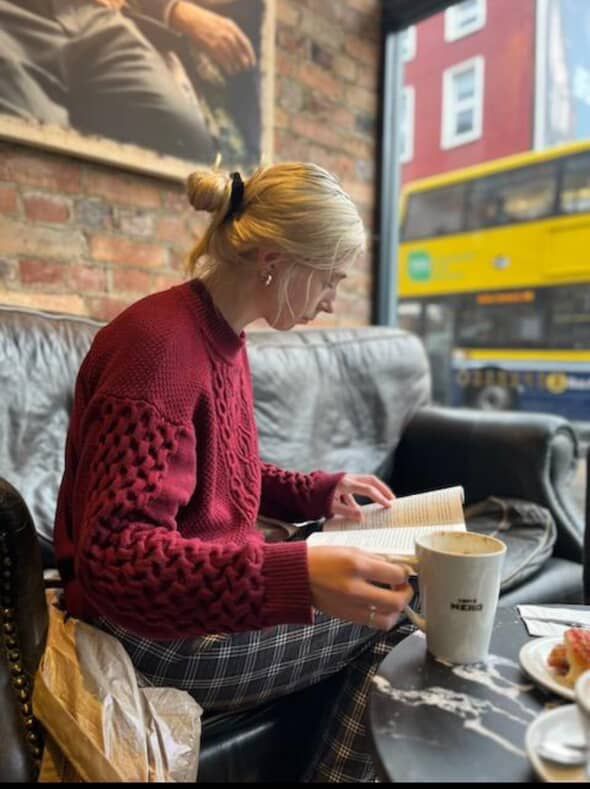
For one, studying abroad is probably one of the best experiences you could ever have in your young adulthood. No matter what you are studying, it really opens your mind, and it not only helps shape your academic and career goals, but you also gain so much personal growth. I decided to do it in my fall senior year, which is not typically ideal, but before I started my college journey, I told myself that I would do it, and it was then or never. While I was there, my professor assigned us assignments that catered to Irish culture– we not only wrote, but we also read a lot of travel writing. One of the stories, “Europe Through an Open Door” by Rick Steves, is a travel book that encourages travelers to experience what is beyond typical tourist destinations. This story opened my mindto focus on destinations that are underappreciated. So, when I would write, I made sure to find experiences that were as unique as possible.
I would sit alone in a small, quiet pub away from the city and learn some of its history. My friends and I did a ‘staycation’ in a small town called Sligo. Our Airbnb was in the middle of nowhere, and we had to walk almost an hour to get to town. We wanted to go to a small Irish pub down the road, which was difficult to get to since taxis rarely came out where we were. Finally, when our taxi driver pulled up to our Airbnb, he laughed when we told him we were going to ‘Ellen’s Pub’. It made sense when we arrived; it looked like a shack-like building. We ended up chatting with some locals, and a small Irish band gave us an intimate concert in the backroom– it was dark, and it felt as if I was sitting around a campfire listening to classic Irish tunes. Moments like those give you opportunities to write about personal and engaging experiences.
The connections that you can make while exploring another country create memories you will never forget, eager to write down quickly in your journal, which will later turninto a developed narrative.
Storytelling Approach
When covering topics like the job market, do you prioritize human stories or data in your reporting? What advantages do you find in your approach?
Covering topics like the job market, I tend to prioritize human stories rather than reporting. I mostly do this because these types of stories are personal to me, and I think people’s stories are more raw instead of throwing a reader a bunch of data to read. Not that a lot of data is bad, but for me, I enjoy focusing on the story aspect because those emotions from real people get reactions from other people. When you get reactions from other people, they are more inclined to advocate what you are advocating for, and then you know you have made a difference. I actually just had a job interview, and one of my stories that talks about the job market caught the hiring manager’s eye. He referenced it, which made me feel really good because it’s like, if a hiring manager brought up one of my stories I wrote about the decline of the job market, then I clearly made some kind of difference.
I also enjoy telling the stories of others because it amplifies their voice and makes them feel seen and heard. I have recently interviewed a lot of political figures in my area, and they talked about how they feel about the current political environment. They shared where they came from, their journey to how they got towhere they are today and what has inspired them in their careers. Being given a platform to share these stories is very rewarding.

AI and News Production
How do you evaluate the impact of artificial intelligence (e.g., Google Gemini) on news production processes, particularly in stories like Marc Robin and Fulton Theater?
I evaluate a lot of this impact by asking myself how we can use it, without getting rid of the human aspect of the craft. Although many of us disagree with artificial intelligence, it stillcontinues to evolve, so we may eventually reach a point where it’s difficult to avoid it. When I interviewed Marc Robin, the current artistic director of Fulton Theater, he talked about how they started to incorporate the Google Gemini with grant research, so it really speeds up thatprocess and leaves more room for creative development on the theater’s end, which I think is great.
If we can use it separately to leave room to further develop the craft of journalism, then journalists can further elevate their stories. In my interview with Robin, he expressed hisconcerns over the overuse of AI. Artificial intelligence is not able to mimic human emotion, so similarly to theater, as journalists, you are expressing the emotions of other people.
There are many ethical boundaries along with AI, but there is so much practical use to it. I think many people, especially in this industry, may be opposed to it. But, I would say in my program, I have learned a lot about its practical use, and I have found myself utilizing it as a research tool.
Local Journalism & Audience Connection
In focusing on local and specific news like election security in Pennsylvania, what do you think is the most effective way to build an emotional connection with your readers?
I focus a lot of my coverage on policies and issues that are important to communities in Pennsylvania. I want readers to be able to feel how much the story is rooted in their community— specifically Pennsylvania as a swing state, there is a lot at stake with elections. Right now, there are specific areas that are seeing a lot more blue especially after the No Kings Day protest.
I see the passion in the people that I talk to, and I translate that passion into a story. A lot of the local politicians I talk to have families, and they see a lot of issues that directly impact their children and their experiences, so translating that in my reporting carries a lot of weight. For
me, the most effective way I have found to build this emotional connection is to talk to local people who are passionate about specific issues and get their story out there. I also incorporate the “what’s next” aspect of the story, basically what could happen if a certain outcome would occur with a policy or election. It develops a connection for readers because these issues may directly impact them personally.
Political Coverage Insights
What were some key findings from your work on campaign ads during the 2024 election cycle? What do you pay attention to when reporting on such content?
Many of my key findings were based on how meaningless the ads were, despite Pennsylvania being a swing state. I paid a lot of attention to how much each candidate was spending on political ads. Despite the increased expenditures from previous elections, people didn’t seem to care for it. I think this comes from people already deep into their beliefs and wanting to see more action. People that I talked to rather see the money being spent on more beneficial projects. It’s important to pay attention to what people actually care about, because you see a lot of things that politicians say or advertise things, but there may be little action on their end. You have to really pay attention to what people actually care about when reporting crucial moments in an election season.

Future Perspectives
Are there new areas you plan to focus on in your journalism career? For example, digital journalism, data journalism, or freelance work?
My goal one day is to get into investigatihtve journalism. I really want to invest my time in underrepresented communities. A dream of mine is to go into film and produce a documentary to cover the work I do. Kiki Mordi’s work as an investigative journalist has been really inspiring to me. She produced a BBC documentary called Sex for Grades exposing lecturers in Ghana and Nigeria that were sexually harassing their students. In the documentary she also shared her own experience of sexual abuse and harassment.
She experienced a lot of misogynistic attacks, which says how much the media can try to silence your work. I look up to her because despite attacks online, she pushed through the people that tried to discredit her. For me, I want to think about the community that I am doing this work for and how they are impacted because it’ll always remind me how much change you can really bring with your work.




















 prcarnetworld.com