
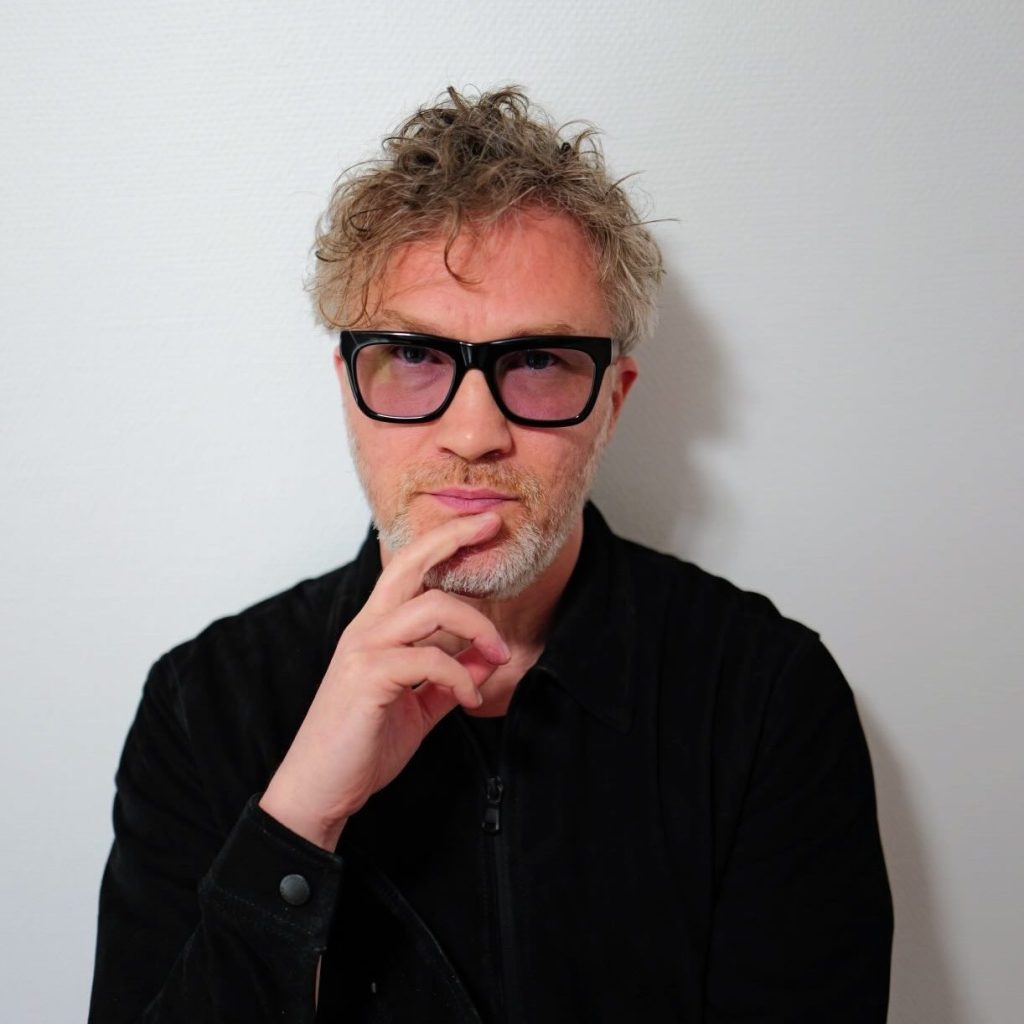
Interview Series: The Human in the Digital Age | Interviewer: Gökhan Çolak | Photo: Kristina Simic

The Construction of Meaning
We have access to more information than at any other point in history, yet many argue that we are experiencing a growing crisis of meaning. In your view, is the primary role of communication today to inform, or to create meaning?
I am interested in contradiction and ambivalence because most concepts that seem clear in theory become much more complex in practice. Communication can inform, but it can also distort, seduce, simplify, manipulate, or reveal. The moment you decide what to say and how to say it, you are already creating meaning, not just transmitting information. There is no neutral transmission. So the question is not what communication should do, but what it actually does, and under what conditions.
The institutions that used to organise meaning for people have lost their authority without anything coherent replacing them. As a result, I think the central struggle today is less about access to facts and more about interpretation. The same image, event, or statistic can be used to support completely different stories about the world.

Storytelling and Truth
Brands, institutions, and even individuals invest heavily in storytelling. Where do you think the line lies between a compelling story and a manipulative narrative?
A compelling story becomes manipulative when it hides its own interests. I work in communications, so I understand the value of storytelling. I also approach it in a no-BS way. If a story cannot survive a few uncomfortable questions, it probably was not very strong to begin with. Honesty is difficult, but I think people are far more receptive to it than communication professionals sometimes assume.
Of course, we live in a society shaped by the market, and most organisations and companies are, at the end of the day, profit and particular interest-driven. That does not automatically make their stories false, but they are usually trying to shape perception in some way.
The cultural sector is different in theory, because cultural institutions are often expected to reveal what commercial culture conceals, question dominant narratives, and create space for complexity. But even that is not innocent. Institutions also have funding structures, audiences, politics, and reputations to manage. I find it more useful to apply the same critical lens consistently rather than exempting the things we like from scrutiny.

Digital Identities
In the age of social media, people have increasingly become the narrators of their own lives. Does this represent a new form of personal empowerment, or has it created a new pressure?
Access to knowledge, communities, and people who share similar dilemmas can be genuinely empowering. The internet can make people feel less alone. It can connect you to ideas, experiences, and perspectives that would otherwise remain distant.
On the other hand, performativity is one of the defining characteristics of social media culture. We become the narrators, editors, and audiences of our own lives. We are not only being watched by others, but we also begin to watch ourselves from the outside. In that sense, we become the Other to ourselves. This self-curation can be creative, but it can also be exhausting. I think it is important to further analyse what happens when identity becomes something constantly produced, displayed, and evaluated through screens.
The Commodification of Culture
Cultural symbols, social movements, and even identities are rapidly adopted by brands and organizations. Do you believe this process increases cultural visibility, or does it risk turning culture into a consumable product?
I have written about this in relation to the incorporation of cultural symbols as forms of cultural capital and commodities to be acquired. Identities are offered through taste, music, fashion, aesthetics, and lifestyle choices.
In oversaturated markets, the mainstream constantly looks for what feels new, authentic or different. What begins in subcultures, the avant-garde, the alternative, and at the margins of culture attracts mainstream attention surprisingly quickly. The market always needs a new product, or at least new packaging.
I do not think visibility is simply good or commodification is simply bad. The same process can make certain identities, symbols, or movements more visible while also stripping them of their context and politics. That is why I’m interested in how quickly cultural symbols, identities, critiques, and subcultures are absorbed into the mainstream, and what survives that transition.

Artificial Intelligence and Creativity
Artificial intelligence can now write, design, strategize, and generate content. In the future, will the true value of human creativity lie in producing ideas, or in interpreting and giving meaning to them?
AI doesn’t emerge from nowhere. It is trained on enormous archives of human culture and constantly recombines what already exists. In that sense, it may be one of the most powerful remix machines ever created. The present is already very much about learning how to use AI as effectively as possible, creatively, commercially, and competitively. The quantity and speed of production are rising exponentially. What used to take days can now take minutes.
I do think AI can be used in creative and even authentic ways. It depends on how it is used, the intention behind it, and in what context. It is great for structure. But I do have to say that I have very little patience for what people now call AI slop.
Part of it is aesthetic. A lot of it simply looks hideous. I have lost count of how many times I have heard people proudly explain that they no longer need designers, writers, illustrators, photographers, or other specialists because AI can now do it for them. What I find fascinating is the confidence, arrogance, and self-importance with which some of these remarkably mediocre results are presented.
And you know what? Some of them are right. If the goal is cheap content, AI can do a lot of it perfectly well. The conversation itself is depressing. It revolves around producing more things, more quickly, and at lower cost. More posts. More images. More marketing. Nobody is curing cancer here. Most of the time we are simply finding more efficient ways to mass-produce digital garbage.
Human creativity is not only the ability to produce, much less to be productive in the market sense. It is the ability to take a risk, make a mistake, hesitate, do something stupid, and give form to something that is not yet fully clear.

The Loss of Silence
Digital society encourages constant visibility, sharing, and reaction. Are we losing the silence and distance that deep thinking requires?
I think about this often when I see the “content-creatisation” logic spreading into every profession. Today, if you are a dentist, accountant, hairdresser, plumber, firefighter, dermatologist, florist, or almost anything else, you are also expected to become a content creator in order to do your job.
This creates a strange situation where someone may be excellent at creating engaging content, but their internet fluency tells us very little about their actual expertise. I see this not only in work and media, but also in politics and even education, where the skill of presentation and the ability to sell are often valued more than substance and practice. Deep thinking requires silence, boredom, and time without immediate performance. But today even reflection becomes content.
The bigger problem is not distraction. We seem unable to justify time that serves no immediate purpose. Productive time is valued. Doomscrolling is normalised. Boredom, wandering thoughts, and moments when nothing appears to be happening are often treated as time that could be used better, more “optimally” or “efficiently”, despite the fact that these are often the conditions that make thinking, creativity, and new ideas possible.
Of course, not everyone can afford long stretches of unstructured time. Many people have multiple jobs, care responsibilities, and are simply making ends meet. But that only makes the issue more significant. The space for reflection, boredom, and wandering thought is becoming increasingly scarce, while more and more of life is expected to justify itself in “productive” terms.
The irony is that we rarely stop to ask: productive towards what? Productivity is often treated as a virtue in itself, detached from the question of what is actually being produced. Again, it is not as if everyone is out there curing cancer.
The Crisis of Trust
Trust in institutions, media, and experts has declined in many parts of the world. Can trust still be rebuilt, or are communication professionals increasingly focused on managing attention rather than cultivating trust?
Trust is no longer built through institutional authority, official statements, or polished campaigns. It is formed more organically within communities, through people who share the same experiences, problems and doubts.
What I do think has changed is that people are far more aware of performativity than they once were. Governments, institutions, companies, and public figures can no longer rely on simply saying the right things. The gap between rhetoric and action is much more visible than it once was, and trust tends to disappear when that gap becomes too large.
The bottom-up and grassroots communication often feels more trustworthy because it does not begin from authority, but from lived experience. Of course, that can also be manipulated. Communities and movements can be instrumentalised, so I would be careful not to romanticise it. Once movements, communities, or causes gain visibility, they attract the support of larger institutions, political actors, corporations, and interest groups, each with their own priorities and agendas. That does not automatically invalidate them, but it does change the dynamics around them.
So yes, trust can still be rebuilt, but not by managing attention or through better messaging alone. Trust is much slower and more demanding. It requires consistency between what you say and what you do and a willingness to communicate honestly, even when the message is complex or uncomfortable.

Culture and Power
Culture is often viewed as a space of creativity and expression, yet it is also a form of power. Who do you believe shapes today’s cultural narratives, and what are the broader consequences of that influence?
Culture is a space of creativity, but it is never outside power. The question is not only who gets to tell stories, but which stories get attention, what remains unsaid and why. Today, digital platforms shape many of those processes. They influence not only what we see, but also what people encounter, share, and remember.
What also worries me is that in the attention economy, visibility often becomes a substitute for value. Ideas that are complex, slow, or difficult often struggle in systems optimised for engagement. They also require time, attention, and a degree of cognitive investment that not everyone can afford to give. The result is not censorship in the traditional sense. It is a subtler pressure toward simplification and performance.

The Future of Being Human
As technology becomes more deeply embedded in everyday life, which uniquely human qualities do you think will become most valuable in the coming decade?
Empathy, an obvious one, precisely because technology is moving us toward speed, optimisation, and efficiency. But not empathy in the self-help or Instagram-therapeutic sense the word has been reduced to. I see empathy as one of the foundations of social life. We may think of ourselves as individuals, but none of us exists outside relationships, communities, and society, whether we choose to acknowledge it or not. The same goes for collaboration. There is a strong tendency to imagine the future in terms of competition, but many of the challenges we face, from technology and pandemics to climate change and political polarisation, are collective problems. They cannot be solved by individuals acting alone. I would also add the ability to live with ambiguity. We demand certainty from politics, technology, media, and even from each other. Most meaningful questions are messier than that.
A Personal Manifesto
Much of your work revolves around communication, culture, and the creation of meaning. If you could leave future generations with just one idea, what would it be and why?
I’ll keep it simple: curiosity over certainty.


 prcarnetworld.com
Leave a comment